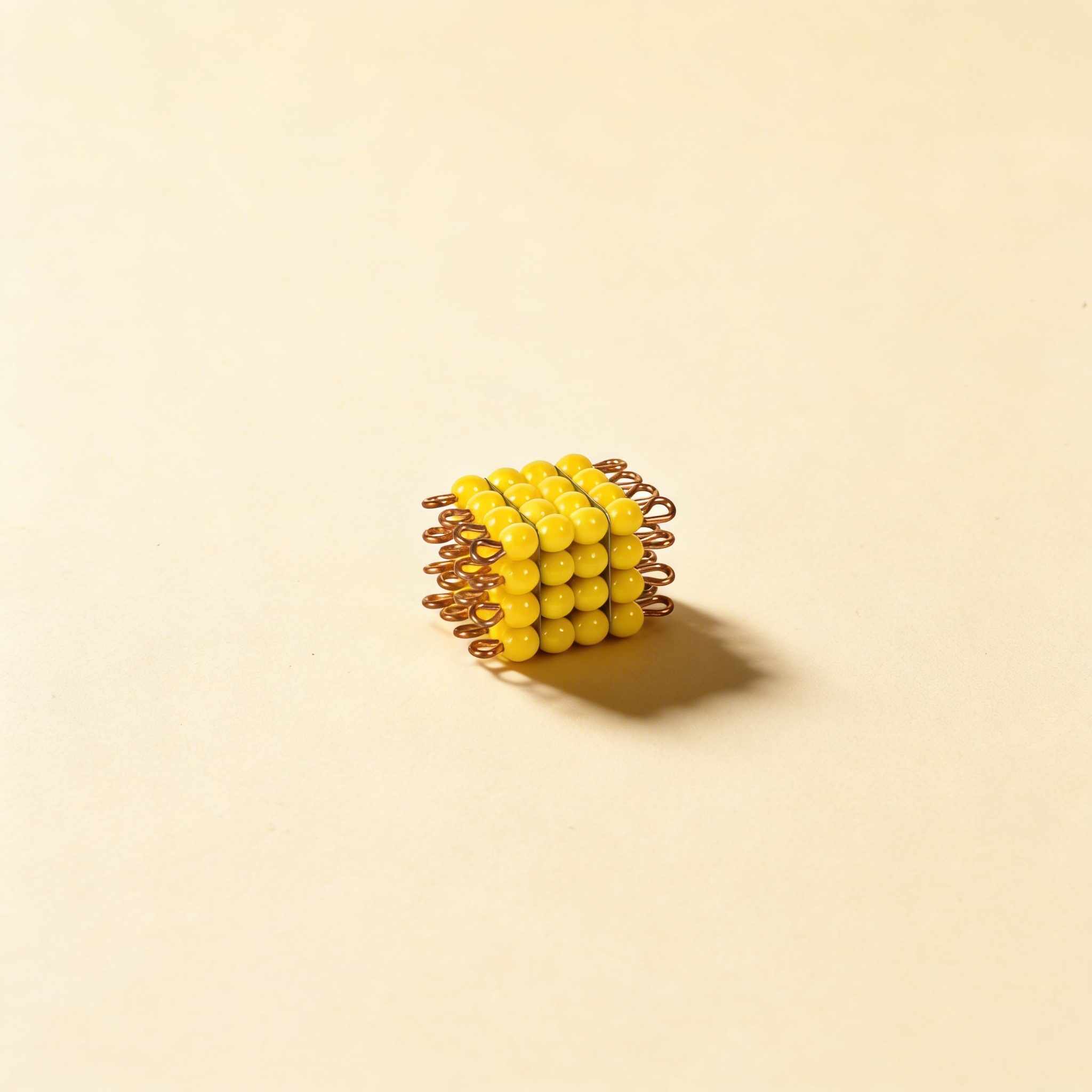
The Glass Bead Cube of 4 — Yellow Mathematical Cube Representation is a Sensorial Montessori material designed for children aged 3-6, crafted by Nienhuis Montessori to AMI standards.
This Individual Glass Bead Cube of 4 represents the mathematical concept of 4³ through a precise arrangement of 64 yellow glass beads forming a 4×4×4 cube. Part of the Montessori bead material series, this sensorial tool provides a concrete representation of cubing numbers, allowing children to physically explore mathematical relationships through visual and tactile experiences.
“Children display a universal love of mathematics, which is par excellence the science of precision, order, and intelligence.”— Maria MontessoriThe Discovery of the Child
“The greatest sign of success for a teacher is to be able to say, 'The children are now working as if I did not exist.'”
— Maria Montessori, The Absorbent Mind
The Individual Glass Bead Cube of 4 embodies Maria Montessori's principle of making abstract mathematical concepts concrete through sensorial exploration. This material bridges the gap between the sensorial and mathematical areas of the classroom, allowing children to physically experience the concept of cubing before they cognitively understand the mathematical operation. The precise arrangement of 64 beads in a 4×4×4 formation provides a visual and tactile representation of 4³, enabling children to internalize mathematical relationships through their senses. The yellow color creates visual clarity and beauty, appealing to the child's aesthetic sense while supporting concentration. This material demonstrates Montessori's belief that children can grasp complex mathematical concepts when presented through concrete, manipulable objects that engage multiple senses simultaneously.
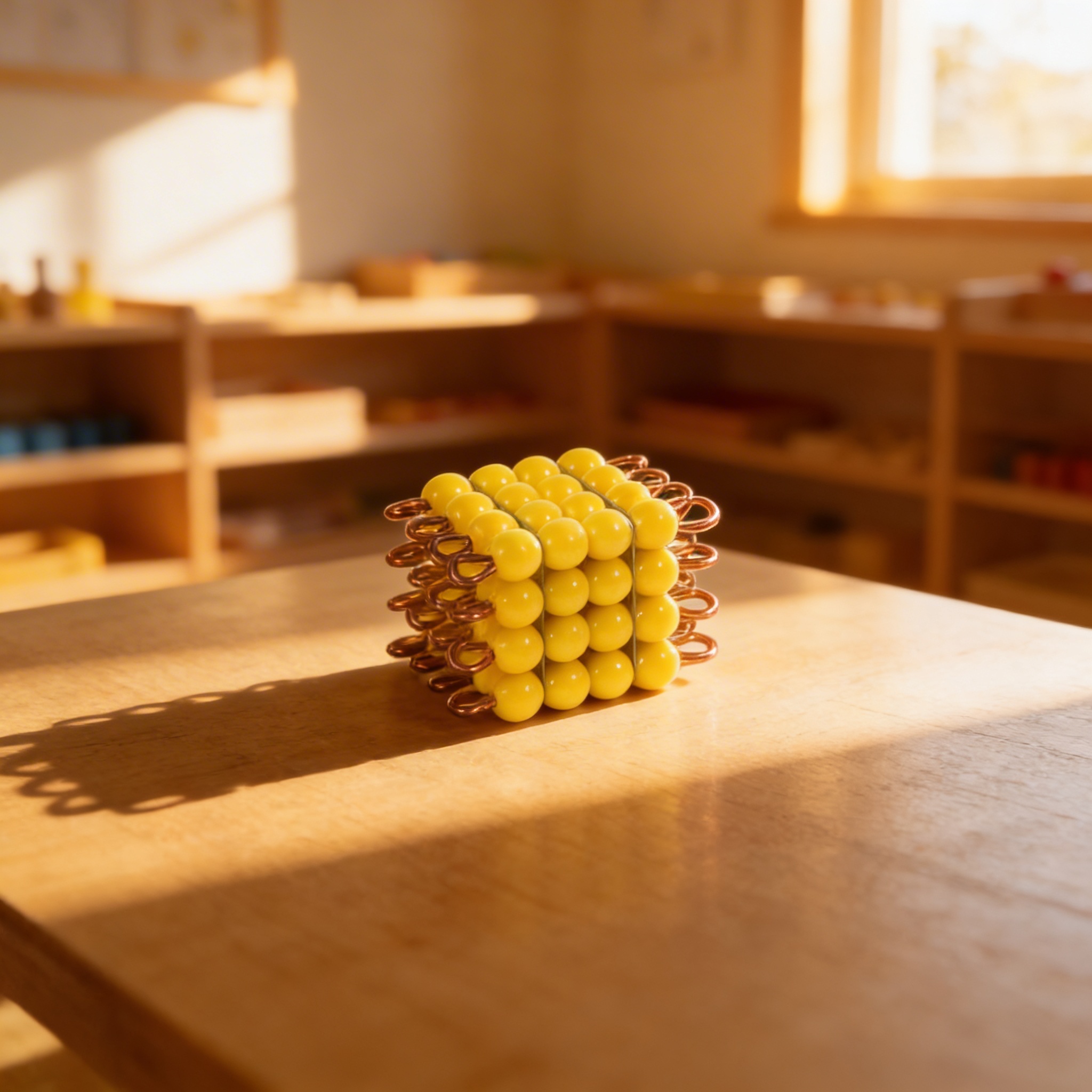
Each order includes everything needed for proper presentation and long-term use.
Follow the Montessori method of presentation for optimal child development.
Invite the child to carry the cube carefully with two hands to their mat
Place the cube gently on the mat and sit beside the child at their eye level
Slowly trace the edges of the cube with your index finger, counting each edge
Count the beads along one edge: '1, 2, 3, 4' touching each bead gently
Explore the faces of the cube, noting how each face contains 16 beads (4×4)
Carefully lift and rotate the cube to examine all six faces
Every material is carefully selected for durability, safety, and authentic Montessori experience.
Precision-made glass beads provide consistent size and weight, essential for accurate mathematical representation and sensorial exploration.
Each material supports multiple areas of child development simultaneously.
Provides concrete representation of cubing, preparing for abstract mathematical concepts through hands-on exploration.
Develops ability to perceive three-dimensional relationships and understand spatial mathematical concepts.
Introduces cubic forms and volume concepts through sensorial experience before formal geometric study.
Designed for child-sized hands
Professional tips from AMI-trained guides to maximize the educational value of this material.
“Present this material after the child has worked extensively with the golden bead material and understands unit, ten, hundred concepts”
Store the cube at eye level on the sensorial shelves near other bead materials to create visual connections
Observe the child's handling skills before presentation - they should demonstrate careful movements with other glass bead materials
Connect this work to the geometric solids, particularly the cube, to reinforce three-dimensional understanding
Everything you need to know about this material.
This cube represents 4³ (4 cubed) or 4×4×4=64. It helps children understand cubing through a concrete, visual representation of 64 beads arranged in a perfect cube formation.
Children can touch, hold, and examine the cube from different angles, developing spatial awareness and understanding three-dimensional shapes. The glass beads provide weight and texture feedback, enhancing the sensorial experience.
Children should be familiar with basic counting, number recognition up to at least 10, and have experience with simpler bead materials like bead bars or squares before progressing to cube work.
This specific cube represents the number 4 cubed, containing exactly 64 yellow beads. It's part of a series where each cube represents a different number cubed (1³, 2³, 3³, etc.), allowing comparative study of exponential growth.
Children can count individual beads, explore the cube's faces and edges, compare it with other cubes in the series, use it for skip counting by 4s, and eventually connect it to written mathematical notation of exponents.
Can't find what you're looking for?
Contact Our Experts
Share your experience with this material and help other educators and parents.
Bundle related materials and save. Free curriculum guide included with every set.


