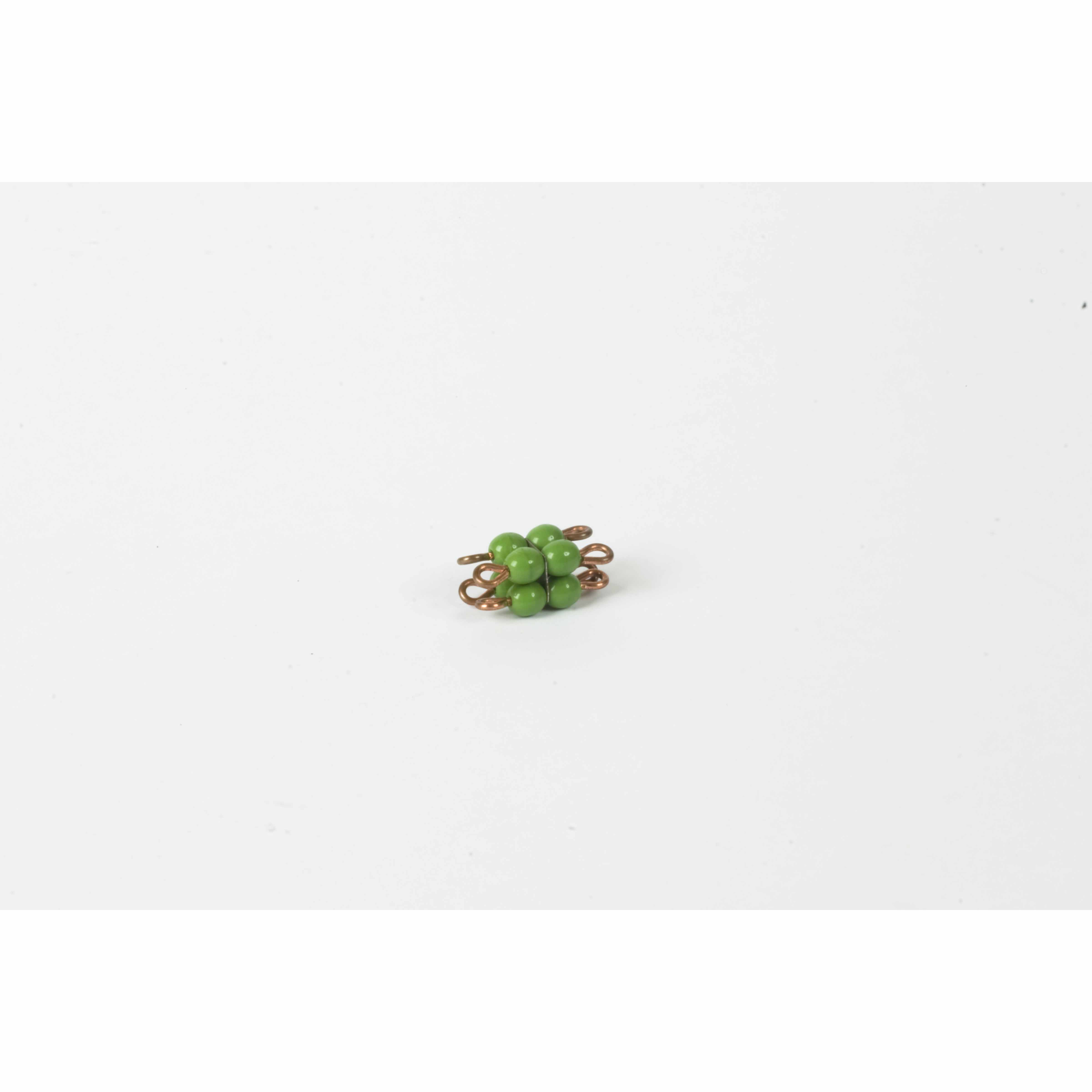
The Individual Glass Bead Cube Of 2: Green is a Mathematics Montessori material designed for children aged 3-6, crafted by Nienhuis Montessori to AMI standards.
This Individual Glass Bead Cube of 2 represents the mathematical concept of 2³ (2×2×2=8) through a precise three-dimensional model. Part of the Montessori bead cabinet materials, this green cube contains 8 glass beads connected by wire, providing a concrete representation of cubing numbers that prepares children for advanced mathematical understanding.
“Children display a universal love of mathematics, which is par excellence the science of precision, order, and intelligence.”— Maria MontessoriThe Discovery of the Child
“The greatest sign of success for a teacher is to be able to say, 'The children are now working as if I did not exist.'”
— Maria Montessori, The Absorbent Mind
The Individual Glass Bead Cube of 2 transforms abstract mathematical concepts into tangible experience by allowing children to hold and examine eight glass beads arranged in a 2×2×2 formation. This green cube serves as a bridge between concrete counting and abstract exponential thinking, as children can physically verify that 2³ equals 8 by touching each bead within the wire framework. The transparent glass construction enables visual counting from multiple angles while the rigid wire structure maintains the precise cubic arrangement essential for understanding three-dimensional multiplication. In Montessori mathematics, this bead cube addresses the developmental need to experience quantity through manipulation before progressing to written notation. The specific choice of green color distinguishes powers of 2 from other numerical sequences in the bead cabinet, creating a visual system that aids memory and pattern recognition. By isolating the concept of 2³ in this single manipulative, children build foundational understanding of exponential growth through repeated doubling.
Each order includes everything needed for proper presentation and long-term use.
Follow the Montessori method of presentation for optimal child development.
Invite the child to count each glass bead by gently touching through the wire framework, establishing the total of 8
Show how the cube has 2 beads along each edge: length, width, and height
Demonstrate the multiplication: '2 beads long, times 2 beads wide, times 2 beads high equals 8 beads total'
Introduce the notation 2³ and explain it means 2×2×2
Let the child verify by counting in groups: first layer of 4, second layer of 4
Every material is carefully selected for durability, safety, and authentic Montessori experience.
Smooth glass beads provide the perfect weight and tactile experience for mathematical exploration, allowing children to physically feel the concept of cubing.
Each material supports multiple areas of child development simultaneously.
Bridges concrete manipulation to abstract understanding of exponential concepts and cube numbers.
Three-dimensional cube structure develops geometric visualization and spatial intelligence.
Part of systematic progression from linear counting to squared and cubed number concepts.
Tactile experience of holding and examining the cube reinforces mathematical relationships through the senses.
Designed for child-sized hands
Professional tips from AMI-trained guides to maximize the educational value of this material.
“Store the glass bead cube carefully in the mathematics area where children can access it independently”
Connect this material to the pink tower cube of 2cm to reinforce cubic concepts across materials
'cube of 2' not 'two cubed' to match the concrete-first approach
Allow children to discover that 2³ equals 2×4 through their own manipulation and counting
Everything you need to know about this material.
This green cube represents 2³ (2×2×2=8), containing exactly 8 glass beads arranged in a three-dimensional cube formation. It provides a concrete, visual representation of the mathematical concept of cubing the number 2.
Children use this cube to explore powers of numbers, understand three-dimensional concepts, and transition from concrete to abstract mathematical thinking. It's typically introduced after children master linear and square bead materials, helping them visualize how 2×2×2 creates a cube of 8 beads.
In the Montessori color-coding system, green represents units. This green cube specifically represents the cube of 2 (a unit value), helping children associate the color with the mathematical concept and maintain consistency across Montessori mathematics materials.
While suitable for ages 3-6, most children are introduced to cube materials around age 4-5, after they've mastered linear counting and square formations. The child should have experience with the golden bead material and understand basic multiplication concepts before working with cubes.
The glass beads are made from high-quality, smooth glass that resists chipping with normal classroom use. The wire construction is sturdy and maintains the cube's shape while allowing children to feel the individual beads. With proper handling and storage, this material can last many years in a Montessori environment.
Can't find what you're looking for?
Contact Our Experts
Share your experience with this material and help other educators and parents.


