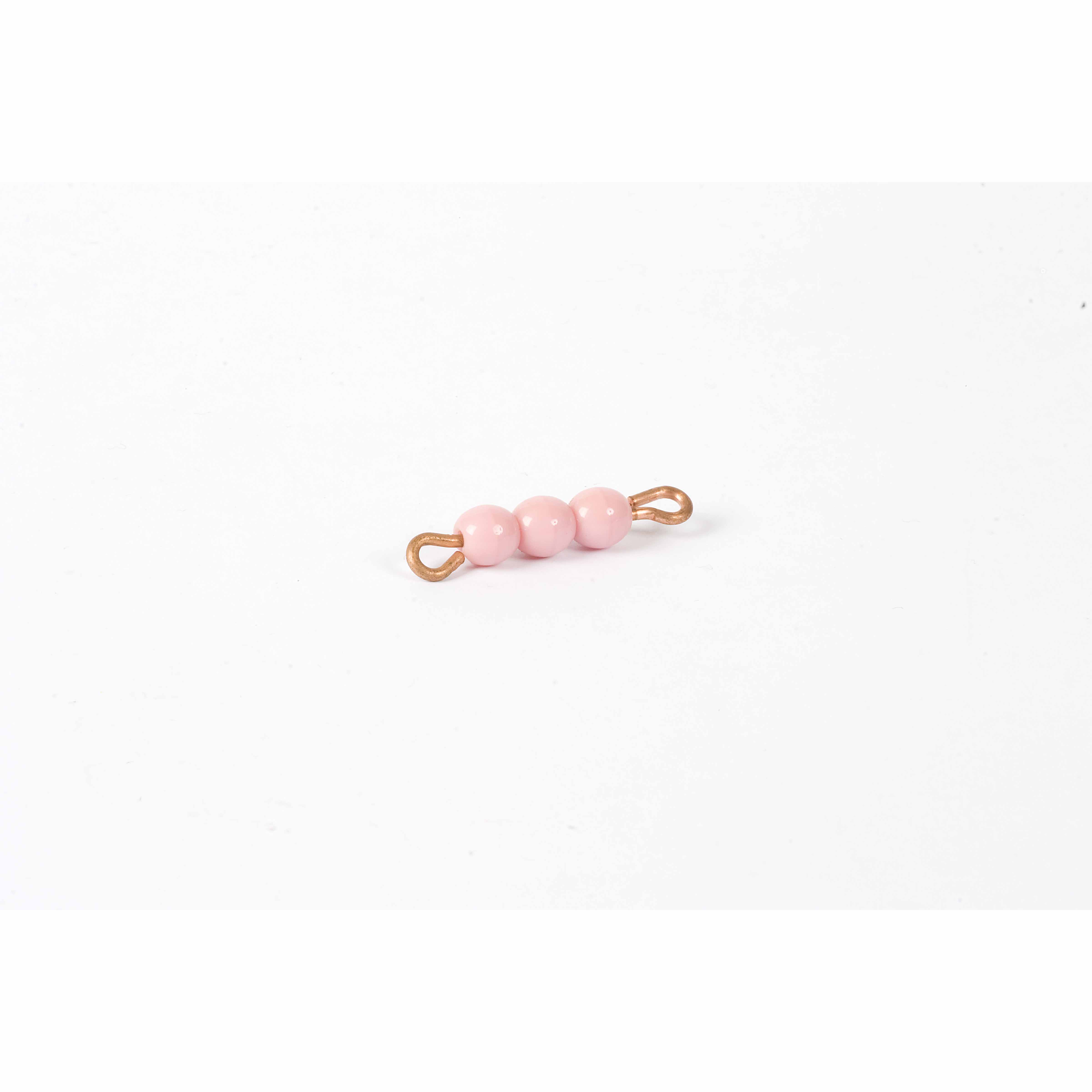
The Individual Glass Bead Bar Of 3: Pink is a Mathematics Montessori material designed for children aged 3-6, crafted by Nienhuis Montessori to AMI standards.
This Individual Glass Bead Bar of 3 features three uniform pink glass beads threaded on durable metal wire, forming an essential component of the Montessori bead stair and golden bead materials. The wire's looped ends provide safe, easy handling while children explore concrete representations of quantity, supporting their journey from concrete to abstract mathematical understanding.
“Children display a universal love of mathematics, which is par excellence the science of precision, order, and intelligence.”— Maria MontessoriThe Discovery of the Child
“The greatest sign of success for a teacher is to be able to say, 'The children are now working as if I did not exist.'”
— Maria Montessori, The Absorbent Mind
The Individual Glass Bead Bar of 3 embodies Maria Montessori's principle that mathematical concepts must first be experienced through touch and sight. These three pink glass beads create a physical representation of the quantity three, allowing children to hold this abstract concept in their hands. The glass material's smooth weight and the metal wire's firm structure give substance to number, making the bead bar distinct from symbolic representations. In the Montessori mathematics curriculum, this pink bar of three forms a crucial link between the child's sensorial experiences and emerging number sense. The specific color coding—pink for three—creates a visual memory that persists even when the beads are absent. By manipulating these glass beads, counting them, and comparing the bar's length to other quantities, children build a concrete understanding of 'threeness' that forms the foundation for all future arithmetic work.
Each order includes everything needed for proper presentation and long-term use.
Follow the Montessori method of presentation for optimal child development.
Invite the child to hold the bead bar, feeling its weight and texture
Count each glass bead slowly, touching each one: 'One, two, three'
Place the bar horizontally and run your finger along its length while saying 'three'
Introduce the color association: 'This is the pink bar. Pink is three.'
Every material is carefully selected for durability, safety, and authentic Montessori experience.
The smooth, uniform glass beads provide consistent weight and size, allowing children to experience quantity through multiple senses while maintaining the durability needed for repeated classroom use.
Each material supports multiple areas of child development simultaneously.
Children physically count and manipulate beads, building a sensorial understanding of quantity that forms the foundation for abstract mathematical thinking.
The distinct pink color helps children identify and remember the quantity 3, supporting pattern recognition and the development of mathematical memory.
Handling the bead bars and arranging them in various formations refines pincer grasp and hand-eye coordination essential for later writing.
Through combining bead bars, children discover number relationships, preparing for addition, skip counting, and early multiplication concepts.
Designed for child-sized hands
Professional tips from AMI-trained guides to maximize the educational value of this material.
“Store glass bead bars in a designated box where children can see the color progression”
When introducing, isolate this single bar before presenting within the complete bead stair
always refer to it as 'the pink bar' or 'three'
Demonstrate proper handling to protect the glass beads and metal wire from damage
Everything you need to know about this material.
The pink 3-bead bar helps children visualize and understand the quantity of three through hands-on manipulation. It's part of the bead stair material that introduces numbers 1-10, allowing children to physically experience quantities before moving to abstract number symbols.
The bead bar features sturdy metal wire with securely looped ends that withstand daily classroom handling. The wire is flexible enough for comfortable use while maintaining its shape, and the glass beads are firmly secured to prevent sliding or loss.
While this individual bead bar can be used for specific lessons or replacements, it's most effective when used as part of the complete bead stair set (1-10) or with other mathematical materials. Individual bars are perfect for focused activities or replacing lost pieces.
Children can explore counting to three, one-to-one correspondence, skip counting by 3s, simple addition combinations that equal 3, and comparing quantities. It's also used in the decimal system for building numbers and understanding place value.
Montessori materials use consistent color coding where each number 1-9 has a specific color. Pink represents 3 throughout all bead materials, helping children form strong visual associations between quantities and colors, supporting memory and pattern recognition.
Can't find what you're looking for?
Contact Our Experts
Share your experience with this material and help other educators and parents.


