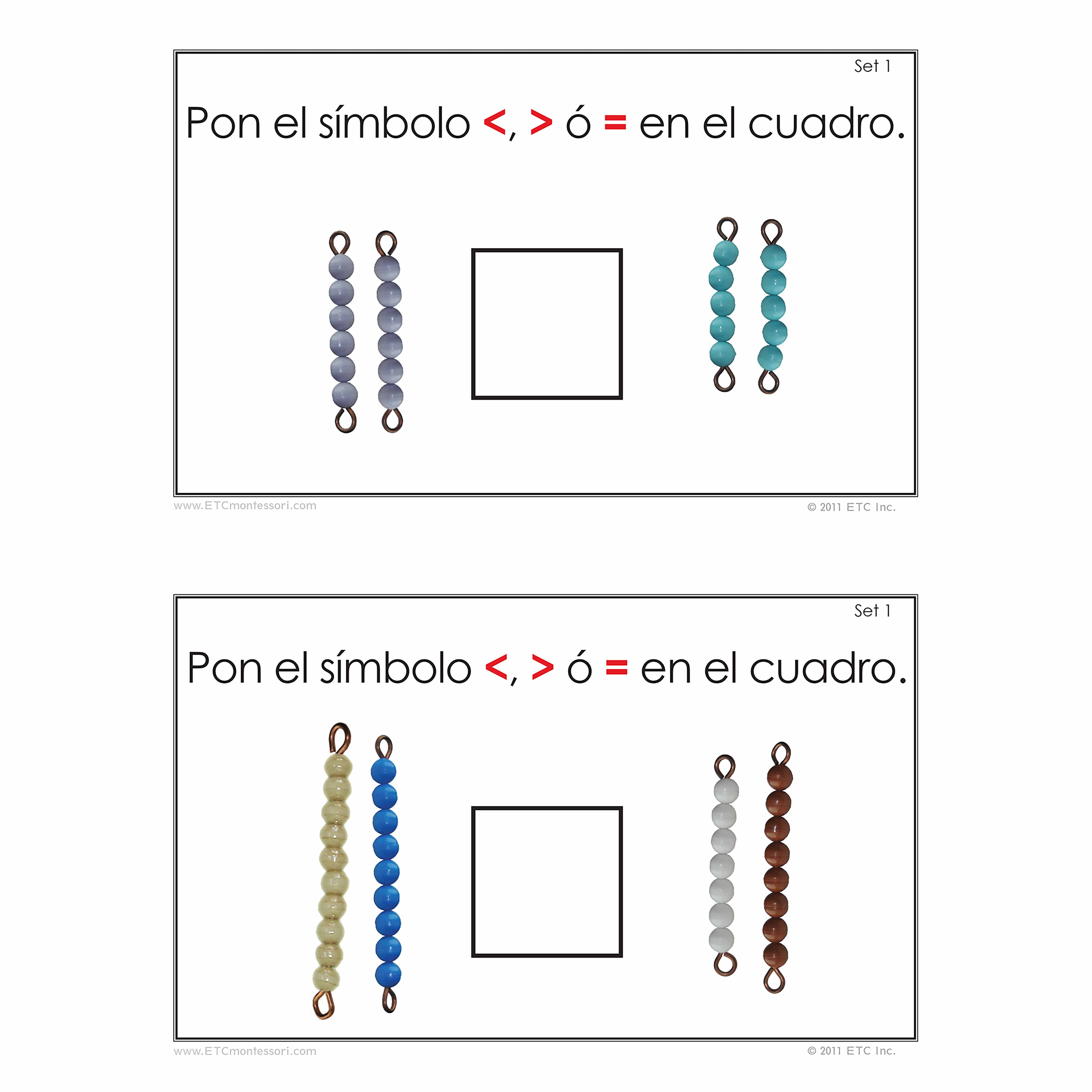
The Igual, Mayor Que, Menor Que is a Educational Materials Montessori material designed for children aged 3-6, crafted by Nienhuis Montessori to AMI standards.
These Spanish-language comparison cards introduce mathematical inequality concepts through visual bead string representations. Children place greater than, less than, or equal to symbols in the empty box between bead quantities, building foundational understanding of mathematical relationships through concrete visual comparisons.
“The child is both a hope and a promise for mankind.”— Maria MontessoriEducation and Peace
“The hands are the instruments of man's intelligence.”
— Maria Montessori, The Absorbent Mind
The Igual, Mayor Que, Menor Que cards present mathematical inequality as a visual language that children can read before formal number work begins. These Spanish-language comparison cards transform abstract mathematical symbols into concrete decisions about bead quantities that children can verify through counting. Each card's bead string representations allow the child to see mathematical relationships as physical realities rather than arbitrary rules. The empty box between bead quantities invites the child to become an active participant in mathematical thinking, choosing which symbol correctly describes what their eyes perceive. By presenting inequalities through colorful bead arrangements, these cards connect the child's sensorial experiences with mathematical reasoning. The Spanish text reinforces that mathematics is a universal language while honoring linguistic diversity in the classroom. Through repeated work with these comparison cards, children develop the ability to analyze quantities visually before moving to numerical comparisons, building a foundation for algebraic thinking that emerges from their own observations rather than memorized procedures.
Each order includes everything needed for proper presentation and long-term use.
Follow the Montessori method of presentation for optimal child development.
Select one comparison card and examine the bead strings on both sides
Count the beads on the left side, then count the beads on the right side
Determine which side has more beads, fewer beads, or if they're equal
Select the appropriate symbol card and place it in the empty box
Read the complete mathematical statement aloud in Spanish
Continue with remaining cards, creating a pattern of work
Each material supports multiple areas of child development simultaneously.
Develops understanding of quantity relationships and comparison symbols through visual representation.
Strengthens ability to perceive differences in quantity through careful observation of bead arrangements.
Introduces mathematical notation for greater than, less than, and equal to in meaningful contexts.
Supports Spanish-speaking children in accessing mathematical concepts in their native language.
Designed for child-sized hands
Professional tips from AMI-trained guides to maximize the educational value of this material.
“Introduce vocabulary in context: 'mayor que' (greater than), 'menor que' (less than), 'igual' (equal to)”
Create a three-period lesson with the symbols before using the cards
Allow children to verify their choices by physically matching beads one-to-one
Connect to other mathematical materials like the red and blue rods or number rods
Everything you need to know about this material.
These cards are designed for children ages 3-6, though children showing readiness for mathematical concepts around age 3 can begin with simple comparisons of 1-5 beads.
While basic counting skills (1-10) are helpful, children can begin by visually comparing quantities without counting, naturally developing their understanding of more/less through the concrete bead representations.
The set includes the mathematical symbols for greater than (>), less than (<), and equal to (=), which children place in the empty box between the bead string images.
The set includes multiple cards featuring different bead string quantities, allowing for varied practice with numbers typically ranging from 1-20 beads per string.
Yes, while the title is in Spanish, the mathematical symbols are universal and the visual nature of the bead comparisons makes this accessible to children regardless of language.
Can't find what you're looking for?
Contact Our Experts
Share your experience with this material and help other educators and parents.

