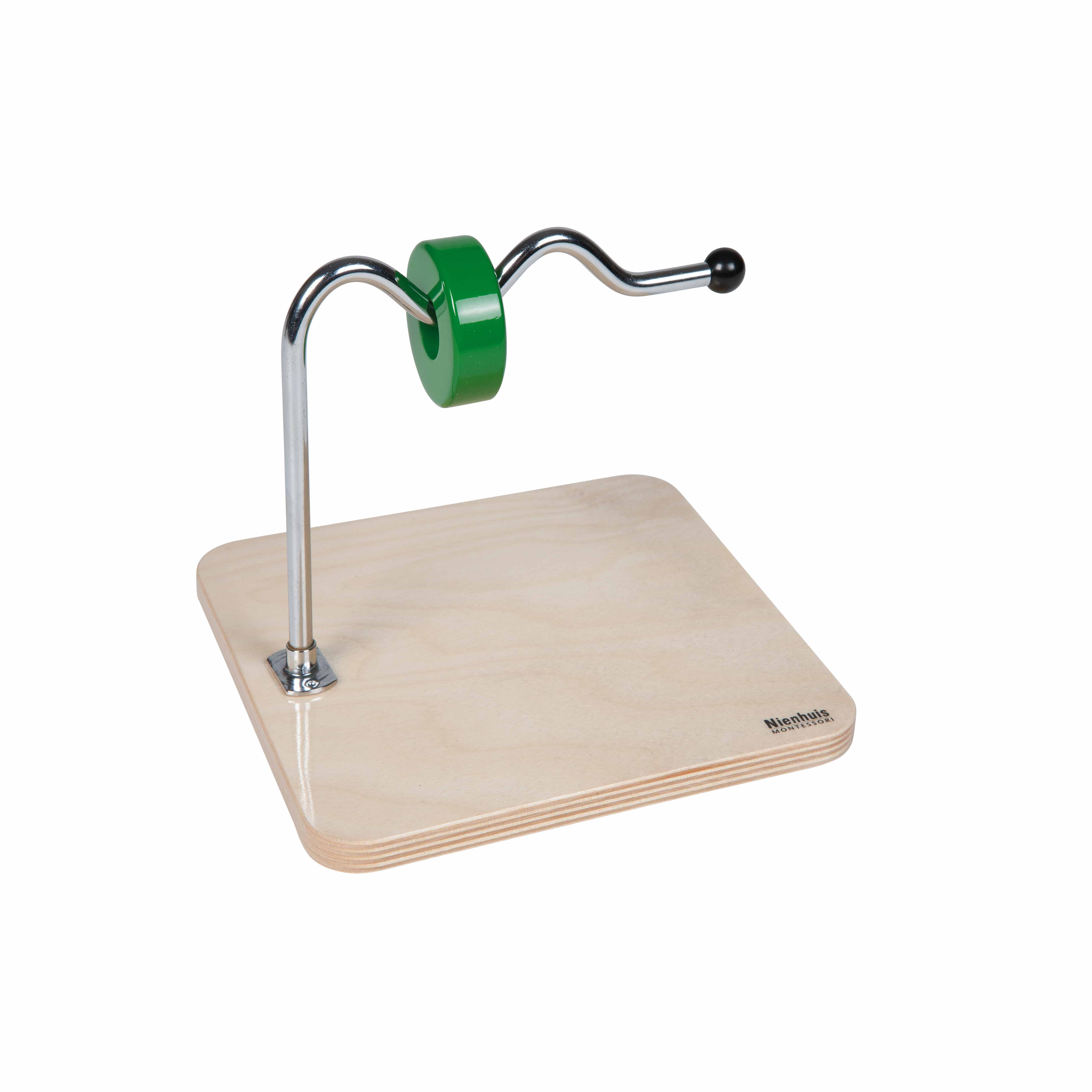
The Horizontal Dowel Variation - Serpentine is a Educational Materials Montessori material designed for children aged 0-3, crafted by Nienhuis Montessori to AMI standards.
This Horizontal Dowel Variation features a serpentine metal rod that challenges young children to guide a sliding disc through smooth curves and waves. The stable wooden base and green disc create an engaging hand-eye coordination exercise that builds concentration, fine motor control, and visual tracking skills essential for later writing movements.
“The child is both a hope and a promise for mankind.”— Maria MontessoriEducation and Peace
“The hands are the instruments of man's intelligence.”
— Maria Montessori, The Absorbent Mind
The Horizontal Dowel Variation - Serpentine addresses the infant's developmental need for refined hand movements and visual tracking through its unique curved metal pathway. Between ages 0-3, children experience a critical period for movement refinement, and the serpentine's smooth waves require precise wrist rotation and controlled finger placement to guide the green disc successfully. Unlike straight dowel variations, this serpentine design isolates the challenge of following a curved path, preparing the hand for the flowing movements needed in writing. The stable wooden base allows the child to focus entirely on manipulating the disc through the metal curves without worrying about steadying the material. By requiring the child to navigate the disc through alternating waves, the serpentine variation builds the concentration and hand-eye coordination that emerge naturally when children engage with appropriately challenging materials. The green disc's visibility against the metal rod helps young children track their movements visually while developing the pincer grasp essential for holding writing instruments.
Each order includes everything needed for proper presentation and long-term use.
Follow the Montessori method of presentation for optimal child development.
Demonstrate slowly moving the disc from one end to the other, emphasizing smooth wrist movements through curves
Invite the child to grasp the disc with thumb and index finger at the starting position
Allow independent exploration of moving the disc through the serpentine curves
Once mastered in one direction, show how to return the disc to the starting point
Each material supports multiple areas of child development simultaneously.
Following the curved path develops visual tracking and hand movement synchronization crucial for future writing skills.
The serpentine challenge naturally extends focus periods as children work to master the curved movements.
Navigating curves and waves develops the wrist rotation and control needed for pencil grip and writing fluency.
Children learn to adjust their approach when the disc gets stuck, building persistence and analytical thinking.
Designed for child-sized hands
Professional tips from AMI-trained guides to maximize the educational value of this material.
“Observe which curve sections challenge each child most - this reveals their current motor development stage”
Place on individual work mats to define the activity space and prevent rolling if dropped
Rotate between serpentine and straight dowel variations to prevent muscle fatigue
Document hand preference patterns - many children will naturally experiment with both hands
Everything you need to know about this material.
This material is designed for children ages 12-36 months who have mastered simpler threading activities and are ready for more complex hand movements. The serpentine pattern provides an appropriate challenge for toddlers developing refined motor control.
The curved path requires children to adjust their hand movements continuously, developing wrist flexibility, hand-eye coordination, and visual tracking skills. These serpentine movements directly prepare the hand for the flowing motions needed in cursive writing.
Children should first master straight horizontal and vertical dowels, demonstrating steady hand control and the ability to guide objects along a linear path. They should also show interest in more challenging activities and have developed a pincer grasp.
Sit beside your child and slowly demonstrate moving the disc from one end to the other, emphasizing smooth, controlled movements. Use minimal words, allowing the child to observe the serpentine motion. Then invite them to try, offering support only if needed.
Unlike straight dowels that develop linear tracking, the serpentine design introduces curves and direction changes that challenge spatial awareness and require constant hand adjustments. This complexity bridges the gap between basic threading and more advanced fine motor activities.
Can't find what you're looking for?
Contact Our Experts
Share your experience with this material and help other educators and parents.

