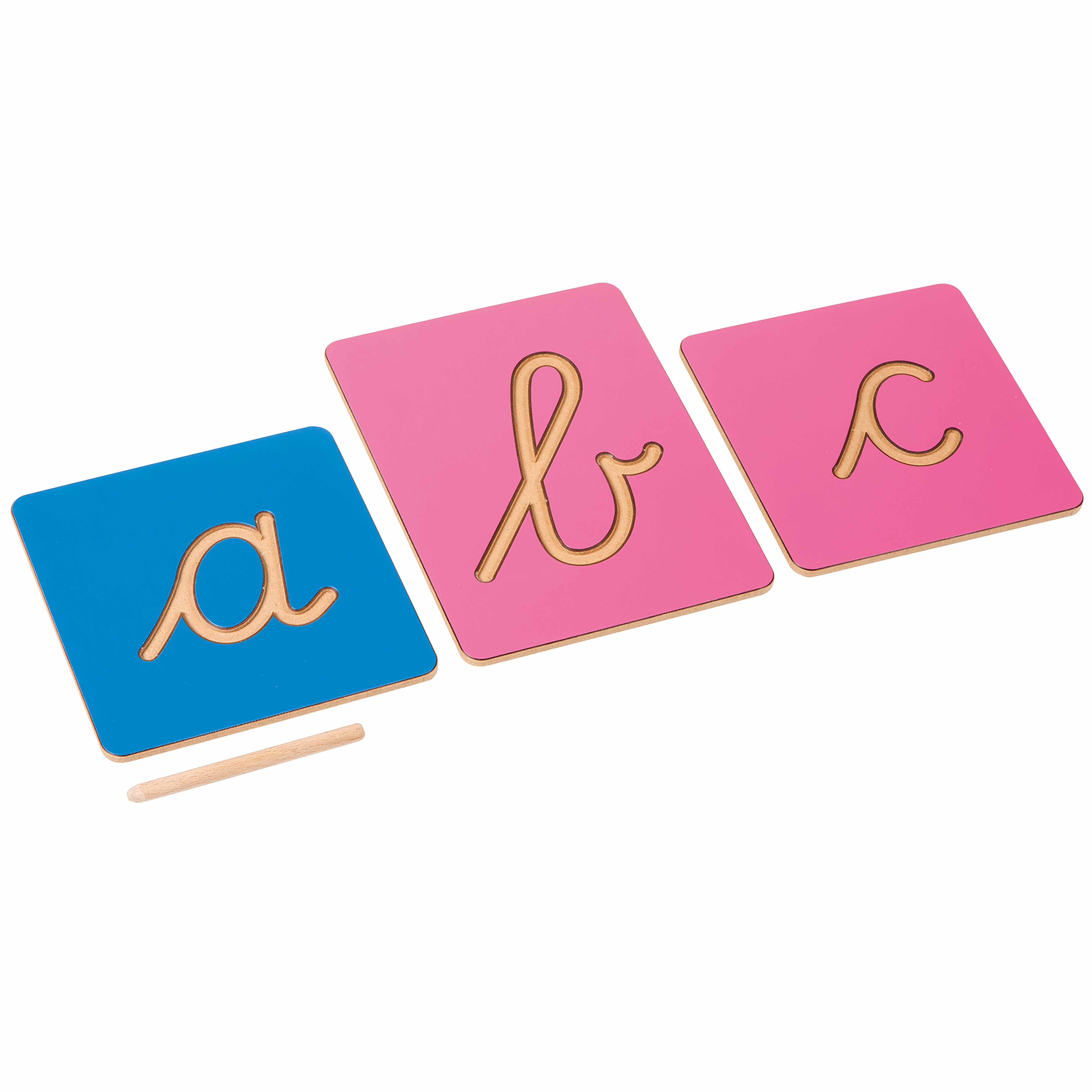
The Hollow Letter Shapes: International Cursive is a Language Montessori material designed for children aged 3-6, crafted by Nienhuis Montessori to AMI standards.
These Hollow Letter Shapes boards introduce children to international cursive writing through tactile exploration. Each wooden board features precisely routed letter grooves that guide finger movements, helping children internalize the flowing patterns of cursive script. The pink and blue surfaces follow traditional Montessori color coding, supporting the transition from sandpaper letters to written formation.
“The greatest sign of success for a teacher is to be able to say, 'The children are now working as if I did not exist.'”— Maria MontessoriThe Absorbent Mind
“Free the child's potential, and you will transform him into the world.”
— Maria Montessori, To Educate the Human Potential
The Hollow Letter Shapes for international cursive embody Maria Montessori's understanding that children learn writing through muscular memory before visual recognition. These precisely routed wooden boards create a defined pathway for fingers to follow, establishing the flowing movements essential to cursive formation. The hollow grooves provide immediate tactile feedback when fingers stray from the correct path, allowing children to self-correct without adult intervention. By tracing within these carved channels, children develop the controlled hand movements necessary for fluid cursive writing. The pink and blue surfaces of the Hollow Letter Shapes connect directly to earlier work with sandpaper letters, creating a bridge between tactile exploration and actual writing. Unlike print letters that require lifting the pencil, these cursive boards teach the continuous flow that defines cursive script. The wooden construction ensures durability through thousands of tracings, while the smooth routed edges protect small fingers during repetitive practice.
Each order includes everything needed for proper presentation and long-term use.
Follow the Montessori method of presentation for optimal child development.
Demonstrate tracing one letter slowly with your index and middle fingers together, starting at the correct point
Invite the child to trace the same letter, watching as their fingers follow the groove
Once comfortable, introduce the letter's sound while tracing
Progress to tracing with eyes closed to enhance muscle memory
When ready, offer chalk or pencil to trace the letter on paper immediately after finger tracing
Every material is carefully selected for durability, safety, and authentic Montessori experience.
Each board is crafted from solid wood, providing the weight and stability needed for precise tracing movements. The smooth routed grooves offer just the right resistance for developing muscle memory.
Each material supports multiple areas of child development simultaneously.
The hollow grooves guide natural hand movements, establishing the flowing patterns essential for cursive writing before pencil work begins.
Repeated tracing with finger or stick builds the specific hand movements needed for each letter formation.
Children connect the visual appearance of cursive letters with their kinesthetic formation through guided touch.
Color-coded boards reinforce the distinction between vowels and consonants while introducing cursive letter shapes.
Designed for child-sized hands
Professional tips from AMI-trained guides to maximize the educational value of this material.
“Present hollow letters only after solid work with sandpaper letters in the same script”
Group letters by formation families (e.g., letters with loops, letters with dots) rather than alphabetically
Observe the child's dominant hand and ensure they're using the correct fingers for tracing
Keep presentations short - 3-4 letters maximum to maintain concentration and prevent fatigue
Everything you need to know about this material.
While sandpaper letters provide textured surfaces for tracing, hollow letter shapes feature routed grooves that physically guide the child's finger through the correct letter formation. This deeper tactile feedback helps children who need more support transitioning to writing, as the grooves prevent fingers from straying off the letter path.
The pink and blue colors follow traditional Montessori language coding: pink represents consonants and blue represents vowels. This visual distinction helps children recognize and categorize letters while building phonemic awareness, supporting their understanding of how letters work together to form words.
These boards work best after children have explored sandpaper letters and before they begin writing with pencils. Typically around ages 4-5, when children have developed the pincer grip and hand strength needed for writing but still benefit from guided letter formation practice.
The routed grooves follow the precise flowing movements of international cursive script, including proper entry and exit strokes. This helps children internalize the connected nature of cursive writing, making the eventual transition to pen and paper more natural and fluid.
Yes, the deep grooves provide excellent support for children who struggle with fine motor control or visual-motor integration. The physical boundaries help build muscle memory and confidence, making these boards particularly beneficial for children with dysgraphia or developmental delays in writing readiness.
Can't find what you're looking for?
Contact Our Experts
Share your experience with this material and help other educators and parents.


