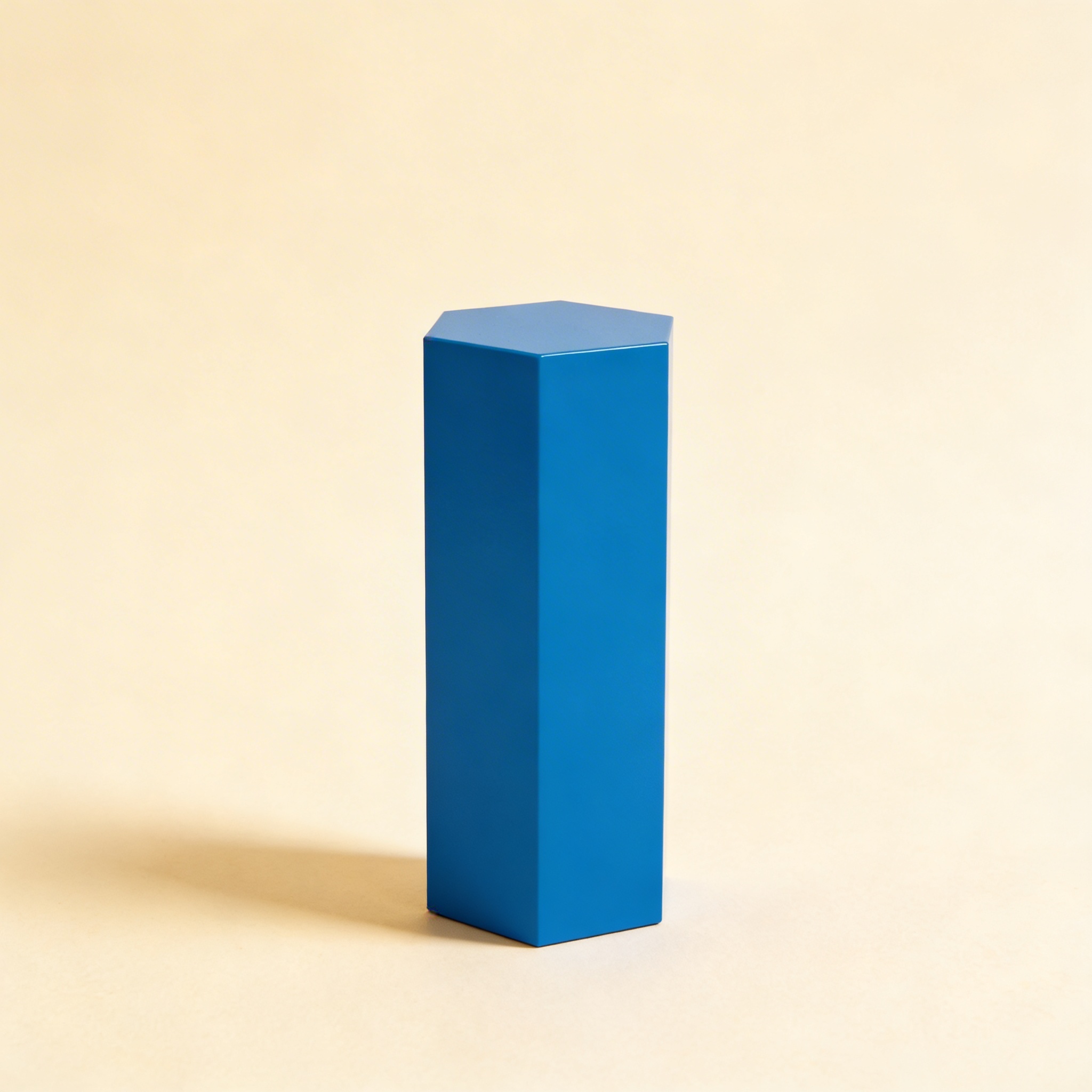
The Hexagonal Prism — Geometric Solid for Shape Exploration is a Sensorial Montessori material designed for children aged 6-12, crafted by Nienhuis Montessori to AMI standards.
This Hexagonal Based Prism is part of the Geometric Solids collection, introducing children to three-dimensional shapes and their properties. The smooth blue lacquered surface and precise hexagonal construction support the child's development of stereognostic sense and geometric understanding through tactile exploration.
“The senses, being explorers of the world, open the way to knowledge.”— Maria MontessoriThe Discovery of the Child
“Children display a universal love of mathematics, which is par excellence the science of precision, order, and intelligence.”
— Maria Montessori, The Discovery of the Child
The Hexagonal Based Prism exemplifies Montessori's principle of educating the senses as the foundation for intellectual development. Through stereognostic exploration, children internalize geometric concepts by handling this solid, building what Montessori called 'muscular memory' of form. The material's precision and beauty respond to the child's natural mathematical mind, particularly during the second plane of development when abstraction becomes possible. The smooth lacquered surface isolates the geometric property, allowing focused attention on the hexagonal form's unique characteristics. This concrete manipulation prepares the child for later abstract geometric study, following Montessori's progression from concrete to abstract. The material serves as a key to understanding how two-dimensional shapes relate to three-dimensional forms, supporting the child's construction of spatial intelligence through sensorial impression rather than verbal explanation.

Each order includes everything needed for proper presentation and long-term use.
Follow the Montessori method of presentation for optimal child development.
Invite the child to explore the prism with both hands, eyes closed, feeling all surfaces systematically
Open eyes and examine the hexagonal bases, counting vertices and edges while tracing with fingers
Compare lateral faces to the bases, discovering all lateral faces are rectangles
Trace around the base on paper, then stand the prism on the tracing to verify the match
Roll the prism on its lateral faces, observing how it moves differently than curved solids
Every material is carefully selected for durability, safety, and authentic Montessori experience.
The smooth, glossy surface allows children to focus on the geometric properties through touch, supporting the development of the stereognostic sense.
Each material supports multiple areas of child development simultaneously.
Develops the ability to recognize forms through touch, a key sensorial refinement in Montessori education.
Introduces hexagonal forms and prismatic shapes, preparing for advanced geometry studies.
Concrete exploration of three-dimensional shapes supports abstract mathematical thinking.
Designed for child-sized hands
Professional tips from AMI-trained guides to maximize the educational value of this material.
“Present this after the child has worked extensively with the basic geometric solids and shows readiness for more complex forms”
Use precise mathematical language consistently - avoid saying 'sides' when you mean 'faces' or 'edges'
Create opportunities for the child to discover that all prisms have two congruent, parallel bases connected by rectangular faces
Connect to practical life by finding hexagonal prisms in the environment (pencils, certain buildings, honeycomb structures)
Everything you need to know about this material.
At this age, children are ready for advanced geometric concepts and can appreciate the mathematical properties of hexagonal shapes, including angles, parallel faces, and spatial relationships that prepare them for geometry studies.
The smooth lacquered finish allows children to focus on the shape's properties through touch, while the consistent blue color across geometric solids helps children classify and compare shapes without color distraction.
It develops stereognostic sense (recognizing shapes through touch), understanding of 3D geometry, vocabulary for mathematical concepts, spatial reasoning, and prepares children for advanced geometric studies including surface area and volume.
Children compare and contrast the hexagonal prism with other shapes, exploring differences in faces, edges, and vertices. They can sort solids by properties, match to base cards, and discover relationships between 2D and 3D forms.
Children can trace bases to create 2D representations, explore cross-sections, build vocabulary through three-period lessons, create impressions in sand or clay, and investigate real-world hexagonal structures like honeycombs or crystals.
Can't find what you're looking for?
Contact Our Experts
Share your experience with this material and help other educators and parents.
Bundle related materials and save. Free curriculum guide included with every set.


