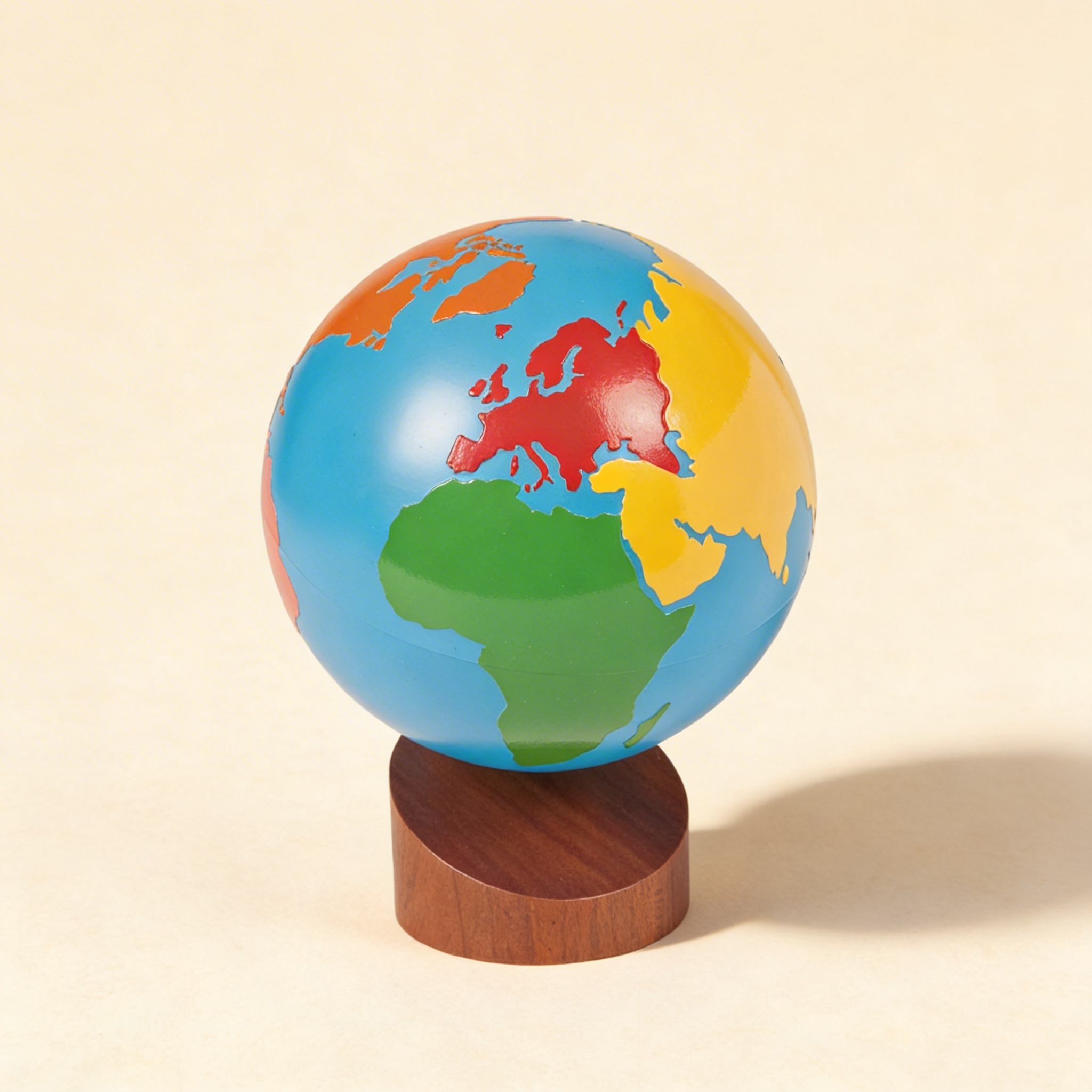
The Globe Of Continents — Coloured Geography Introduction is a Sensorial Montessori material designed for children aged 3-6, crafted by Nienhuis Montessori to AMI standards.
This Globe of the Continents introduces children to the physical geography of our world through color-coded continents on a smooth, tactile sphere. Each continent is distinguished by a specific color following traditional Montessori conventions, allowing children to develop spatial awareness and begin their journey in cultural studies. The globe rotates freely on its wooden base, inviting exploration through touch and sight.
“The greatest sign of success for a teacher is to be able to say, 'The children are now working as if I did not exist.'”— Maria MontessoriThe Absorbent Mind
“Free the child's potential, and you will transform him into the world.”
— Maria Montessori, To Educate the Human Potential
The Globe of the Continents embodies Maria Montessori's principle of cosmic education, introducing the child to their place in the world through concrete, sensorial experiences. This material bridges the sensorial and cultural areas, allowing the child to explore geography through touch and sight before abstract understanding. The color-coding provides a visual key that isolates difficulty, enabling the child to focus on continental shapes and positions without the complexity of political boundaries. Through manipulation of this beautiful, scientifically accurate material, children develop spatial intelligence and begin to understand Earth as our shared home. The globe's three-dimensional nature offers a true representation of our planet, unlike flat maps, supporting the child's developing mathematical mind and preparing them for more complex geographical studies.
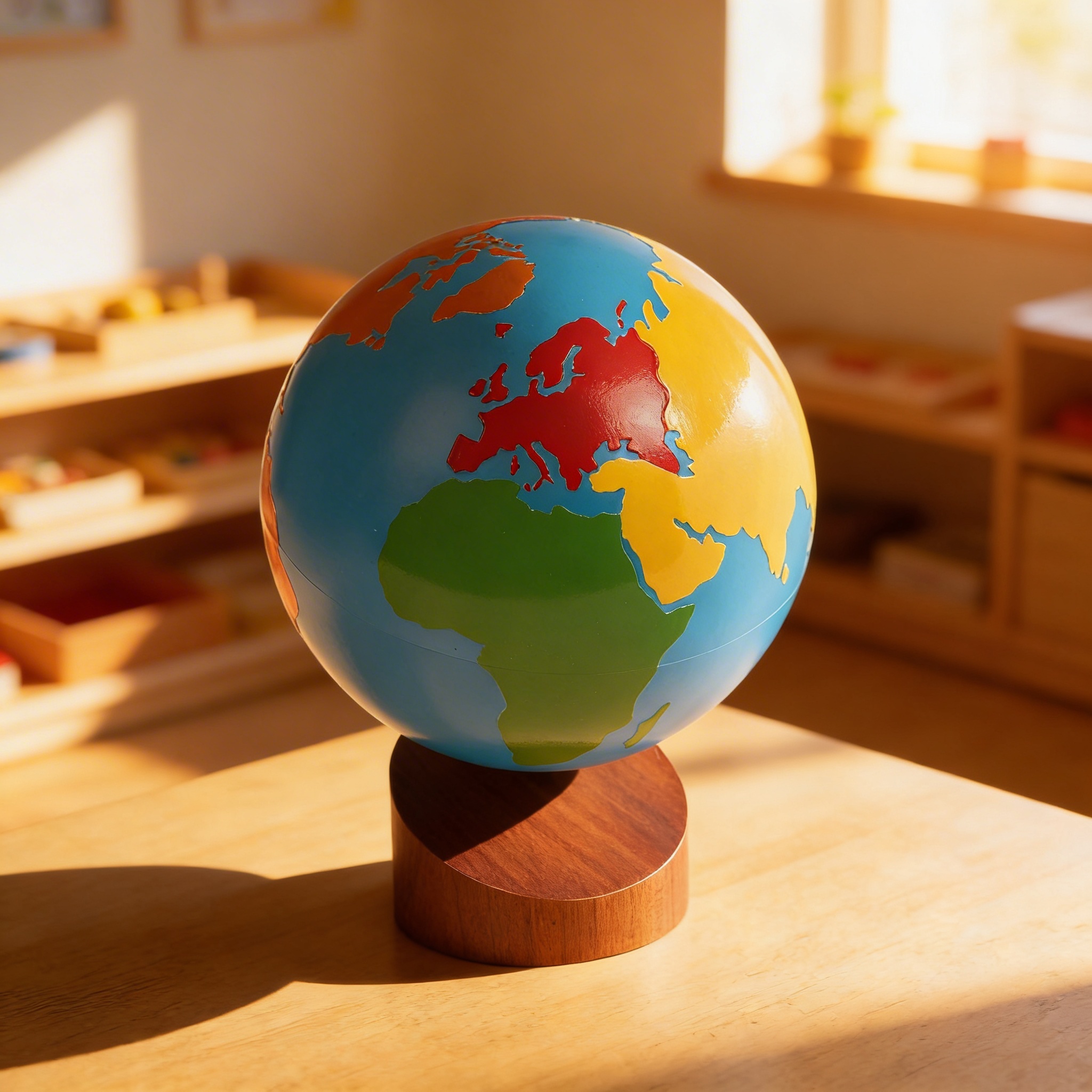
Each order includes everything needed for proper presentation and long-term use.
Follow the Montessori method of presentation for optimal child development.
Invite the child, saying 'I'd like to show you our Earth.' Demonstrate carrying the globe with two hands, one supporting the base, one steadying the sphere.
Once seated, gently rotate the globe, letting your fingers trace over the smooth blue water. Say 'This is water' while touching the blue areas.
Slowly trace one continent with two fingers, saying its name clearly: 'This is Asia.' Repeat for 2-3 continents in the first presentation.
Invite the child to feel the water and land, noticing the smooth painted surfaces and the raised continental areas.
In subsequent lessons, introduce remaining continents, always reviewing previously learned ones first.
Every material is carefully selected for durability, safety, and authentic Montessori experience.
The glossy finish allows children to trace continent shapes with their fingers, reinforcing learning through tactile experience
Each material supports multiple areas of child development simultaneously.
Introduces the concept of continents and their relationships, building foundation for cultural studies
Color-coding helps children distinguish and remember different land masses
Three-dimensional representation helps children understand flat maps later
Designed for child-sized hands
Professional tips from AMI-trained guides to maximize the educational value of this material.
“Present this material after the child has worked extensively with the Sandpaper Globe, understanding land and water forms”
Keep initial presentations short and focused - introduce only 2-3 continents at first, based on the child's capacity
Asia-yellow, Europe-red, Africa-green, North America-orange, South America-pink, Australia-brown, Antarctica-white
Create a designated space for geography materials together, encouraging repeated exploration and combination with related materials
Everything you need to know about this material.
The continents follow traditional Montessori color-coding: North America (orange), South America (pink), Europe (red), Africa (green), Asia (yellow), Australia/Oceania (brown), and Antarctica (white). These colors remain consistent across all Montessori geography materials.
The Globe of the Continents has smooth, painted surfaces with color-coded continents, while the sandpaper globe has textured land masses and smooth water areas. This globe is typically introduced after the sandpaper globe to help children identify and name the continents.
Children can spin the globe to locate continents, match continent puzzle pieces to the globe, create their own maps by tracing, play games identifying continents by color, and eventually learn continent names. It serves as a reference for other geography work.
The globe measures approximately 16cm in diameter and sits on a sturdy wooden base. It's specifically designed for daily classroom handling by young children, with a smooth, wipeable surface and balanced rotation for easy manipulation.
After children can confidently identify all continents by color (usually 3-6 months of regular use), introduce the labeled globe. Children should be able to match continent puzzle pieces and show beginning interest in reading before transitioning to labeled materials.
Can't find what you're looking for?
Contact Our Experts
Share your experience with this material and help other educators and parents.
Bundle related materials and save. Free curriculum guide included with every set.


