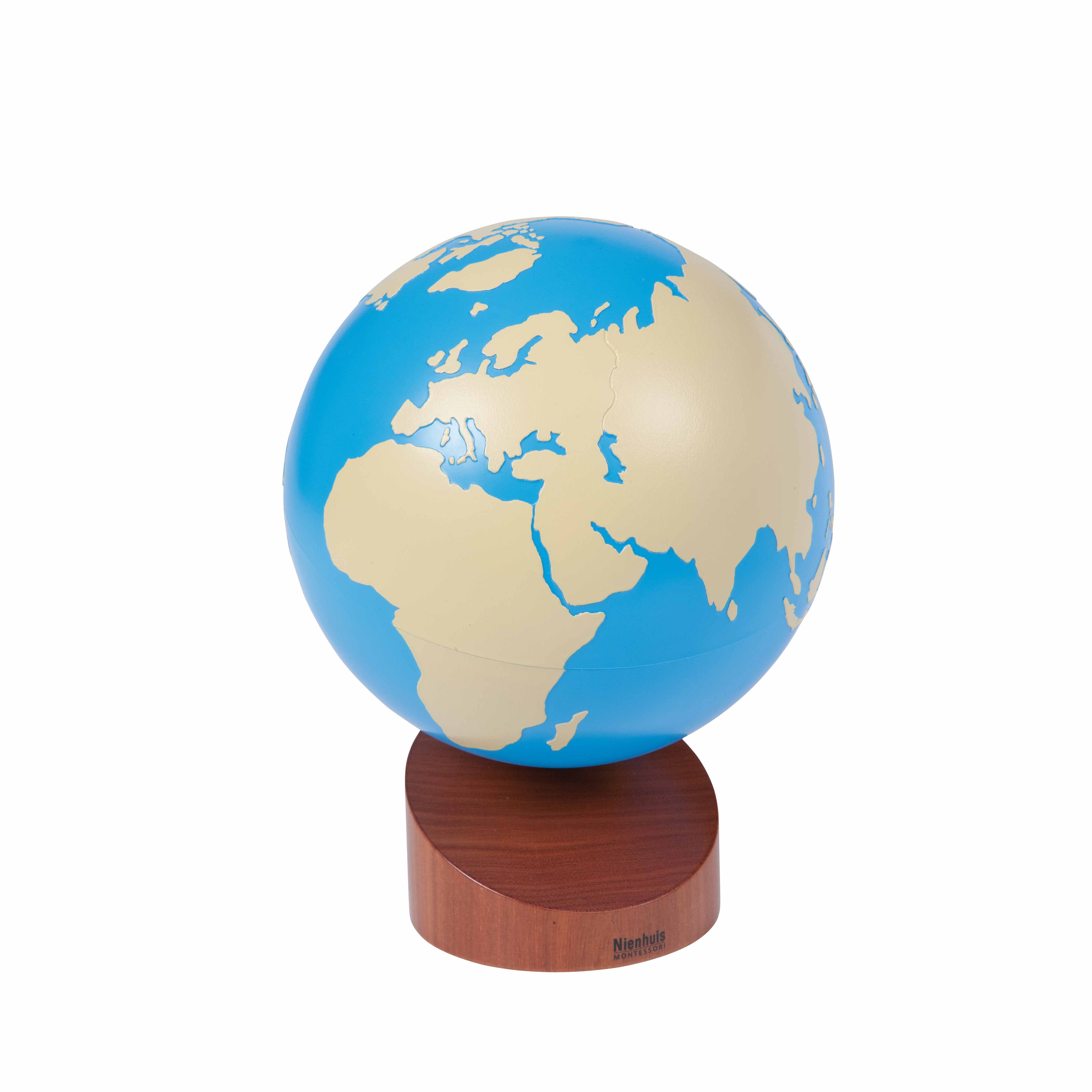
The Globe Of Land And Water: Painted is a category.geography Montessori material designed for children aged 6-12, crafted by Nienhuis Montessori to AMI standards.
This painted Globe of Land and Water introduces children to the fundamental geography concept of land and water distribution on Earth. The globe features continents in a natural beige tone contrasting with blue oceans, mounted on a sturdy wooden base, helping children develop a concrete understanding of our planet's physical geography through tactile exploration.
“Education is a natural process spontaneously carried out by the human individual, and is acquired not by listening to words but by experiences upon the environment.”— Maria MontessoriEducation for a New World
“The child is both a hope and a promise for mankind.”
— Maria Montessori, Education and Peace
The Globe of Land and Water serves as the child's first concrete representation of Earth's physical structure, bridging their immediate environment to global understanding. This painted globe presents continents in natural beige contrasting with blue oceans, offering elementary children their first scientific model of planetary geography. The wooden base allows children to rotate and examine Earth's surface from multiple perspectives, essential for developing spatial reasoning. Unlike flat maps, the globe's spherical form demonstrates how continents relate to each other across curved surfaces, correcting misconceptions about distance and direction. The simplified two-color scheme isolates the fundamental geographical concept of land versus water distribution, preparing children for more complex geographical studies. Through handling this globe, children aged 6-12 construct mental models of Earth as a sphere covered by land masses and water bodies, establishing the foundation for understanding climate, ocean currents, and human migration patterns.
Each order includes everything needed for proper presentation and long-term use.
Follow the Montessori method of presentation for optimal child development.
Introduce the globe by inviting the child to observe the two colors, asking what they might represent
Demonstrate gentle rotation of the globe on its axis, showing how land and water appear on all sides
Trace the outline of one continent with your finger, then invite the child to trace others
Introduce vocabulary by pointing: 'This is land' (beige areas), 'This is water' (blue areas)
Explore the proportion of water to land by rotating the globe to find the 'water hemisphere' (Pacific Ocean view)
Each material supports multiple areas of child development simultaneously.
Builds foundational knowledge of Earth's land and water distribution through visual and tactile exploration.
Develops understanding of continents, oceans, and their relationships on a spherical surface.
Introduces concepts of physical geography and prepares for advanced studies of specific continents and countries.
Rotating and examining the globe refines hand movements and coordination.
Designed for child-sized hands
Professional tips from AMI-trained guides to maximize the educational value of this material.
“Present this globe before introducing flat maps to establish Earth's spherical nature first”
Connect to children's experiences by locating approximately where they live on the globe
Use natural lighting to demonstrate day and night by shining light on one side
Keep presentations brief (10-15 minutes) to maintain engagement and allow processing time
Everything you need to know about this material.
The Globe of Land and Water is the first globe presented to children in Montessori geography. It introduces the fundamental concept that Earth is made up of land and water, providing a concrete, tactile way for children to understand this basic geographical distinction before moving on to more complex concepts like continents and countries.
While both globes show land and water, the Painted Globe has smooth surfaces with land areas painted in beige and water in blue. The Sandpaper Globe has textured surfaces - rough sandpaper for land and smooth paint for water - allowing children to feel the difference. The Painted Globe is typically introduced after the sandpaper version.
Children can identify and trace land and water areas, match the globe to flat maps, create their own land and water forms with clay or paint, discuss which is more prevalent on Earth, and use it as a reference for lessons about continents, oceans, and geographical features. It also serves as an introduction to more detailed geography work.
The globe features a painted sphere with continents in natural beige tones and oceans in blue, mounted on a sturdy wooden base. The size is appropriate for children ages 6-12 to handle comfortably. The smooth painted surface allows for easy cleaning and durability in classroom use.
This globe follows the Montessori principle of moving from simple to complex. After sensorial work with the Sandpaper Globe, children use this Painted Globe to reinforce land/water concepts before progressing to the Continent Globe and political globes. It provides a visual reference for discussions about Earth's surface and prepares children for more detailed geographical studies.
Can't find what you're looking for?
Contact Our Experts
Share your experience with this material and help other educators and parents.

