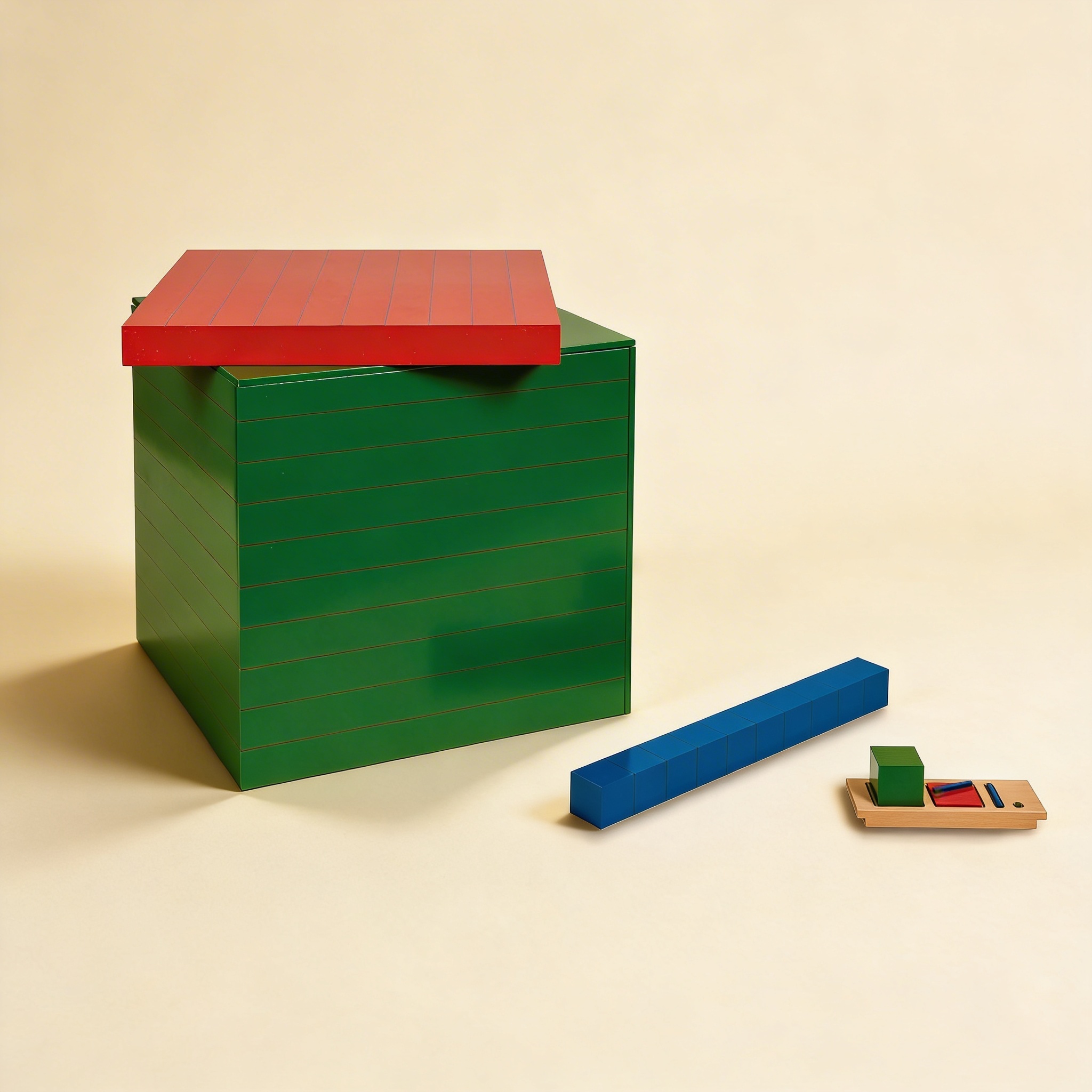
The Geometric Hierarchy of Number — Mathematical Relationships Through Solids is a Sensorial Montessori material designed for children aged 3-6, crafted by Nienhuis Montessori to AMI standards.
The Geometric Hierarchy of Number introduces children to mathematical relationships through graduated geometric solids. This sensorial material builds understanding of dimensional progression from units to thousands, preparing the foundation for decimal system work while refining visual discrimination of size and volume.
“The hands are the instruments of man's intelligence.”— Maria MontessoriThe Absorbent Mind
“The senses, being explorers of the world, open the way to knowledge.”
— Maria Montessori, The Discovery of the Child
The Geometric Hierarchy of Number perfectly embodies Montessori's principle of moving from concrete to abstract learning. Through graduated geometric solids, children physically experience mathematical relationships before encountering abstract numbers. The material's sensorial nature allows children to internalize dimensional concepts through touch, sight, and manipulation. Each geometric piece represents a specific numerical value - the small cube as one unit, the long rectangular prism as ten, building to thousands - creating a tangible foundation for decimal understanding. The color-coding and size progression support the Montessori emphasis on self-correction and independent learning. Children naturally discover patterns and relationships through exploration, fostering intrinsic motivation rather than external instruction. This material honors the child's mathematical mind by presenting complex concepts in their simplest, most concrete form, allowing natural mathematical thinking to emerge through sensorial experience.
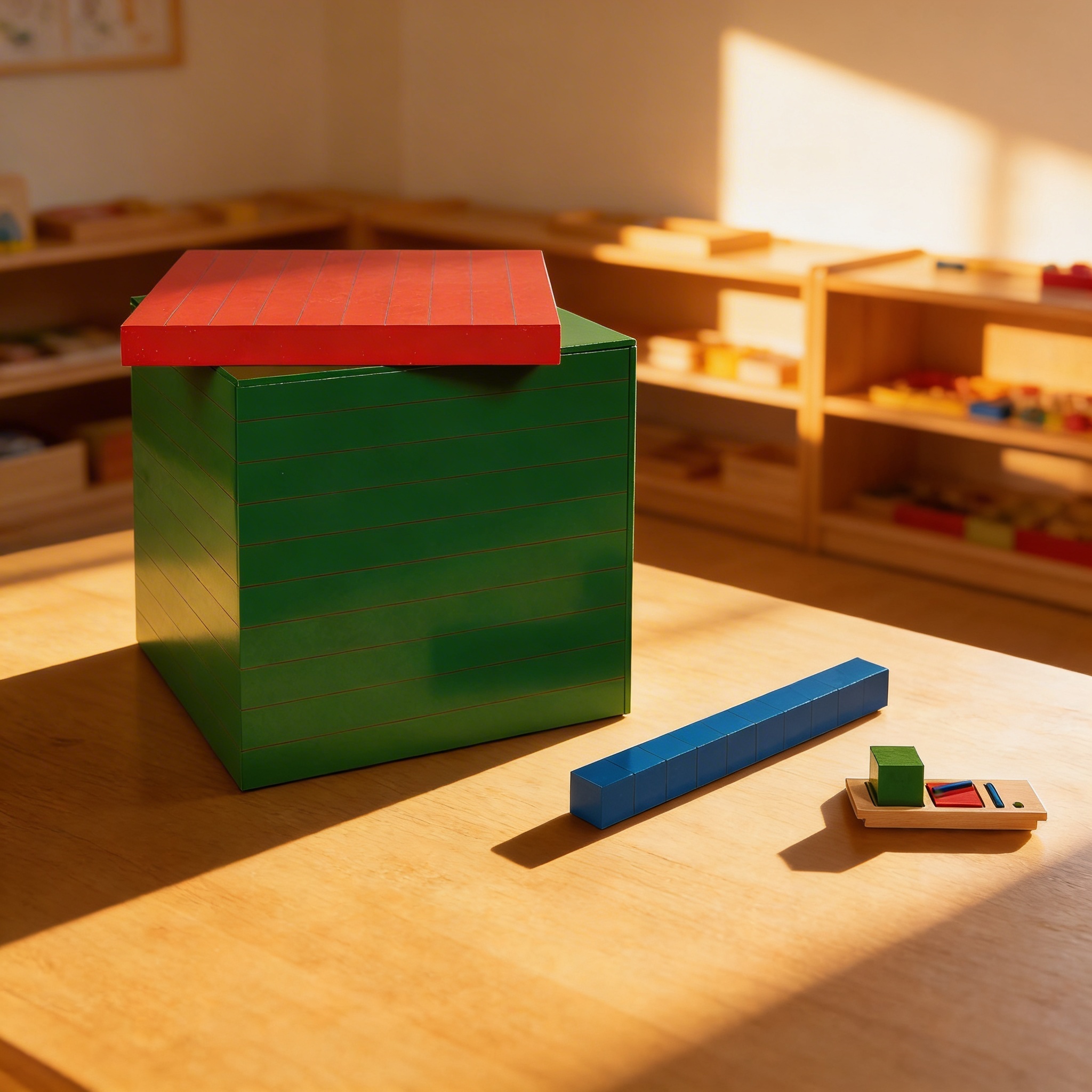
Each order includes everything needed for proper presentation and long-term use.
Follow the Montessori method of presentation for optimal child development.
Invite the child to explore each piece individually, feeling the weight and examining the dimensions
Demonstrate building the hierarchy by placing pieces in order from smallest to largest
Guide the child to rebuild the sequence independently, emphasizing the size relationships
Encourage the child to experiment with stacking and arranging pieces in different configurations
Every material is carefully selected for durability, safety, and authentic Montessori experience.
Selected for its durability and smooth finish, our hardwood blocks withstand years of handling while maintaining their precise geometric properties. The natural wood grain provides tactile feedback that enhances the sensorial experience.
Our vibrant color system uses child-safe, water-based paints that resist chipping and fading. The distinct colors help children quickly identify and organize the geometric hierarchy while ensuring complete safety during exploration.
Each material supports multiple areas of child development simultaneously.
Introduces concrete understanding of base-10 relationships and decimal hierarchy through manipulable geometric forms, preparing for advanced mathematical concepts.
Refines ability to perceive dimensional differences and spatial relationships, strengthening visual-spatial intelligence and geometric understanding.
Develops sequential thinking and pattern recognition as children arrange blocks from smallest to largest, building logical mathematical reasoning skills.
Combines visual, tactile, and proprioceptive feedback through handling weighted geometric forms, reinforcing mathematical concepts through multi-sensory experience.
Designed for child-sized hands
Professional tips from AMI-trained guides to maximize the educational value of this material.
“Present this material after the child has mastered basic geometric solids and shows interest in size relationships”
Use precise mathematical language consistently but don't overwhelm with technical terms initially
Observe carefully which dimensional relationships intrigue each child most - this guides future presentations
Connect this work to other mathematical materials gradually, especially the golden beads and decimal system
Everything you need to know about this material.
Yes, this material is specifically designed for children aged 3-6 years. Three-year-olds can begin exploring the sensorial aspects - feeling the different sizes and weights of the geometric solids. The material grows with your child, as older children (4-6) will grasp the mathematical relationships and decimal system concepts. The self-correcting nature allows children to work at their own pace and developmental level.
The Geometric Hierarchy of Number works beautifully in both home and classroom settings. In a home environment, parents can present the material following Montessori principles - allowing the child to explore the sensorial qualities first, then gradually introducing the mathematical concepts. The material's design makes it intuitive for children to discover relationships independently, though some basic understanding of Montessori presentation methods enhances its educational value.
Our Geometric Hierarchy of Number is crafted from premium hardwood with a natural finish that highlights the wood's beautiful grain. Each piece is precisely manufactured to exact specifications ensuring perfect graduation in size. The smooth, tactile finish is essential for sensorial exploration, while the durability ensures this investment will serve multiple children over many years. The quality construction maintains the material's educational integrity and sensorial appeal.
Begin with a simple three-period lesson focusing on the sensorial qualities - 'small cube,' 'medium cube,' 'large cube.' Allow your child to explore the weight, size, and texture differences. As they mature, introduce the mathematical vocabulary (units, tens, hundreds, thousands) and demonstrate how each piece represents a power of ten. The key is following your child's interest and readiness, moving from concrete sensorial exploration to abstract mathematical understanding gradually.
AMI-approved materials like our Geometric Hierarchy of Number meet rigorous standards for proportion, materials, and educational design established by Maria Montessori herself. The precise mathematical relationships, premium materials, and exact specifications ensure the material delivers its intended learning outcomes. While the investment is higher, AMI materials provide superior durability, sensorial quality, and educational effectiveness that supports your child's mathematical foundation for years to come.
Can't find what you're looking for?
Contact Our Experts
Share your experience with this material and help other educators and parents.
Bundle related materials and save. Free curriculum guide included with every set.


