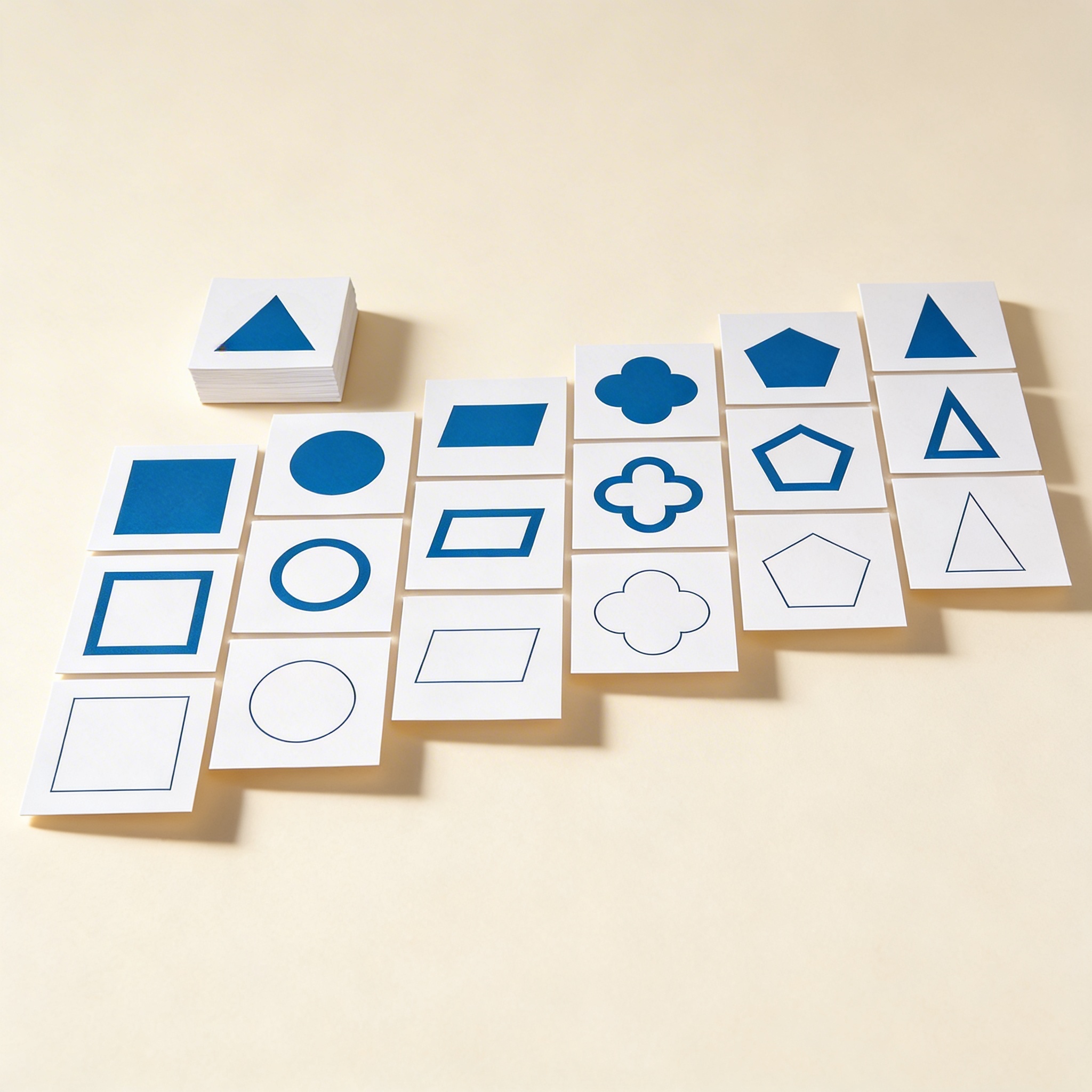
The Geometric Form Cards — Three-Part Visual Discrimination is a Sensorial Montessori material designed for children aged 3-6, crafted by Nienhuis Montessori to AMI standards.
These Geometric Form Cards present a three-part matching activity that helps children develop visual discrimination skills through the recognition and matching of geometric shapes. The cards progress from filled shapes to outlined forms, supporting the child's understanding of geometric concepts while refining their perception of form and space in preparation for geometry work.
“Free the child's potential, and you will transform him into the world.”— Maria MontessoriTo Educate the Human Potential
“Education is a natural process spontaneously carried out by the human individual, and is acquired not by listening to words but by experiences upon the environment.”
— Maria Montessori, Education for a New World
The Geometric Form Cards embody Montessori's principle of isolating difficulty, presenting one concept—geometric form—through progressive abstraction. This material bridges the concrete experience of the Geometric Cabinet with more abstract representations, supporting the child's natural progression from sensorial to cognitive understanding. Through repeated matching activities, children internalize geometric forms not through memorization but through visual discrimination and muscular memory from handling the cards. The three-part card format respects the child's need for order and classification while developing the visual perception essential for later mathematical work. This material exemplifies Montessori's insight that geometry begins as a sensorial experience before becoming an intellectual study, allowing children to absorb geometric concepts through their absorbent mind during the sensitive period for order and visual discrimination.
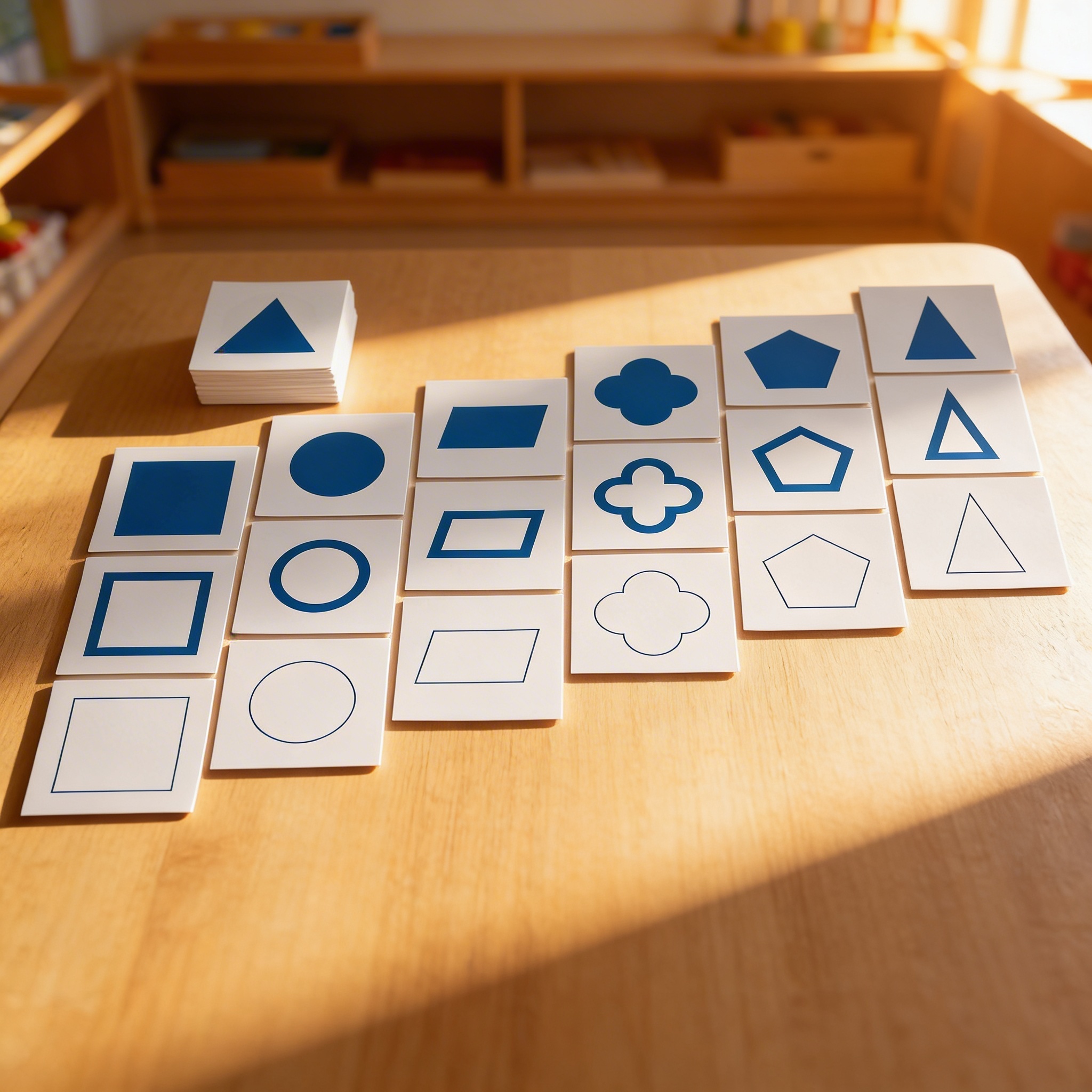
Each order includes everything needed for proper presentation and long-term use.
Follow the Montessori method of presentation for optimal child development.
Introduce 3-4 control cards, naming each shape precisely
Mix the corresponding filled shape cards and invite the child to match them to the controls
Once mastered, introduce the outlined form cards for the same shapes
Progress to matching all three forms: control, filled, and outlined
Gradually increase the number of shapes as the child shows readiness
Every material is carefully selected for durability, safety, and authentic Montessori experience.
Durable material that withstands repeated handling while maintaining crisp, clear geometric forms essential for visual discrimination work
Each material supports multiple areas of child development simultaneously.
Children refine their ability to perceive differences and similarities between geometric forms, essential for later mathematical understanding.
Introduces fundamental geometric shapes and their properties through concrete matching activities before abstract study.
The precise matching work requires focused attention, supporting the development of sustained concentration.
Progression from filled to outlined shapes helps children move from concrete to more abstract representations.
Designed for child-sized hands
Professional tips from AMI-trained guides to maximize the educational value of this material.
“Present this after the child has worked with geometric solids and before the Geometric Cabinet”
'equilateral triangle' not just 'triangle'
Store cards in separate envelopes by type to maintain order and allow gradual introduction
Observe which shapes the child gravitates toward—this indicates their current sensitive period
Everything you need to know about this material.
The set typically includes fundamental geometric shapes such as circle, square, triangle, rectangle, pentagon, hexagon, octagon, and other polygons. Each shape comes in three forms: filled (solid), thick outline, and thin outline, creating a complete three-part matching activity.
Children begin by matching identical filled shapes, then progress to matching filled shapes with thick outlines, and finally match all three variations together. This progression helps develop visual discrimination from concrete (filled) to abstract (outlined) representations of geometric forms.
Start with 3-4 basic shapes (circle, square, triangle), presenting only the filled cards first. Once mastered, introduce the thick outline cards for matching, then add thin outlines. Gradually increase the number of shapes as the child's discrimination skills develop.
The cards develop foundational skills for geometry by training the eye to recognize shapes regardless of presentation style, understanding that a shape's essential properties remain constant whether filled or outlined. This prepares children for later work with geometric solids, constructive triangles, and formal geometry studies.
Yes, these cards complement the geometric cabinet, metal insets, and geometric solids. Children can match the cards to corresponding shapes in the geometric cabinet or use them alongside the geometric solids to understand 2D representations of 3D forms.
Can't find what you're looking for?
Contact Our Experts
Share your experience with this material and help other educators and parents.
Bundle related materials and save. Free curriculum guide included with every set.


