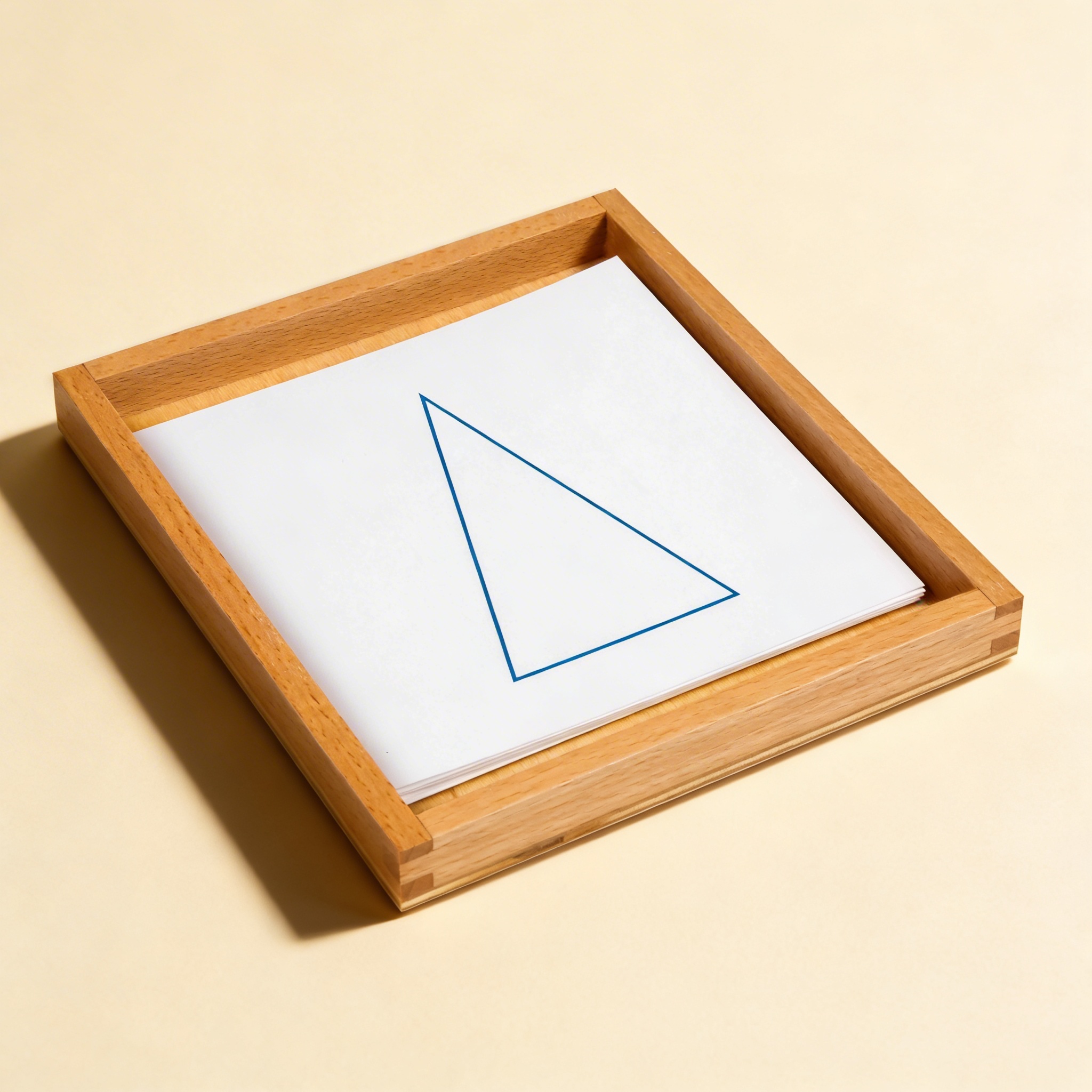
The Geometric Cards — Basic Shape Recognition with Blue Triangle is a Sensorial Montessori material designed for children aged 3-6, crafted by Nienhuis Montessori to AMI standards.
These Geometric Cards introduce children to fundamental shapes through precise visual isolation. The wooden frame contains cards featuring a blue triangle outline on a white background, allowing focused exploration of geometric forms. This material bridges concrete geometric solids work with abstract shape recognition, supporting the child's developing mathematical mind through careful observation and comparison.
“The hands are the instruments of man's intelligence.”— Maria MontessoriThe Absorbent Mind
“The senses, being explorers of the world, open the way to knowledge.”
— Maria Montessori, The Discovery of the Child
The Geometric Cards embody Montessori's principle of isolation of difficulty by presenting each shape in its purest form - a simple blue outline on white background. This material serves as a crucial bridge between the concrete experience of the Geometric Solids and the abstract understanding of two-dimensional shapes. Through this work, the child's mathematical mind is nurtured as they develop visual discrimination and begin to perceive the geometric patterns that exist throughout their environment. The cards support the child's natural tendency toward order and classification, allowing them to organize their understanding of shapes systematically. This material also prepares the child indirectly for later geometry work and develops the visual perception necessary for reading and writing, as letter recognition requires similar shape discrimination abilities.
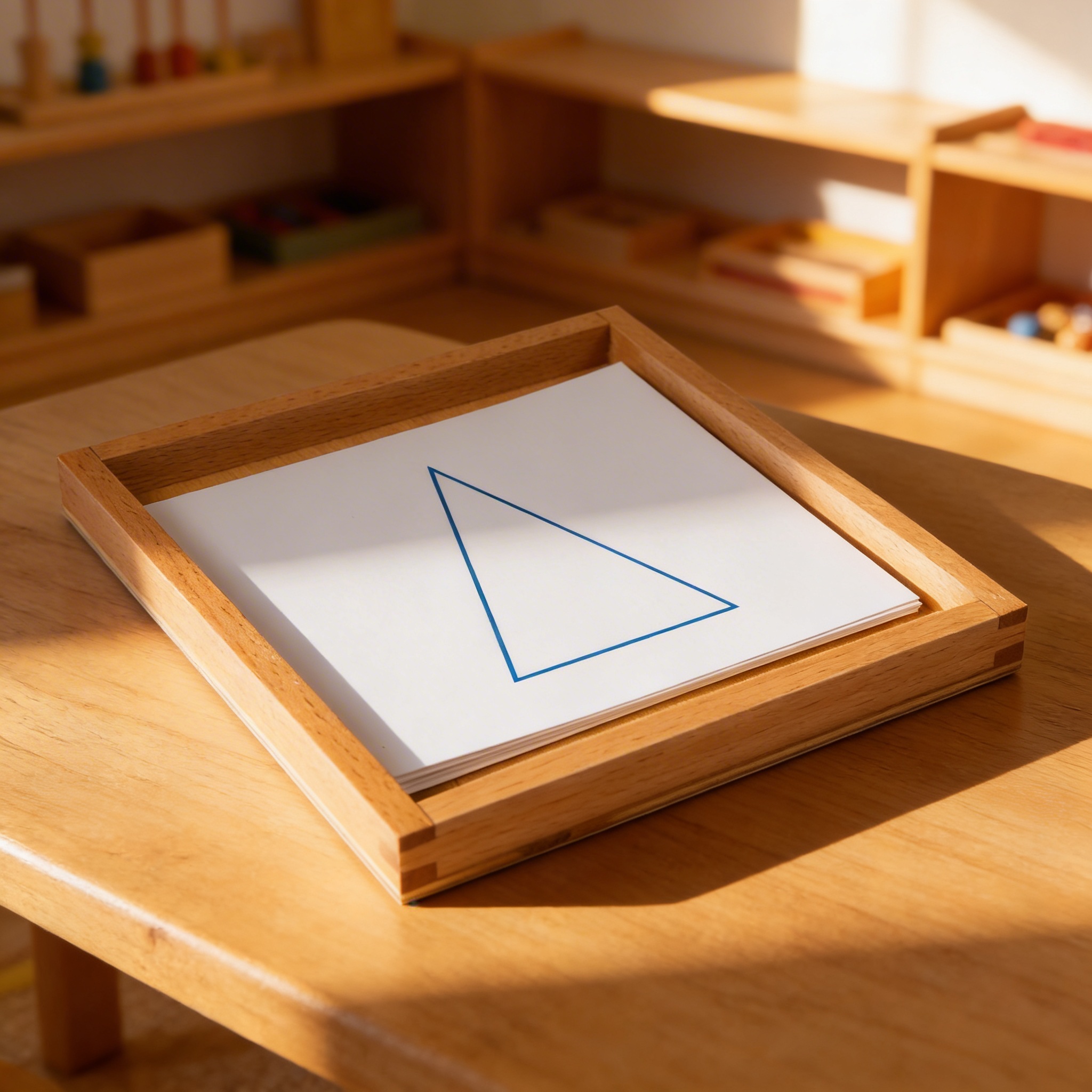
Each order includes everything needed for proper presentation and long-term use.
Follow the Montessori method of presentation for optimal child development.
Remove one card slowly with a three-finger grip, place it centrally on the mat
Trace the blue outline with your index finger, moving slowly and precisely
Give a three-period lesson: 'This is a triangle' (naming)
Continue with recognition: 'Show me the triangle' and recall: 'What is this?'
Invite child to trace the shape, observing their finger movement
Return card to frame before introducing next shape
Every material is carefully selected for durability, safety, and authentic Montessori experience.
The isolated blue outline on white background follows Montessori principles of visual clarity, allowing the child to focus solely on the geometric form without distraction.
Each material supports multiple areas of child development simultaneously.
Develops ability to perceive subtle differences in geometric shapes through focused observation.
Prepares for geometry work by establishing visual memory of fundamental shapes.
Introduces geometric vocabulary through three-period lessons with shape names.
Bridges concrete geometric solid work with abstract two-dimensional representations.
Designed for child-sized hands
Professional tips from AMI-trained guides to maximize the educational value of this material.
“Present only three shapes initially, choosing those with maximum contrast (circle/triangle/square rather than square/rectangle)”
Observe which hand the child uses for tracing to note dominance, but don't correct if they switch hands
Use precise mathematical language from the beginning - 'triangle' not 'three-sided shape'
Allow ample time for repetition; children often need to trace shapes multiple times for full internalization
Everything you need to know about this material.
The Geometric Cards include fundamental shapes such as triangles, circles, squares, rectangles, pentagons, hexagons, and other polygons. Each shape is presented as a precise blue outline on a white background for clear visual isolation and focused study.
These cards bridge concrete geometric work with abstract shape recognition, helping children develop visual discrimination, shape awareness, and mathematical vocabulary. They prepare children for later geometry work by establishing a strong foundation in shape identification and properties.
Begin with the three primary shapes (circle, square, triangle), then gradually introduce more complex polygons. Use a three-period lesson for each shape, allowing the child to trace the outline with their fingers while learning the shape names and properties.
These cards complement the Geometric Solids and Metal Insets, creating a complete geometry sequence. They provide a two-dimensional representation that connects the child's work with three-dimensional solids to later writing and mathematical activities.
Children can match cards to objects in the environment, create shape books, sort shapes by properties (number of sides, angles), trace shapes onto paper, and use them for language work by learning shape vocabulary in multiple languages.
Can't find what you're looking for?
Contact Our Experts
Share your experience with this material and help other educators and parents.
Bundle related materials and save. Free curriculum guide included with every set.


