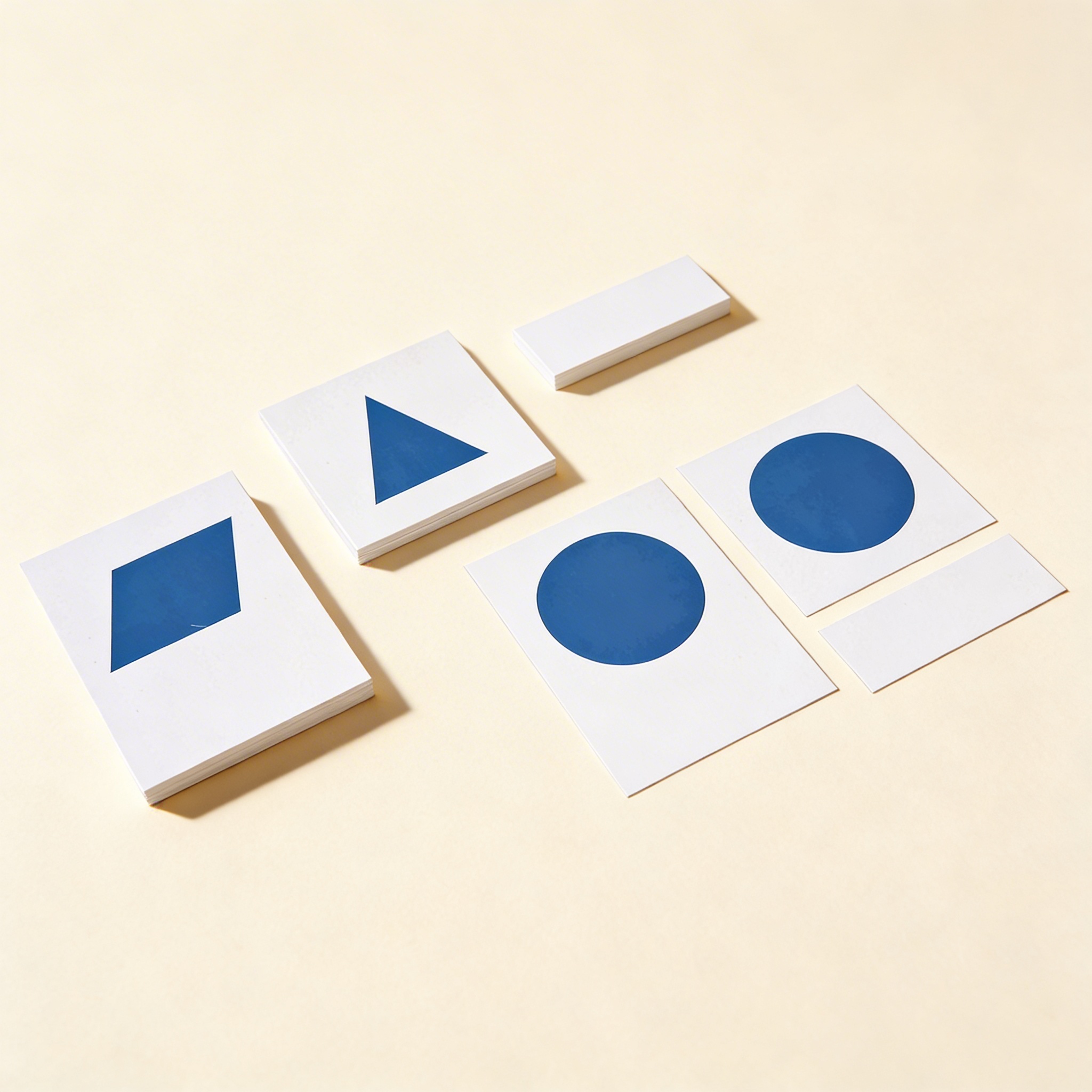
The Geometric Cabinet Cards — Shape Nomenclature Three-Part Cards is a Sensorial Montessori material designed for children aged 3-6, crafted by Nienhuis Montessori to AMI standards.
These Geometric Cabinet Nomenclature Cards complement the Montessori Geometric Cabinet, introducing precise mathematical language through three-part card activities. Each set features clear blue geometric shapes paired with their corresponding names, supporting the child's transition from sensorial exploration to abstract understanding of geometric forms and their nomenclature.
“The senses, being explorers of the world, open the way to knowledge.”— Maria MontessoriThe Discovery of the Child
“Children display a universal love of mathematics, which is par excellence the science of precision, order, and intelligence.”
— Maria Montessori, The Discovery of the Child
The Geometric Cabinet Nomenclature Cards embody Montessori's principle of isolating difficulty by presenting one concept at a time - the name of each geometric form. Following the three-period lesson structure, these cards bridge the gap between the child's sensorial exploration with the Geometric Cabinet and their emerging ability to categorize and name abstract concepts. The material respects the child's need for repetition and self-correction, allowing independent practice of newly acquired vocabulary. By providing the exact language at the moment of readiness, we support the child's natural tendency toward precision and order. The cards serve as keys to language during the sensitive period for vocabulary enrichment, transforming sensorial impressions into conscious knowledge that can be communicated and shared with others.
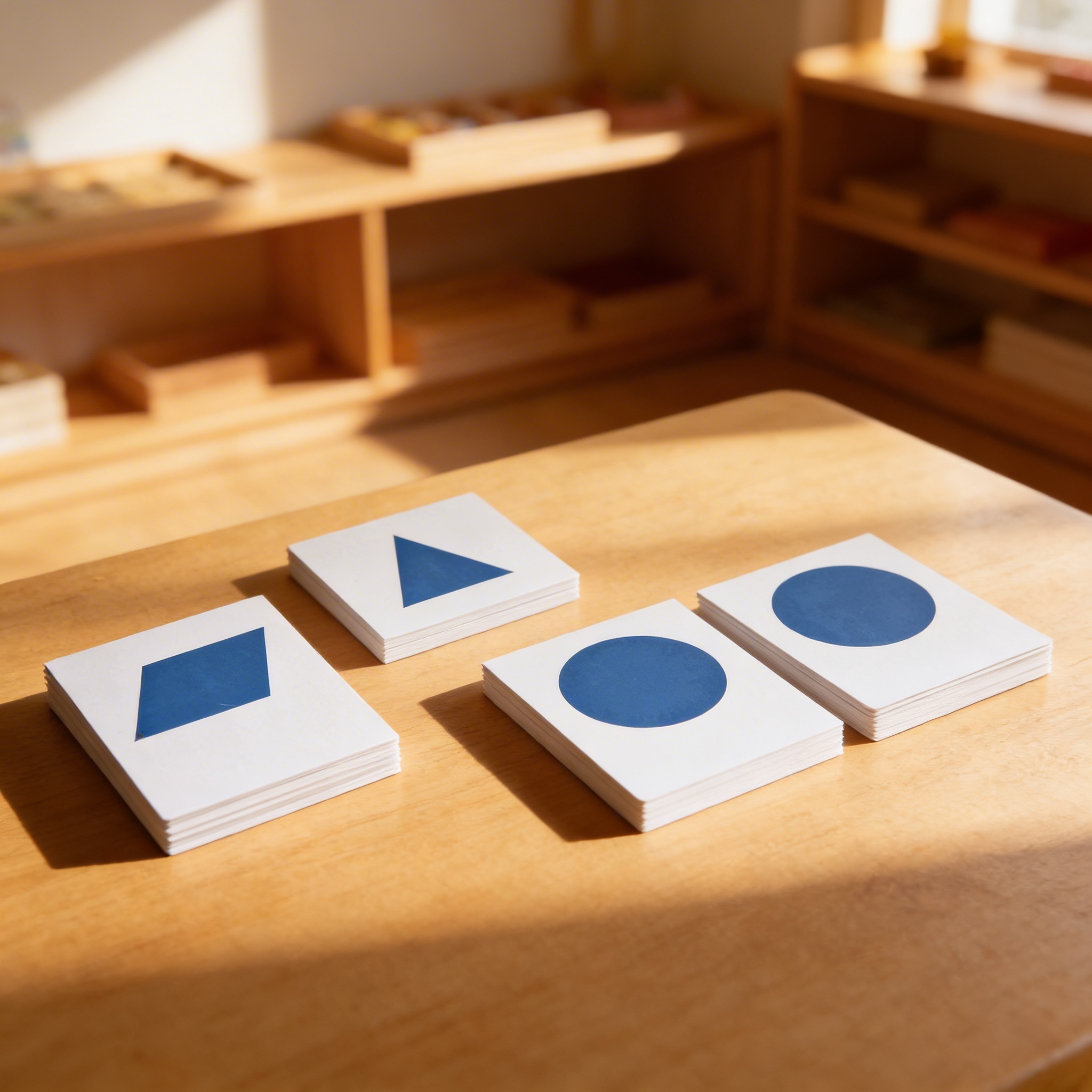
Each order includes everything needed for proper presentation and long-term use.
Follow the Montessori method of presentation for optimal child development.
Invite the child and bring one drawer with its corresponding cards to a mat
Remove shapes from drawer, placing them in a row. Take out matching picture cards and place below shapes
Introduce reading labels using three-period lesson: 'This is the pentagon'
Mix labels and have child match to pictures: 'Can you place the label under the pentagon?'
Child practices independently, matching shapes to pictures to labels
Every material is carefully selected for durability, safety, and authentic Montessori experience.
Professional-grade cards designed to withstand repeated handling by young children while maintaining clarity of images and text.
Each material supports multiple areas of child development simultaneously.
Introduces precise geometric vocabulary, supporting the child's mathematical language development and classification skills.
Refines the ability to distinguish between similar shapes while connecting visual recognition to written language.
Three-part card format supports early reading skills through matching activities and word recognition exercises.
Designed for child-sized hands
Professional tips from AMI-trained guides to maximize the educational value of this material.
“Present nomenclature cards only after extensive sensorial work with the actual Geometric Cabinet”
say 'curvilinear triangle' not 'rounded triangle'
Store cards organized by drawer to maintain connection with the concrete material
Observe which shapes the child gravitates toward; this indicates readiness for those specific cards
Everything you need to know about this material.
The cards include all shapes from the traditional Montessori Geometric Cabinet: circles, triangles (equilateral, isosceles, scalene, right-angled), quadrilaterals (square, rectangle, rhombus, parallelogram, trapezoid), regular polygons (pentagon through decagon), and curved figures (ellipse, ovoid, curvilinear triangle, quatrefoil).
Three-part cards consist of a control card showing both the shape and its name, a picture card displaying only the shape, and a label card with just the written name. Children match the separate picture and label cards to the control card, promoting reading skills and shape recognition simultaneously.
While the cards can be used independently for shape recognition and vocabulary building, they are designed to complement the Geometric Cabinet. Children benefit most when they can match the cards to the concrete shapes, creating a meaningful connection between the sensorial experience and abstract concepts.
Begin with shapes the child has explored sensorially in the Geometric Cabinet. Start with 3-4 familiar shapes, introducing the nomenclature through the three-period lesson. Gradually add more complex shapes as the child masters the initial set, always connecting the cards to their concrete cabinet counterparts.
These cards build precise mathematical vocabulary essential for later geometry studies. They develop visual discrimination, classification skills, and the ability to identify shapes in various orientations. The cards also prepare children for understanding geometric relationships, properties, and measurements in elementary mathematics.
Can't find what you're looking for?
Contact Our Experts
Share your experience with this material and help other educators and parents.
Bundle related materials and save. Free curriculum guide included with every set.


