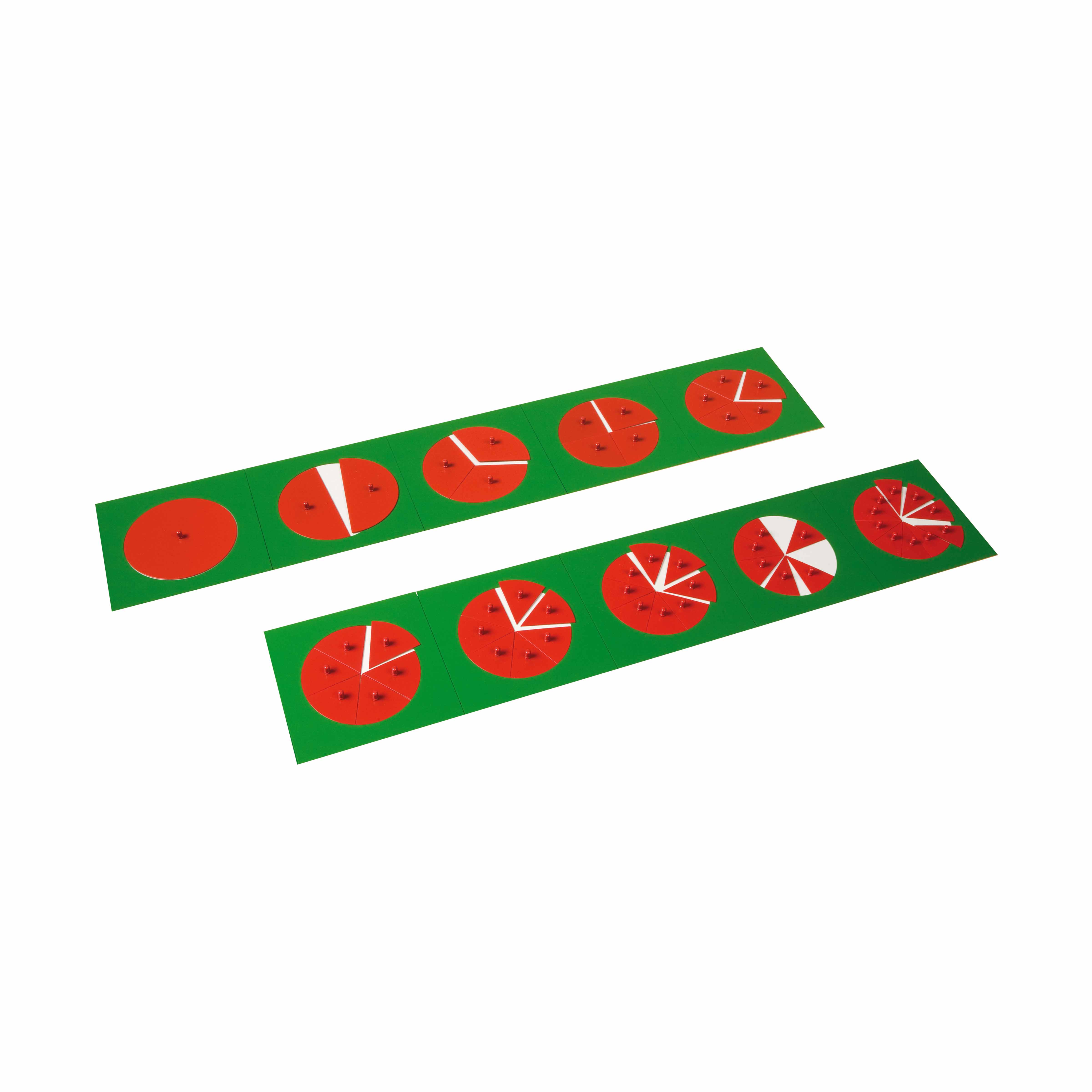
The Fraction Circles is a Mathematics Montessori material designed for children aged 3-6, crafted by Nienhuis Montessori to AMI standards.
The Fraction Circles material introduces young children to the fundamental concept of fractions through concrete manipulation. Each red circle on the green wooden boards is precisely divided with white lines into equal parts, from whole units to increasingly smaller fractions, allowing children to physically explore how wholes can be divided into halves, thirds, quarters, and beyond.
“Children display a universal love of mathematics, which is par excellence the science of precision, order, and intelligence.”— Maria MontessoriThe Discovery of the Child
“The greatest sign of success for a teacher is to be able to say, 'The children are now working as if I did not exist.'”
— Maria Montessori, The Absorbent Mind
The Fraction Circles emerge in the mathematics area when children demonstrate readiness to explore part-whole relationships beyond simple counting. Each red circle, precisely divided by white lines on its green wooden board, transforms the abstract concept of fractions into a tangible experience children can touch and manipulate. The progression from whole circles to circles divided into halves, thirds, quarters, and smaller parts mirrors the child's growing capacity to understand division as equal sharing. The visual contrast between the red circles and white division lines creates clear boundaries that help young minds perceive how one whole can become many equal parts. This material bridges the gap between the child's concrete operational thinking and the eventual abstraction of fractional notation, allowing mathematical understanding to develop through repeated sensorial exploration rather than memorization.
Each order includes everything needed for proper presentation and long-term use.
Follow the Montessori method of presentation for optimal child development.
Begin with the whole circle, tracing its edge with two fingers while saying 'This is one whole circle'
Move to the circle divided into halves, trace each half separately saying 'This is one half' for each piece
Remove one half and place it beside the board, then replace it, noting how two halves make one whole
Continue with thirds, removing one piece at a time and counting how many pieces make the whole
After exploring each circle separately, compare pieces from different circles by placing them side by side
Every material is carefully selected for durability, safety, and authentic Montessori experience.
The smooth wooden boards provide a stable foundation for mathematical exploration, allowing children to focus on the abstract concepts without distraction
Each material supports multiple areas of child development simultaneously.
Builds concrete understanding of fractions as parts of a whole through visual and tactile exploration
Develops ability to recognize and compare different fractional parts through color contrast and clear divisions
Bridges the gap between concrete materials and abstract mathematical concepts through hands-on manipulation
Designed for child-sized hands
Professional tips from AMI-trained guides to maximize the educational value of this material.
“Present this material only after the child has worked extensively with the red rods and understands the concept of whole units”
always say 'one half' not 'a half' to emphasize the mathematical precision
Allow ample time for free exploration after the initial presentation - children often discover relationships independently
Keep the boards in sequential order on the shelf to support the child's sense of mathematical progression
Everything you need to know about this material.
While suitable for ages 3-6, most children benefit from this material around age 4-5 when they have developed fine motor control and can understand the concept of parts and wholes. Earlier exposure can focus on sensorial exploration of the circles.
Children begin by exploring whole circles, then progress to halves, thirds, and quarters. They trace the divisions, remove and replace pieces, and eventually compare different fractions. The material naturally leads to naming fractions and understanding equivalence.
This material introduces equivalence (two halves equal one whole), comparison of fractions, the relationship between division and fractions, and prepares children for later work with fraction operations and decimal conversions.
Montessori Fraction Circles provide precise, hands-on manipulation with clear visual representation on green boards. The material isolates the concept of fractions without symbols, allowing sensorial understanding before abstract notation is introduced.
Children can trace divisions, build and rebuild circles, compare different fractions, create equivalent fractions, play matching games, and eventually create their own fraction problems. The material supports both individual exploration and small group activities.
Can't find what you're looking for?
Contact Our Experts
Share your experience with this material and help other educators and parents.


