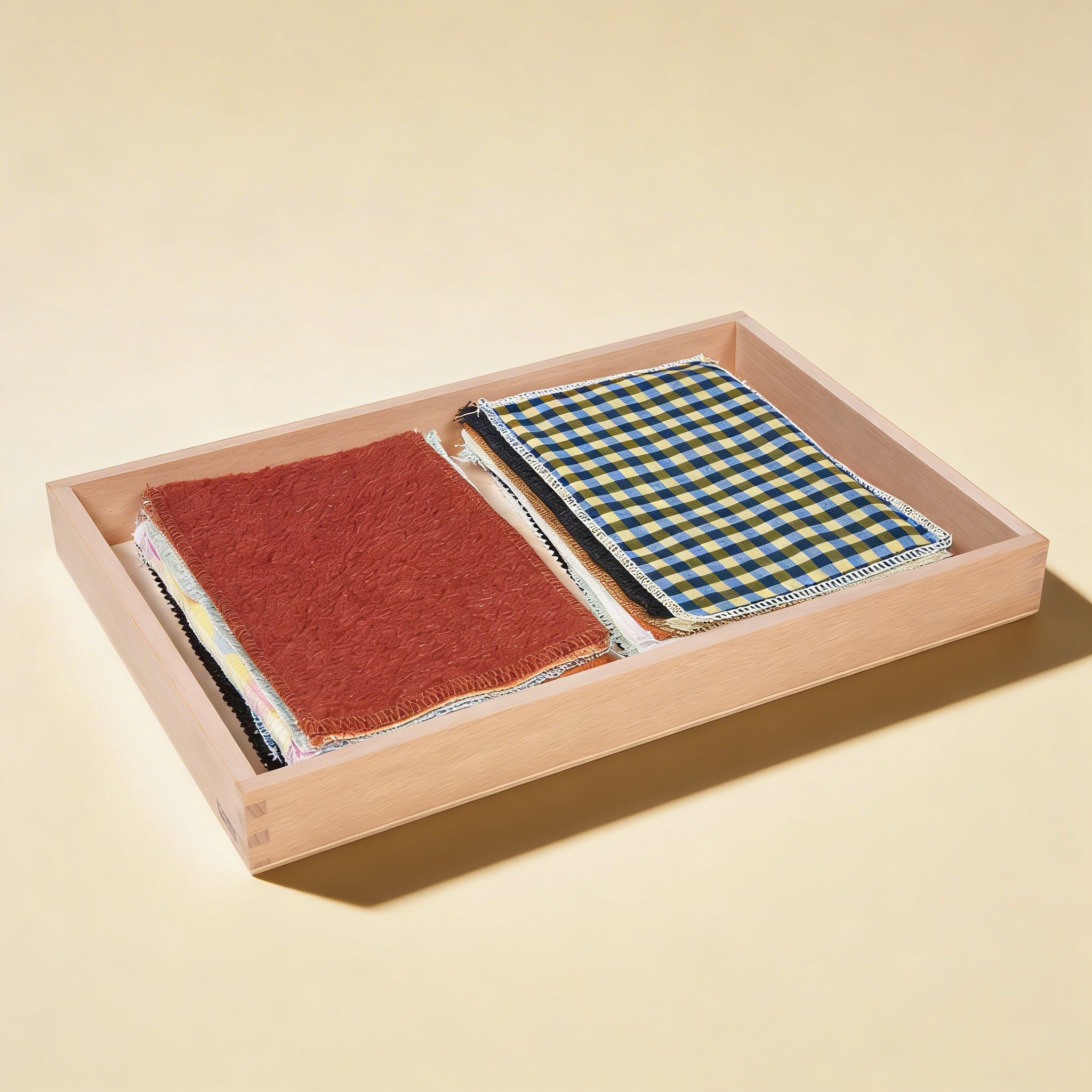
The Fabric Box — Tactile Discrimination Through Paired Matching is a Sensorial Montessori material designed for children aged 3-6, crafted by Nienhuis Montessori to AMI standards.
This Montessori Fabric Box develops tactile discrimination through paired fabric matching exercises. Children refine their stereognostic sense by feeling and matching various textures including smooth, rough, checkered, and textured fabrics. The wooden tray organizes fabric swatches for independent exploration and sensorial refinement.
“The senses, being explorers of the world, open the way to knowledge.”— Maria MontessoriThe Discovery of the Child
“Children display a universal love of mathematics, which is par excellence the science of precision, order, and intelligence.”
— Maria Montessori, The Discovery of the Child
The Fabric Box embodies Dr. Montessori's principle of sensorial education through isolation of difficulty. By focusing solely on tactile qualities, the child develops refined discrimination of textures through their stereognostic sense - the ability to recognize objects through touch alone. This material follows the progression from concrete to abstract, as children first explore textures through direct sensorial experience before later connecting these impressions to descriptive language. The paired matching aspect introduces the mathematical concept of one-to-one correspondence while supporting the child's natural tendency toward order and classification. Through repeated exploration, children build neural pathways that enhance their overall sensory integration and prepare the hand for the subtle movements required in writing.
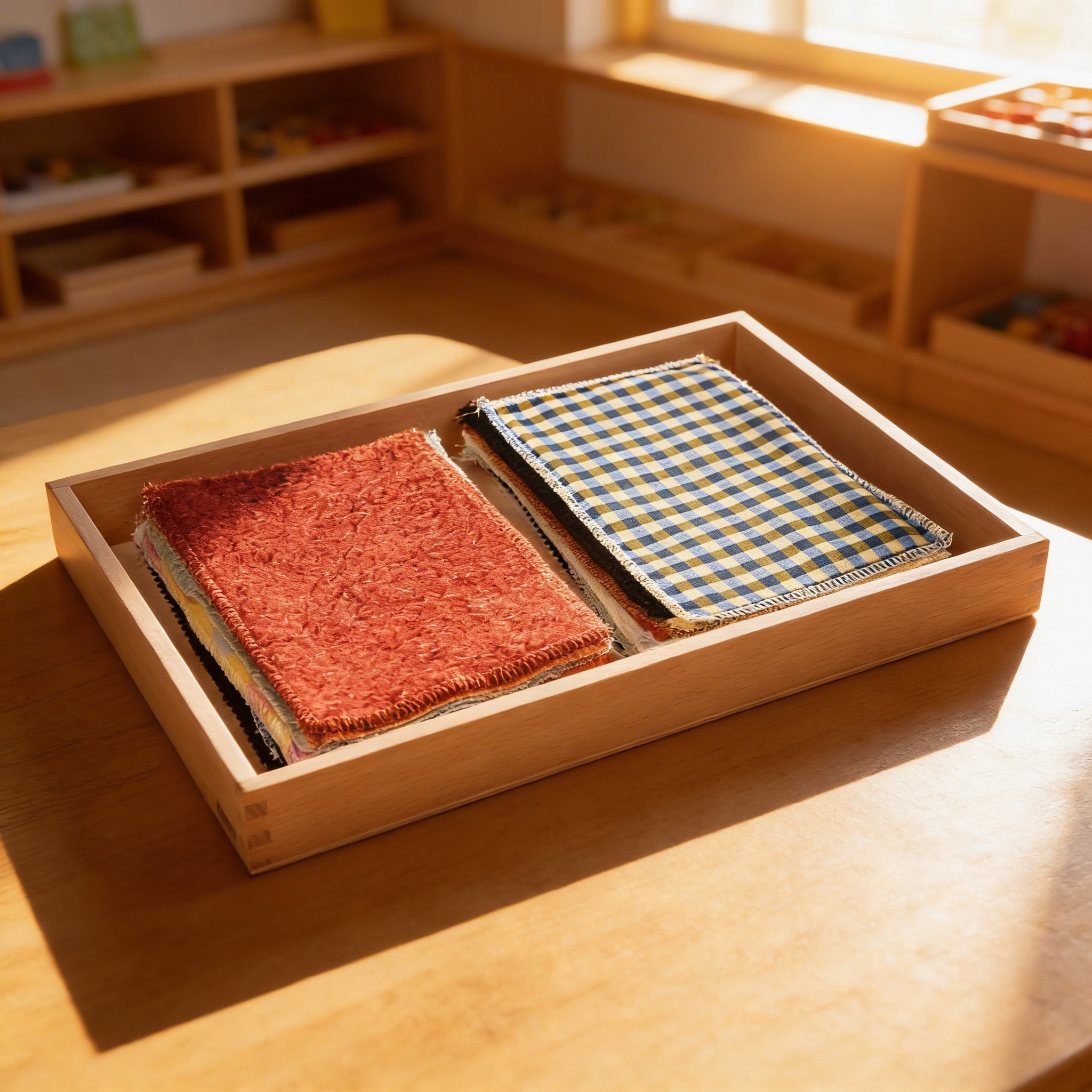
Each order includes everything needed for proper presentation and long-term use.
Follow the Montessori method of presentation for optimal child development.
Invite the child, saying 'I'd like to show you something.' Remove all fabric pieces from the tray
Select one fabric piece. Close your eyes and feel it slowly with your dominant hand's fingertips
Open your eyes, place the fabric to your left. Close eyes again and feel each remaining piece until finding its match
When you believe you've found the match, open eyes and place it next to the first piece
Continue until all pairs are matched. Invite the child to feel each pair to verify
Every material is carefully selected for durability, safety, and authentic Montessori experience.
The smooth wooden tray provides a defined workspace that helps children focus on the tactile experience while maintaining organization of the materials.
Each fabric is carefully selected to provide distinct tactile experiences, from smooth cotton to textured felt, supporting sensorial refinement.
Each material supports multiple areas of child development simultaneously.
Develops the ability to recognize objects through touch alone, a crucial skill for cognitive development.
Refines the sense of touch by distinguishing between subtle differences in texture, preparing for later academic work.
The focused matching activity builds sustained attention and careful observation skills.
Children develop visual discrimination by matching patterns and colors alongside tactile qualities.
Designed for child-sized hands
Professional tips from AMI-trained guides to maximize the educational value of this material.
“Present this material after the child has worked extensively with tactile tablets and shows readiness for more refined discrimination”
Regularly wash fabric pieces to maintain consistent textures and hygiene - store clean replacement sets
Observe whether children are truly using stereognostic sense or relying on visual memory of fabric patterns
Create a fabric book as an extension where children can mount and label different textures they've explored
Everything you need to know about this material.
The Fabric Box includes pairs of various textures such as smooth silk, rough burlap, soft velvet, checkered cotton, corduroy, linen, and other contrasting fabrics. Each texture is represented twice for matching exercises.
Children use their sense of touch without visual input by feeling fabrics behind their back or with closed eyes, then finding matching pairs. This isolation of the tactile sense strengthens their ability to recognize objects through touch alone, developing the stereognostic sense.
Start with 3-4 contrasting pairs, demonstrating gentle touching with fingertips. Progress to matching with eyes closed, then introduce more subtle texture differences. Finally, children can sort fabrics by properties or create texture gradations.
Store fabrics in the wooden tray away from direct sunlight. Spot clean with mild soap if needed, avoiding harsh chemicals that might alter textures. Replace worn swatches to maintain clear tactile differences. Check regularly that pairs remain matched.
Extensions include matching fabrics to objects in the environment, creating texture books, sorting by properties (rough/smooth), language enrichment with texture vocabulary, and combining with other sensorial materials like the Touch Boards for comparative work.
Can't find what you're looking for?
Contact Our Experts
Share your experience with this material and help other educators and parents.
Bundle related materials and save. Free curriculum guide included with every set.


