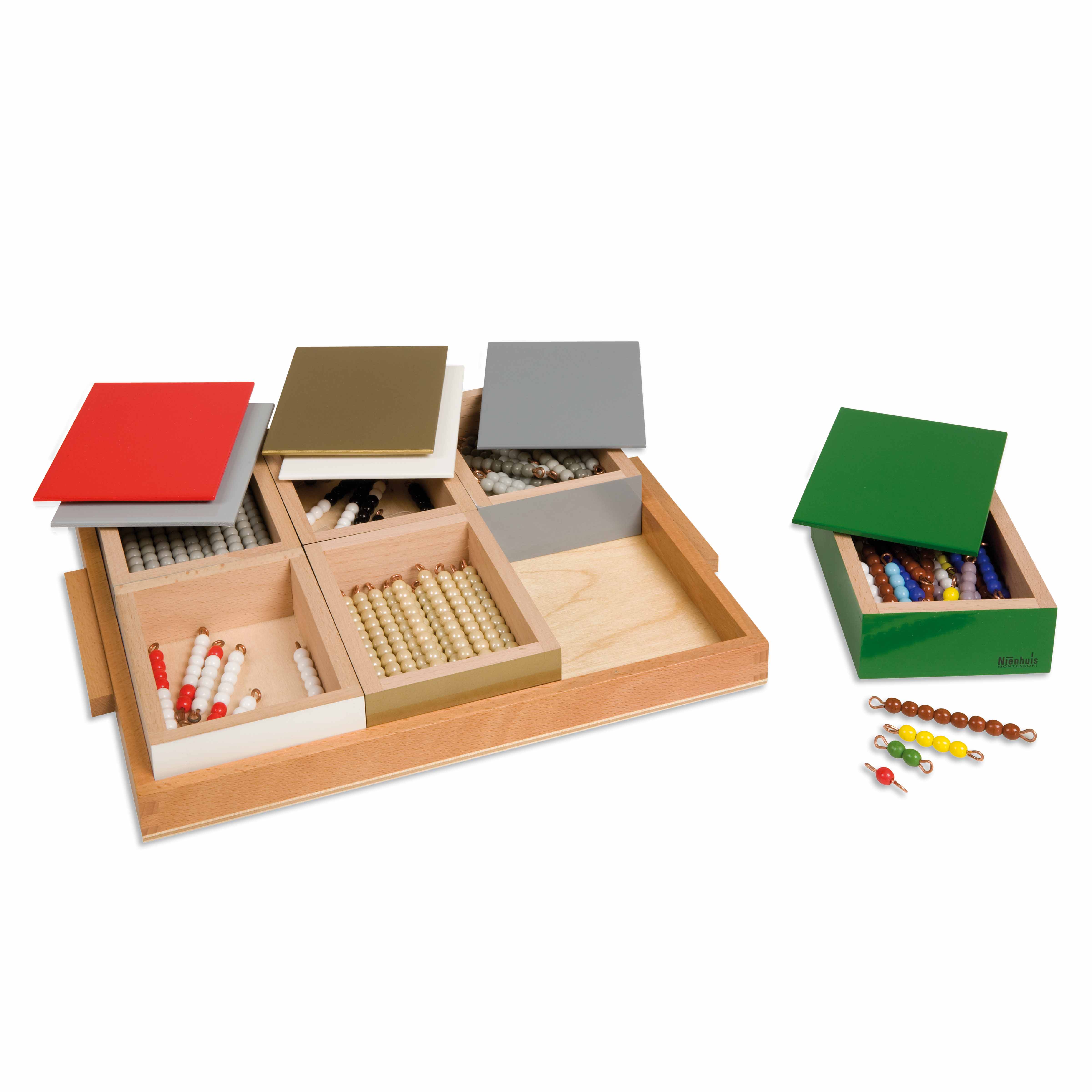
The Elementary Negative Snake Game: Individual Beads Glass is a Mathematics Montessori material designed for children aged 6-12, crafted by Nienhuis Montessori to AMI standards.
The Elementary Negative Snake Game with Individual Glass Beads introduces children to negative number operations through hands-on manipulation of color-coded bead bars. This advanced mathematics material features precision-crafted glass beads organized in painted wooden boxes, allowing students to physically explore subtraction and negative values while developing abstract mathematical thinking.
“Children display a universal love of mathematics, which is par excellence the science of precision, order, and intelligence.”— Maria MontessoriThe Discovery of the Child
“The greatest sign of success for a teacher is to be able to say, 'The children are now working as if I did not exist.'”
— Maria Montessori, The Absorbent Mind
The Elementary Negative Snake Game with its precision-crafted glass beads represents a pivotal moment in mathematical abstraction when children physically encounter quantities less than zero. Each color-coded glass bead bar in the painted wooden boxes provides tactile feedback as students arrange and exchange positive and negative values, transforming an abstract concept into concrete manipulation. The glass beads' weight and smooth texture offer sensory distinction between adding and subtracting quantities, while their transparent quality subtly suggests the 'emptiness' of negative values. Through arranging these glass bead bars into serpentine formations and systematically exchanging them, children discover that negative numbers follow predictable patterns just like positive ones. The Elementary Negative Snake Game bridges the gap between the concrete positive snake game of primary years and the abstract algebraic thinking required in upper elementary, allowing students to physically build equations that cross zero. This hands-on exploration with glass beads develops the mathematical imagination necessary for understanding integers, preparing children for algebra while maintaining the concrete-to-abstract progression fundamental to mathematical development.
Each order includes everything needed for proper presentation and long-term use.
Follow the Montessori method of presentation for optimal child development.
Create initial snake using positive colored bead bars in random sequence
Introduce negative (grey) bead bars, placing them after positive bars
Begin exchanging at the head of the snake, combining positive and negative values
When exchanges result in negative values, use black and white bead bars to represent them
Continue exchanges until reaching a final positive or negative sum
Verify the result by checking the original equation against the final bead configuration
Every material is carefully selected for durability, safety, and authentic Montessori experience.
Precision-made glass beads provide weight and substance that helps children internalize mathematical concepts through sensorial experience
Color-coded wooden boxes create visual organization that supports mathematical pattern recognition and systematic thinking
Each material supports multiple areas of child development simultaneously.
Bridges concrete manipulation to abstract understanding of negative numbers and subtraction operations
Develops systematic approach to complex mathematical problems through ordered bead exchange
Color-coding and physical manipulation provide immediate feedback for self-correction
Designed for child-sized hands
Professional tips from AMI-trained guides to maximize the educational value of this material.
“Introduce negative beads only after mastery of the positive snake game to ensure foundational understanding”
'taking away more than we have' when first introducing negative results
Allow extended exploration time - understanding negative numbers requires multiple concrete experiences
Connect to real-world examples like temperature below zero or owing money after mastering bead manipulation
Everything you need to know about this material.
The Elementary Negative Snake Game introduces negative numbers and subtraction concepts using grey/black beads to represent negative values, while the positive snake game focuses only on addition with colored beads. This material builds upon the positive snake game foundation to teach more advanced mathematical operations including subtraction and working with negative integers.
Glass beads provide superior durability, consistent weight, and a premium tactile experience that enhances the child's sensory learning. The precision-crafted glass beads maintain their color vibrancy over years of use and offer the authentic Montessori quality that supports focused concentration and careful manipulation during mathematical work.
Children learn subtraction, negative numbers, integer operations, and the relationship between positive and negative values. The material supports understanding of number lines, absolute value, additive inverse, and prepares students for algebra by providing concrete experience with abstract concepts like combining positive and negative quantities.
The painted wooden boxes contain color-coded glass bead bars organized by value: positive numbers use traditional Montessori colors (red for 1, green for 2, etc.) while negative numbers use grey or black beads. Each box compartment is clearly labeled, making it easy for children to select and return beads independently during their work.
While suitable for ages 6-12, most children begin using this material around age 7-8, after mastering positive snake game and basic addition facts. The child should be comfortable with the concept of subtraction and ready to explore what happens when we subtract more than we have, leading naturally into negative number understanding.
Can't find what you're looking for?
Contact Our Experts
Share your experience with this material and help other educators and parents.


