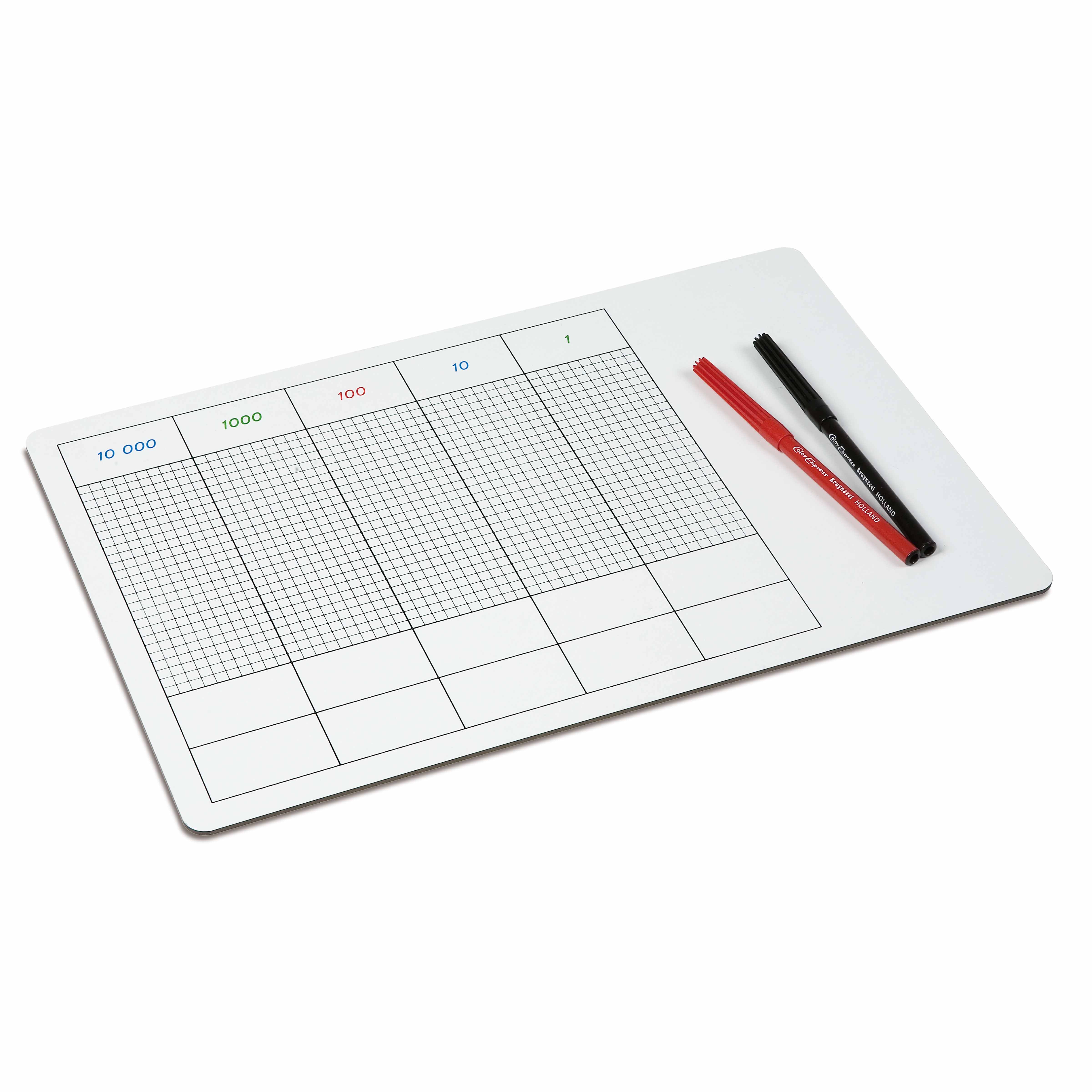
The Dot Exercise is a Educational Materials Montessori material designed for children aged 3-6, crafted by Nienhuis Montessori to AMI standards.
The Dot Exercise is a specialized mathematical learning board that introduces children to place value concepts through hands-on manipulation of quantities. This laminated grid system features clearly marked columns from units to ten thousands, allowing children to physically represent numbers using dots or markers while developing their understanding of the decimal system and mathematical operations.
“The child is both a hope and a promise for mankind.”— Maria MontessoriEducation and Peace
“The hands are the instruments of man's intelligence.”
— Maria Montessori, The Absorbent Mind
The Dot Exercise board transforms abstract mathematical concepts into tangible experiences by allowing children to physically place markers on laminated columns representing units through ten thousands. In Montessori mathematics, this laminated grid bridges the gap between concrete manipulation and abstract numerical understanding, addressing the developmental need for visual and tactile learning before symbolic representation. The Dot Exercise's column structure mirrors the decimal system's base-ten organization, enabling children to discover place value relationships through their own exploration with dots or markers. Each column on the laminated surface provides clear boundaries that help children internalize how quantities group and regroup in powers of ten. This mathematical board serves as a critical preparation for more complex operations, as children must first understand that the position of a digit determines its value within our number system. The Dot Exercise's design encourages repetition and self-correction, as children can easily clear the laminated surface and begin again, building confidence through practice.
Each order includes everything needed for proper presentation and long-term use.
Follow the Montessori method of presentation for optimal child development.
Introduce each column by placing exactly one marker, naming: 'one unit,' 'one ten,' 'one hundred'
Build the number 1,234 by placing 1 marker in thousands, 2 in hundreds, 3 in tens, 4 in units
Demonstrate exchanging: when 10 markers accumulate in units, remove them and place 1 marker in tens
Invite the child to build their own numbers, starting with 3-digit numbers before progressing
Each material supports multiple areas of child development simultaneously.
Children physically represent quantities in appropriate columns, building concrete understanding of units, tens, hundreds, and thousands.
Bridges the gap between concrete manipulatives and abstract number symbols through visual representation of quantities.
Precise dot placement within grid squares develops hand control and coordination essential for later writing.
Organized column structure teaches logical arrangement and systematic approach to mathematical operations.
Designed for child-sized hands
Professional tips from AMI-trained guides to maximize the educational value of this material.
“Keep dry erase markers away during initial presentations to maintain focus on quantity rather than symbols”
'exchange' not 'carry' or 'borrow' to describe regrouping
Allow children to discover the need for exchanging through their own marker placement
Store markers in a divided container with compartments matching the number of columns
Everything you need to know about this material.
The Dot Exercise teaches place value understanding, decimal system comprehension, number composition and decomposition, and foundational skills for addition, subtraction, multiplication, and division through visual representation of quantities from units to ten thousands.
Children place dots or markers in the appropriate columns (units, tens, hundreds, thousands, ten thousands) to represent numbers visually. They can compose large numbers, practice exchanging between place values, and perform mathematical operations by physically manipulating the dots.
The set includes a laminated grid board with clearly marked columns for place values from units to ten thousands. Additional dots or markers for representing quantities may need to be purchased separately or can be made using small counters or stickers.
While designed for ages 3-6, children should have basic number recognition (1-10) and counting skills before using this material effectively. It builds upon earlier Montessori math materials like number rods and sandpaper numbers.
Unlike abstract worksheets, the Dot Exercise provides concrete, hands-on manipulation of quantities. Children physically build numbers and see the relationship between place values, making abstract concepts tangible and supporting the Montessori principle of learning through movement and touch.
Can't find what you're looking for?
Contact Our Experts
Share your experience with this material and help other educators and parents.

