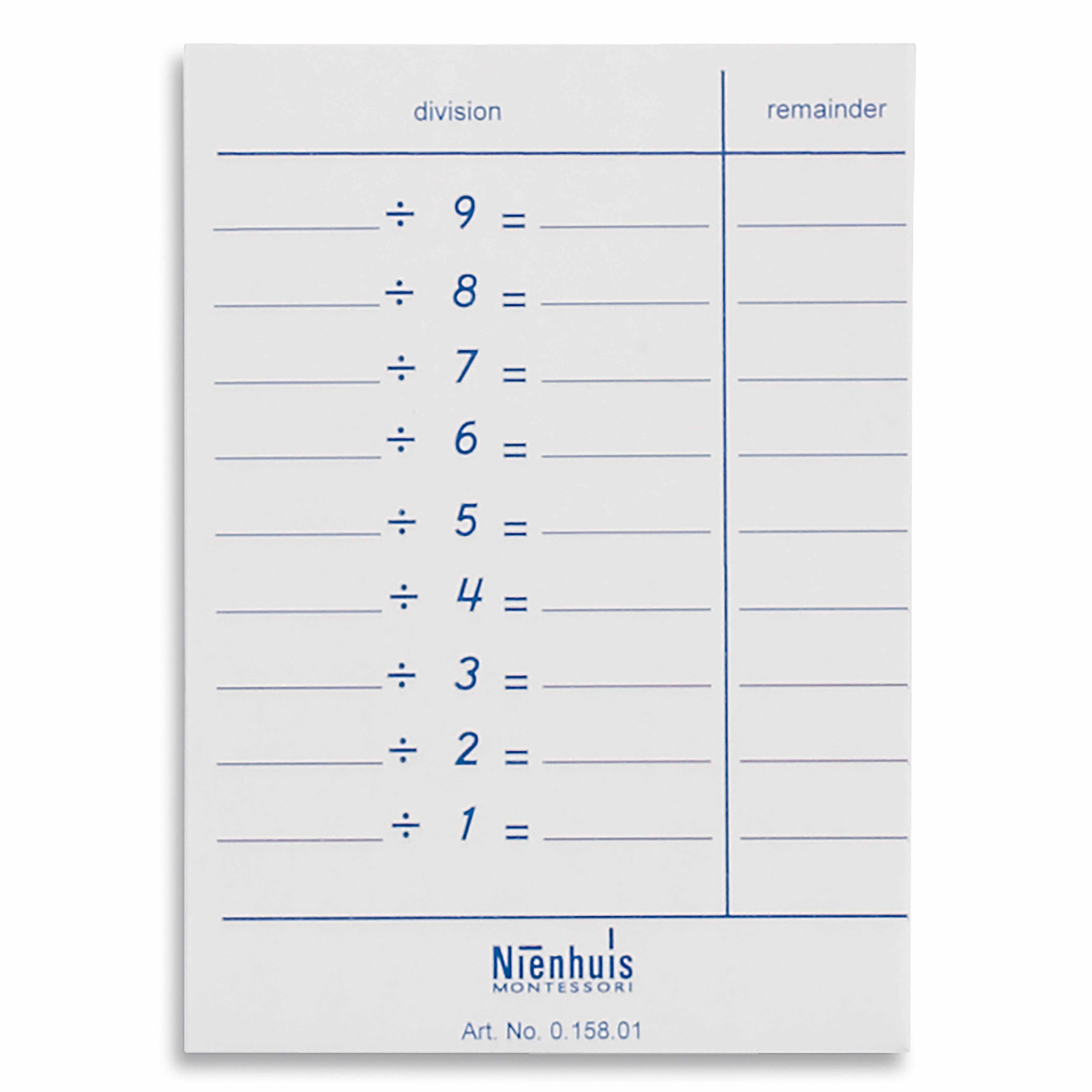
The Division Tables is a Furniture & Storage Montessori material designed for children aged 3-6, crafted by Nienhuis Montessori to AMI standards.
This Division Tables worksheet provides systematic practice for children mastering division concepts in the Montessori mathematics curriculum. The structured format presents division problems from 1 through 9, with dedicated spaces for recording both quotients and remainders, supporting the transition from concrete manipulative work to abstract mathematical thinking.
“The child is both a hope and a promise for mankind.”— Maria MontessoriEducation and Peace
“The hands are the instruments of man's intelligence.”
— Maria Montessori, The Absorbent Mind
The Division Tables worksheet serves as a crucial bridge between hands-on division work with beads or stamps and abstract mathematical recording. These paper-based tables present division problems from 1 through 9 in a systematic format that mirrors the logical progression children have experienced with concrete materials. The structured layout with dedicated spaces for quotients and remainders reflects the Montessori principle of isolating difficulty - children focus solely on recording their calculations without managing problem organization. Each division table builds upon the child's sensorial experiences with division boards and bead materials, allowing them to document patterns they've discovered through manipulation. The worksheet's clear presentation of dividends, divisors, and answer spaces provides the external order necessary for developing internal mathematical understanding. By working through these tables systematically, children internalize division facts while maintaining connection to the concrete experiences that gave these abstract symbols meaning.
Each order includes everything needed for proper presentation and long-term use.
Follow the Montessori method of presentation for optimal child development.
Begin with the table for dividing by 2, working from 2÷2 through 18÷2
Record the quotient in the designated space, writing any remainder separately
Complete one entire table before moving to the next divisor
Review completed work, checking calculations against concrete materials if uncertain
Each material supports multiple areas of child development simultaneously.
Bridges the gap between concrete division work with beads and abstract mathematical operations, supporting the natural progression of mathematical understanding.
Systematic presentation reveals mathematical patterns and relationships within division facts, deepening conceptual understanding.
Clear format enables self-directed work and self-correction, fostering mathematical confidence and autonomy.
Dedicated remainder spaces reinforce understanding that not all numbers divide evenly, preparing for more advanced division work.
Designed for child-sized hands
Professional tips from AMI-trained guides to maximize the educational value of this material.
“Introduce worksheets only after extensive concrete division work - premature abstraction hinders understanding”
Use completed tables as reference sheets during other mathematical work
Create a tracking system to monitor which division facts each child has mastered
Connect division tables to multiplication tables to reinforce inverse relationships
Everything you need to know about this material.
While categorized for ages 3-6, these tables are typically introduced around age 5-6, after children have mastered multiplication and have worked extensively with concrete division materials like the Division Board with beads.
These tables bridge concrete and abstract learning by providing structured practice that mirrors the Division Board work. Children record answers discovered through manipulative work, reinforcing the connection between physical and written mathematics.
No, follow the child's interest and concentration. Montessori practice emphasizes quality over quantity - children might work on one divisor per day or session, allowing for deep understanding rather than rushed completion.
The dedicated remainder spaces help children understand that division doesn't always result in whole numbers. This prepares them for fraction concepts and reinforces the complete division process learned with Montessori materials.
Children should have access to the Division Board with beads, colored bead bars, or stamp game for verification. These concrete materials allow self-correction and deeper understanding of the division process.
Can't find what you're looking for?
Contact Our Experts
Share your experience with this material and help other educators and parents.

