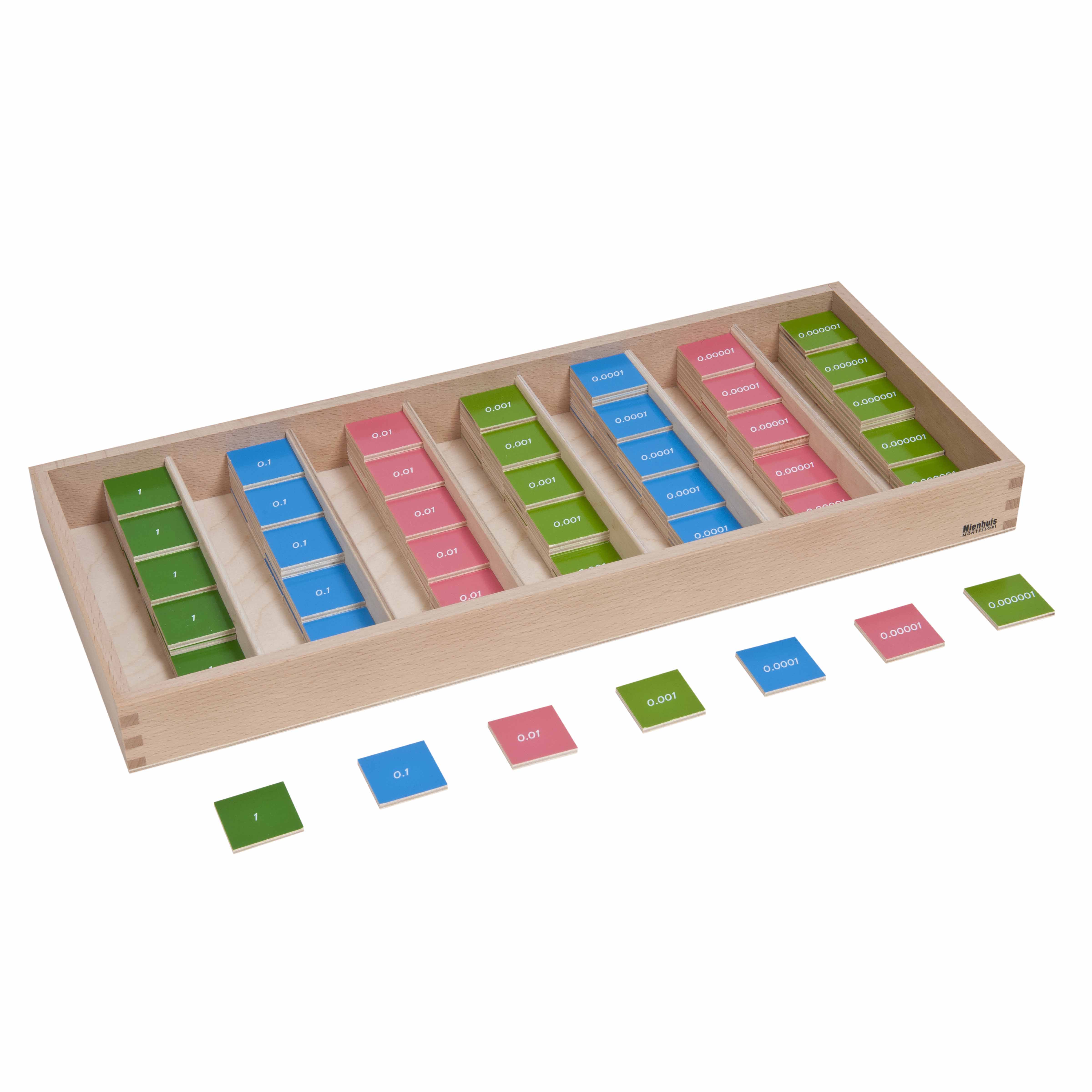
The Decimal Stamp Game is a Mathematics Montessori material designed for children aged 3-6, crafted by Nienhuis Montessori to AMI standards.
This Decimal Stamp Game introduces children to decimal place values through color-coded wooden tiles marked with powers of ten from units to millionths. The organized wooden tray with seven compartments supports systematic exploration of decimal operations, building upon the child's existing knowledge of whole numbers to understand fractional quantities with precision.
“Children display a universal love of mathematics, which is par excellence the science of precision, order, and intelligence.”— Maria MontessoriThe Discovery of the Child
“The greatest sign of success for a teacher is to be able to say, 'The children are now working as if I did not exist.'”
— Maria Montessori, The Absorbent Mind
The Decimal Stamp Game bridges the child's understanding from whole numbers to decimal fractions through its color-coded wooden tiles representing powers of ten. Each compartment in the seven-section wooden tray corresponds to a specific decimal place value, from units through millionths, providing concrete representation of abstract fractional quantities. The physical manipulation of these wooden tiles allows children to experience decimal relationships kinesthetically - moving ten thousandths tiles to exchange for one hundredth tile makes decimal conversion tangible. This material's systematic color-coding matches the traditional Montessori decimal system, enabling children who have mastered whole number operations to naturally extend their mathematical thinking into fractional territories. The Decimal Stamp Game transforms the abstraction of decimal notation into a sensorial experience where children can physically build, exchange, and operate with decimal quantities, preparing them for advanced mathematical concepts through concrete manipulation.
Each order includes everything needed for proper presentation and long-term use.
Follow the Montessori method of presentation for optimal child development.
Introduce decimal notation by building 3.5 using 3 unit tiles and 5 tenth tiles
Demonstrate exchanging 10 tenth tiles for 1 unit tile
Build larger decimals like 24.367 using appropriate tiles from each compartment
Practice addition: 3.4 + 2.7 by combining tiles and exchanging when necessary
Every material is carefully selected for durability, safety, and authentic Montessori experience.
The solid wooden tray and tiles provide durability and a pleasant tactile experience, connecting mathematical concepts with natural materials.
Each material supports multiple areas of child development simultaneously.
Builds concrete understanding of decimal place values through manipulative materials that make abstract concepts tangible.
Develops accuracy in working with fractional quantities and understanding the relationship between whole numbers and decimals.
Color-coding supports place value recognition and helps prevent errors in decimal operations.
Organized compartments encourage methodical approach to decimal calculations and place value exchanges.
Designed for child-sized hands
Professional tips from AMI-trained guides to maximize the educational value of this material.
“Ensure mastery of whole number stamp game before introducing decimals”
Begin with tenths and hundredths only, gradually introducing smaller place values
Use real-world examples like money (euros and cents) to connect to decimal concepts
Create a decimal point marker card to place between units and tenths
Everything you need to know about this material.
While the regular Stamp Game focuses on whole numbers (units, tens, hundreds, thousands), the Decimal Stamp Game extends learning to include decimal place values (tenths, hundredths, thousandths up to millionths). It uses the same color-coding system but adds compartments for fractional quantities, allowing children to explore numbers smaller than one.
The Decimal Stamp Game is typically introduced after children have mastered whole number operations with the regular Stamp Game, usually around ages 5-6. While the product indicates ages 3-6, most 3-year-olds would benefit from working with whole numbers first. The material grows with the child and can be used progressively as their understanding develops.
Children can explore decimal addition, subtraction, multiplication, and division using the color-coded tiles. The material helps them understand decimal place value, compare decimal quantities, and perform exchanges between decimal places. It provides a concrete, visual way to understand that decimals follow the same base-ten pattern as whole numbers.
The set includes wooden tiles for seven decimal place values: units, tenths, hundredths, thousandths, ten-thousandths, hundred-thousandths, and millionths. Each compartment contains multiple tiles to allow for various mathematical operations and exchanges. The exact quantity per compartment is designed to support typical classroom exercises.
Children should have experience with the regular Stamp Game for whole numbers, the Golden Bead Material for understanding place value, and ideally some work with fraction materials. Familiarity with the color-coding system (green for units, blue for tens, red for hundreds) is essential as this same pattern continues into the decimal places.
Can't find what you're looking for?
Contact Our Experts
Share your experience with this material and help other educators and parents.


