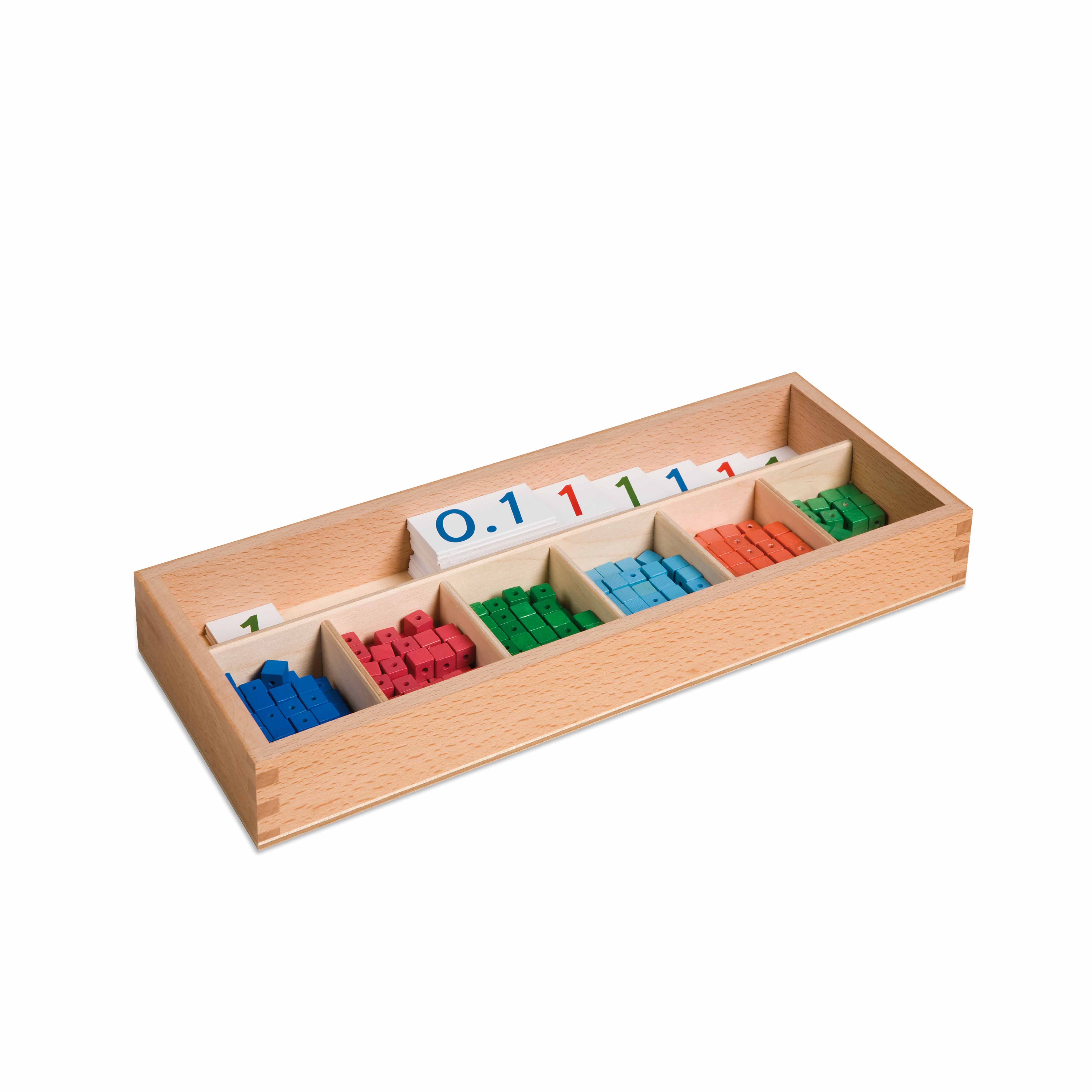
The Decimal Fraction Exercise is a Mathematics Montessori material designed for children aged 6-12, crafted by Nienhuis Montessori to AMI standards.
This Decimal Fraction Exercise provides a concrete, visual approach to understanding decimal place values through color-coded cubes and corresponding notation cards. The beechwood tray with five compartments organizes materials systematically, allowing children to physically manipulate decimal quantities while building connections between concrete representations and abstract decimal notation.
“Children display a universal love of mathematics, which is par excellence the science of precision, order, and intelligence.”— Maria MontessoriThe Discovery of the Child
“The greatest sign of success for a teacher is to be able to say, 'The children are now working as if I did not exist.'”
— Maria Montessori, The Absorbent Mind
The Decimal Fraction Exercise transforms the abstract concept of decimal place values into tangible experience through color-coded cubes that children can hold, count, and arrange. Each cube in the beechwood tray represents a specific decimal place value, allowing mathematical relationships to become visible and touchable. The exercise addresses the developmental need for concrete manipulation before abstraction, particularly crucial when children encounter decimals that represent quantities smaller than one. Through arranging these cubes and matching them with notation cards, children discover how our decimal system extends beyond whole numbers into fractional parts. The five compartments in the beechwood tray create a physical representation of place value positions, from units through ten-thousandths, making the systematic nature of decimals apparent. This material bridges the gap between the familiar golden bead material used for whole numbers and the abstract decimal notation children will encounter in advanced mathematics.
Each order includes everything needed for proper presentation and long-term use.
Follow the Montessori method of presentation for optimal child development.
Introduce each cube type by color and value, starting with the unit cube as reference
Build a decimal number using cubes, such as 2.354, by selecting appropriate quantities from each compartment
Match the concrete arrangement with corresponding notation cards below the cubes
Read the complete decimal number aloud while pointing to each position
Exchange cubes to show equivalencies, like trading 10 hundredths for 1 tenth
Each material supports multiple areas of child development simultaneously.
Children physically manipulate cubes to build concrete understanding of tenths, hundredths, thousandths, and ten-thousandths
Bridges the gap between concrete materials and abstract decimal notation through systematic color-coding
Encourages exact work with decimal fractions, building foundation for advanced mathematical operations
Color-coded system develops ability to distinguish and categorize different decimal place values
Designed for child-sized hands
Professional tips from AMI-trained guides to maximize the educational value of this material.
“Begin with decimals having fewer places (like 3.2) before introducing thousandths and ten-thousandths”
Create a reference chart showing each cube color with its decimal value for independent work
Use real-world contexts like money or measurements when introducing decimal concepts
Allow extensive manipulation time before expecting quick conversion to notation
Everything you need to know about this material.
The set includes a beechwood tray with five compartments, color-coded cubes representing different decimal place values (units, tenths, hundredths, thousandths, and ten-thousandths), and corresponding notation cards. Each decimal place value is represented by cubes in distinct colors to help children visually distinguish between different decimal positions.
Children physically manipulate the color-coded cubes to build decimal quantities, creating a concrete representation of abstract decimal concepts. By matching the cube arrangements with notation cards, they develop a deep understanding of place value in decimals and how each position represents a fraction of the whole.
The material is designed for ages 6-12 because it grows with the child's mathematical development. Younger children begin with simple decimal concepts like tenths, while older children explore complex operations with thousandths and ten-thousandths. The concrete manipulatives support learners at all levels within this range.
By providing hands-on experience with decimal place values, children develop a strong conceptual foundation for decimal operations, conversions between fractions and decimals, and percentage calculations. The visual and tactile experience creates lasting mental models that support abstract mathematical thinking in upper elementary and beyond.
Unlike traditional methods that rely on memorization, this material allows children to discover decimal relationships through manipulation and observation. The systematic color-coding and precise compartments in the beechwood tray enable self-directed learning and error correction, following key Montessori principles of concrete-to-abstract progression.
Can't find what you're looking for?
Contact Our Experts
Share your experience with this material and help other educators and parents.

