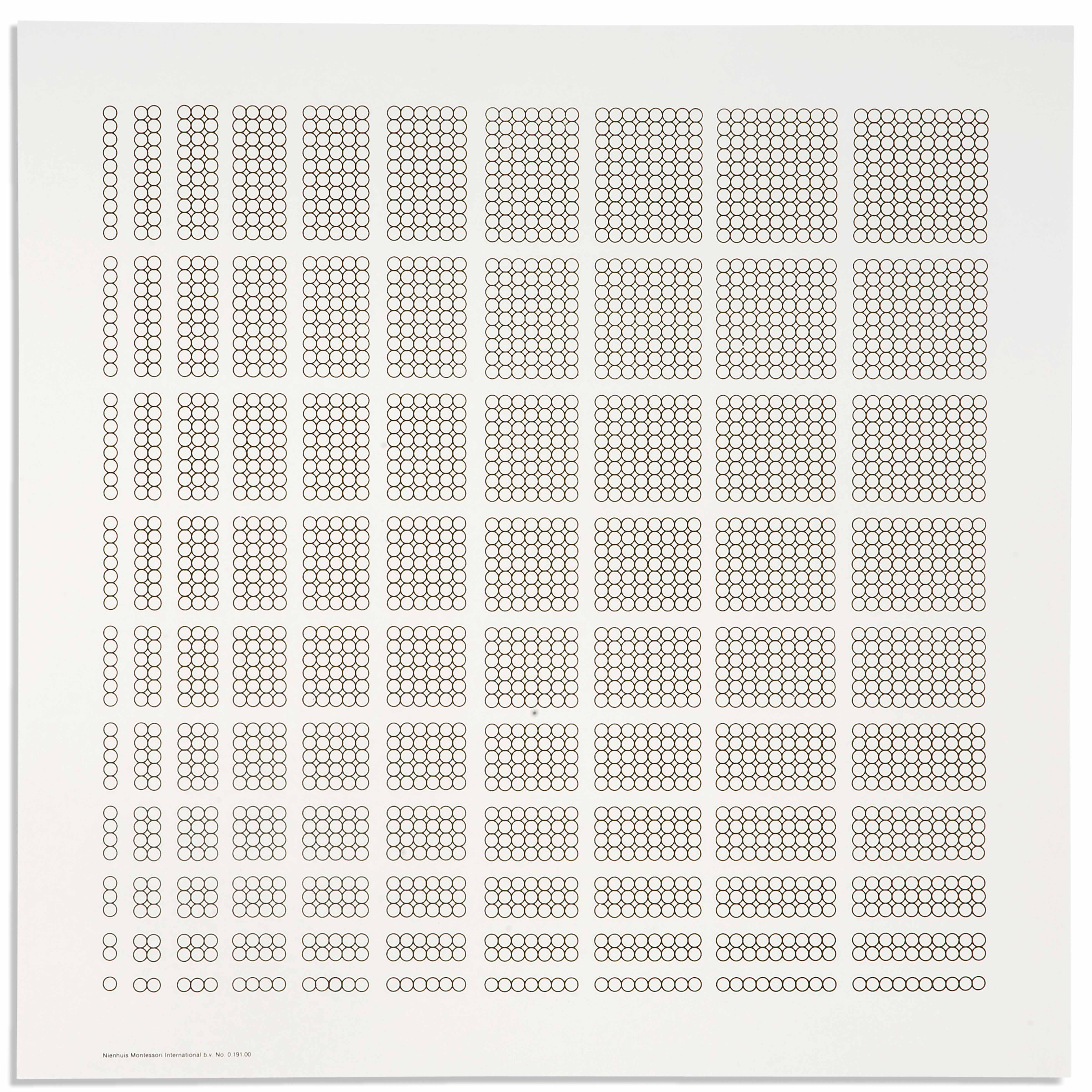
The Decanomial Paper is a Mathematics Montessori material designed for children aged 3-6, crafted by Nienhuis Montessori to AMI standards.
This Decanomial Paper provides essential work sheets for children exploring the algebraic representation of the decanomial square. Each sheet features progressive grid patterns with empty circles, allowing children to systematically mark and visualize the mathematical relationships from (a+b)² through (a+b+c+d+e+f+g+h+i+j)².
“Children display a universal love of mathematics, which is par excellence the science of precision, order, and intelligence.”— Maria MontessoriThe Discovery of the Child
“The greatest sign of success for a teacher is to be able to say, 'The children are now working as if I did not exist.'”
— Maria Montessori, The Absorbent Mind
Decanomial Paper transforms abstract algebraic concepts into concrete visual experiences through carefully designed grid patterns. Each sheet progresses from simple (a+b)² to complex (a+b+c+d+e+f+g+h+i+j)², allowing children to physically mark circles while discovering mathematical relationships. The paper worksheets serve as a bridge between manipulative bead materials and abstract algebraic thinking, respecting the child's need to work with their hands while building mathematical understanding. These progressive grids reveal patterns in squared binomials through organized visual representation. The empty circles on each sheet invite systematic exploration, letting children discover algebraic expansion through their own marking and counting work. By providing structured paper templates for recording mathematical discoveries, children internalize complex algebraic relationships through repeated sensorial experience with the decanomial square's patterns.
Each order includes everything needed for proper presentation and long-term use.
Follow the Montessori method of presentation for optimal child development.
Begin with the (a+b)² sheet, marking circles to represent a², 2ab, and b²
Progress to (a+b+c)², systematically filling circles for each term
Continue through increasingly complex sheets, observing emerging patterns
Compare completed sheets to identify mathematical relationships
Every material is carefully selected for durability, safety, and authentic Montessori experience.
Sourced from sustainably managed European forests. Beechwood is chosen for its exceptional durability, smooth grain, and natural warmth that invites touch.
Natural, unbleached cotton in child-friendly colors. The fabric provides the right amount of friction for developing fingers while being gentle on sensitive skin.
Water-based, child-safe finish that meets the strictest European safety standards. Designed to withstand years of daily use without chipping or peeling.
Each material supports multiple areas of child development simultaneously.
Bridges concrete bead work to abstract algebraic concepts through visual representation of mathematical patterns.
Develops understanding of squared expressions from binomial to decanomial through systematic exploration.
Enhances ability to identify and analyze mathematical relationships within progressive grid structures.
Provides structured format for documenting mathematical discoveries and algebraic expressions.
Designed for child-sized hands
Professional tips from AMI-trained guides to maximize the educational value of this material.
“Introduce sheets gradually, ensuring mastery of simpler expressions before advancing”
Keep completed sheets in portfolios to track mathematical development over time
Use sheets alongside bead materials for concrete-to-abstract connections
Allow children to work at their own pace through the progression
Everything you need to know about this material.
The Decanomial Paper is a set of specialized worksheets featuring progressive grid patterns with empty circles, designed to help children visualize and understand algebraic concepts through hands-on marking. Children use these sheets to explore mathematical relationships from simple binomial expressions (a+b)² up to complex decanomial expressions (a+b+c+d+e+f+g+h+i+j)², building a concrete foundation for abstract algebraic thinking.
While labeled for ages 3-6, the Decanomial Paper is typically introduced to children around ages 5-6 who have already worked extensively with sensorial materials like the binomial and trinomial cubes. Children should have experience with color coding, pattern recognition, and basic mathematical concepts before beginning this work. The material serves as a bridge between concrete manipulatives and abstract mathematical notation.
The Decanomial Paper directly extends work with the decanomial bead box and connects to earlier experiences with the binomial and trinomial cubes. It provides the paper-based representation of the physical decanomial square, allowing children to record their discoveries and recognize algebraic patterns. This material prepares children for later work with squaring, algebra, and advanced mathematical concepts in elementary years.
Children develop multiple skills including pattern recognition, algebraic thinking, systematic organization, and abstract reasoning. The progressive nature of the worksheets helps children understand how mathematical expressions expand and relate to each other. This work also enhances fine motor control through precise marking, concentration through complex pattern work, and logical thinking through discovering mathematical relationships.
The Decanomial Paper set includes multiple worksheets arranged progressively from simple to complex expressions. Starting with (a+b)² grids and advancing through to (a+b+c+d+e+f+g+h+i+j)², each sheet provides the appropriate grid pattern for children to mark and visualize the specific algebraic relationship. The empty circles on each grid allow children to color-code or mark patterns according to their work with physical materials.
Can't find what you're looking for?
Contact Our Experts
Share your experience with this material and help other educators and parents.


