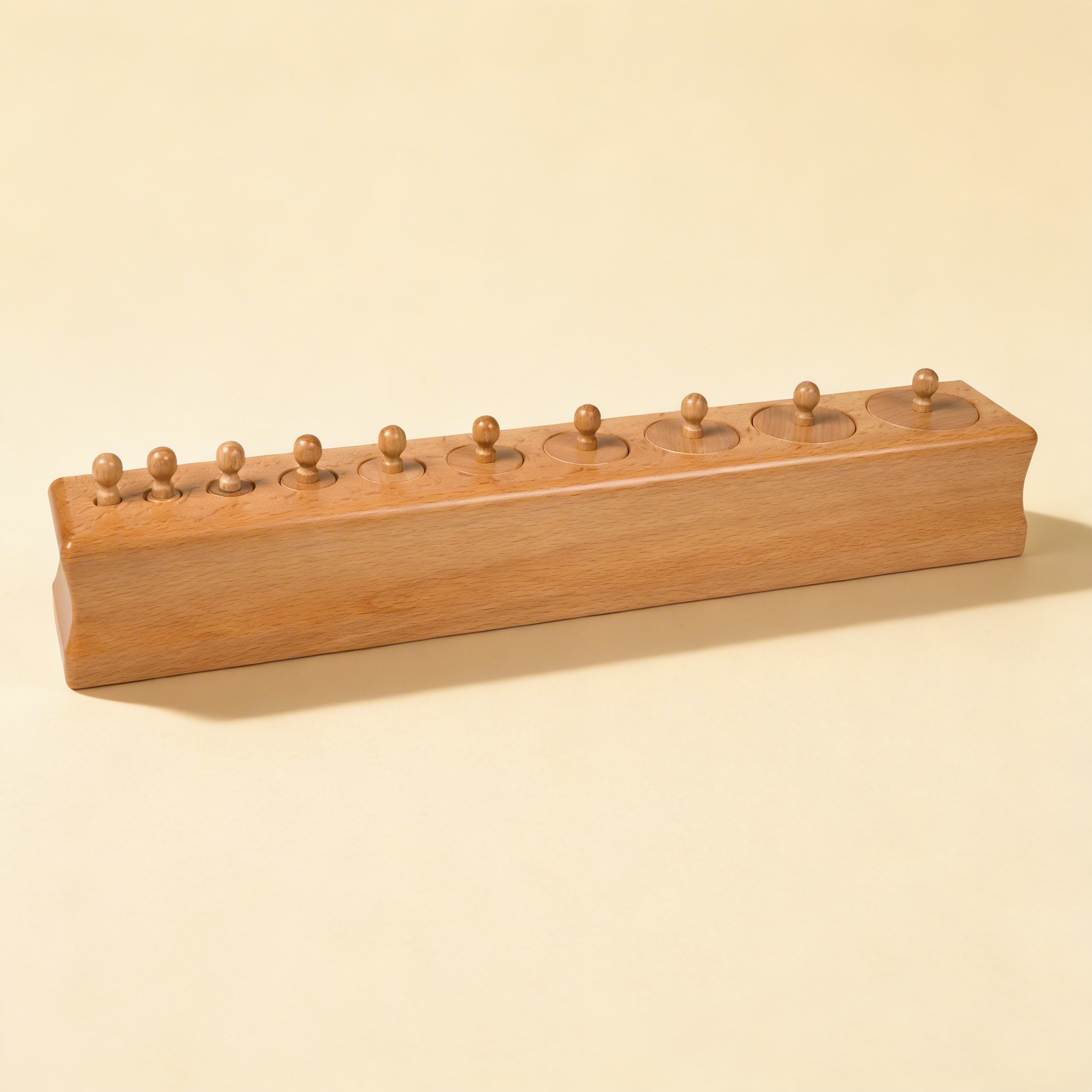
The Cylinder Block No. 3 — Decreasing Diameter Visual Discrimination is a Sensorial Montessori material designed for children aged 3-6, crafted by Nienhuis Montessori to AMI standards.
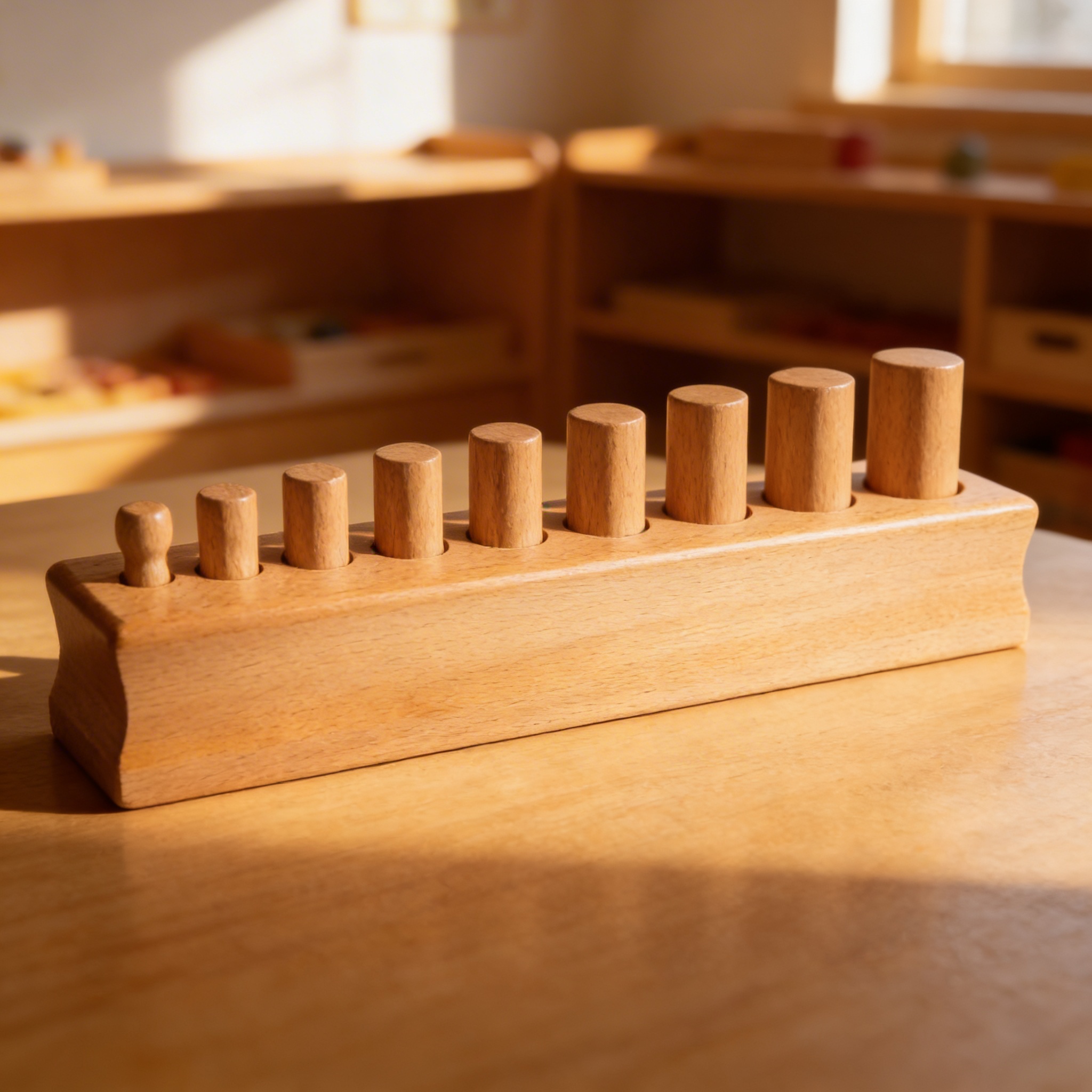
The Cylinder Block No. 3 features ten cylinders that decrease in diameter while maintaining the same height, developing the child's visual discrimination of dimension. This fundamental Sensorial material isolates the concept of diameter, allowing children to refine their perception through matching each cylinder to its corresponding socket. The smooth, polished finish and precisely calibrated gradations make this an essential tool for developing order, concentration, and preparation for mathematical concepts.
“The child is both a hope and a promise for mankind.”— Maria MontessoriEducation and Peace
“The hands are the instruments of man's intelligence.”
— Maria Montessori, The Absorbent Mind
The Cylinder Block No. 3 embodies Dr. Montessori's principle of isolation of difficulty by presenting only one varying dimension—diameter—while height remains constant. This material serves as a key to the child's mathematical mind, offering concrete experiences with seriation and gradation. Through repeated manipulation, the child develops visual discrimination and muscular memory of dimensional differences. The material's self-correcting nature allows children to work independently, building concentration and order while preparing the hand for writing through the pincer grip. As part of the essential Sensorial curriculum, this block provides the foundation for understanding mathematical relationships and develops the child's ability to make fine visual distinctions that will later support geometric understanding.
Each order includes everything needed for proper presentation and long-term use.
Follow the Montessori method of presentation for optimal child development.
Remove cylinders one by one using thumb and two fingers, placing them randomly on the mat
Select the thickest cylinder and find its socket by visual inspection, then test the fit
Continue matching cylinders to sockets, working from extremes (thickest/thinnest) toward the middle
When complete, remove and replace cylinders one by one to verify correct placement
Every material is carefully selected for durability, safety, and authentic Montessori experience.
Crafted from solid hardwood for durability and precise calibration, ensuring cylinders fit perfectly in their sockets for years of classroom use.
Each material supports multiple areas of child development simultaneously.
Isolates the concept of diameter, training the eye to perceive subtle differences in dimension.
Develops understanding of gradation and seriation, fundamental for mathematical thinking.
Knobbed cylinders develop pincer grip essential for writing preparation.
Self-correcting design allows independent discovery and builds confidence in judgment.
Designed for child-sized hands
Professional tips from AMI-trained guides to maximize the educational value of this material.
“Present this material only after the child has mastered Practical Life exercises requiring pincer grip”
Observe without correcting—the material itself provides feedback through the child's inability to fit cylinders incorrectly
Note which cylinders cause difficulty to understand the child's visual discrimination development
Use minimal language during presentation, allowing the material to speak through the child's senses
Everything you need to know about this material.
Cylinder Block No. 3 uniquely features cylinders that decrease in diameter while maintaining the same height. This isolates the concept of diameter/width, whereas Block No. 1 varies in both diameter and height, Block No. 2 varies in diameter with increasing height, and Block No. 4 varies only in height.
The cylinder block develops visual discrimination, seriation skills, and understanding of gradation - all foundational for mathematical concepts. Children learn to order by size, recognize patterns, and develop the hand-eye coordination needed for writing numbers. The one-to-one correspondence between cylinders and sockets also introduces early counting concepts.
First, demonstrate removing all cylinders and placing them randomly on the mat. Then, visually compare cylinders to find the correct socket for each, starting with extremes (largest/smallest). Use a three-finger grip to develop pencil grasp. The child should work independently, self-correcting through trial and error.
Yes, once children master individual blocks, they can combine two, three, or all four blocks as an extension activity. This creates more complex discrimination challenges and helps children discover relationships between the different dimensional variations across all blocks.
The polished finish serves multiple purposes: it provides sensorial feedback through touch, encourages careful handling, allows cylinders to fit precisely without friction, and maintains the material's durability. The aesthetic quality also attracts children and shows respect for their work.
Can't find what you're looking for?
Contact Our Experts
Share your experience with this material and help other educators and parents.
Bundle related materials and save. Free curriculum guide included with every set.


