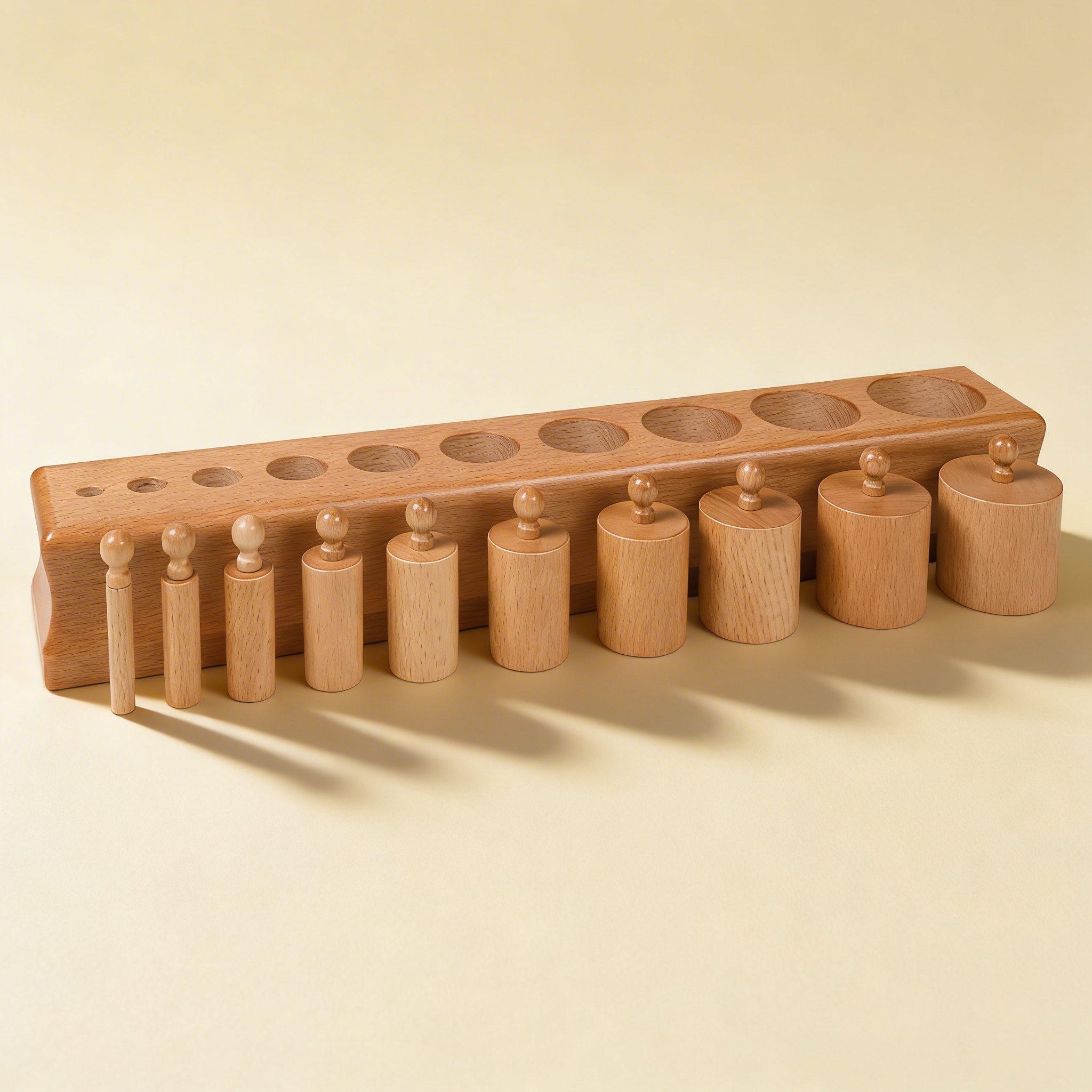
The Cylinder Block No. 2 — Varying Diameter, Constant Height is a Sensorial Montessori material designed for children aged 3-6, crafted by Nienhuis Montessori to AMI standards.
The Cylinder Block No. 2 is a fundamental Montessori sensorial material featuring cylinders that vary in diameter while maintaining constant height. This precision-crafted wooden block develops visual discrimination, fine motor control, and preparation for mathematical concepts through hands-on exploration of dimensional relationships.
“Children display a universal love of mathematics, which is par excellence the science of precision, order, and intelligence.”— Maria MontessoriThe Discovery of the Child
“The greatest sign of success for a teacher is to be able to say, 'The children are now working as if I did not exist.'”
— Maria Montessori, The Absorbent Mind
The Cylinder Block No. 2 embodies Montessori's principle of isolating difficulty by presenting only one varying dimension—diameter—while height remains constant. This material respects the child's sensitive period for order and refinement of the senses, particularly visual discrimination. Through repeated manipulation of the cylinders, children develop what Dr. Montessori called the 'mathematical mind,' unconsciously absorbing concepts of gradation and dimension. The material's self-correcting nature allows children to work independently, building concentration and confidence. The precise fitting of cylinders into their corresponding sockets provides immediate feedback, eliminating the need for adult correction and preserving the child's dignity. This work prepares the hand for writing through the three-finger grip used to grasp the knobs, while simultaneously developing visual perception essential for later mathematical work with dimensions and measurements.
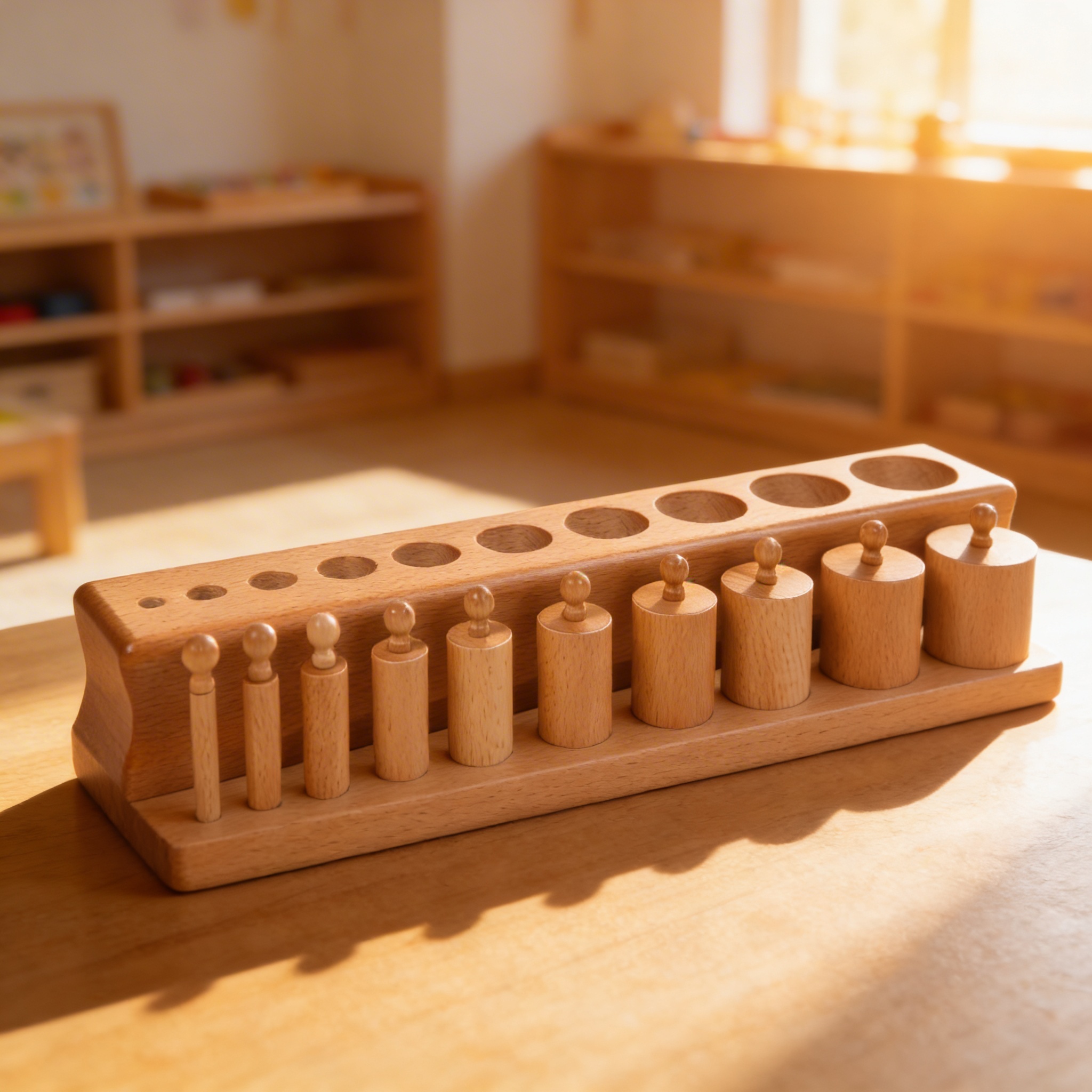
Each order includes everything needed for proper presentation and long-term use.
Follow the Montessori method of presentation for optimal child development.
Using thumb, index, and middle finger, grasp the knob of the thickest cylinder and slowly remove it
Place the cylinder in front of its socket, continuing left to right until all cylinders are removed
Pause and visually scan the empty sockets and cylinders
Select the thickest cylinder and slowly return it to its socket, feeling for the perfect fit
Continue replacing cylinders one at a time, using visual and tactile discrimination
Every material is carefully selected for durability, safety, and authentic Montessori experience.
Selected for durability and smooth finish, allowing children to focus on the sensorial experience without distraction from rough surfaces or splinters.
Each material supports multiple areas of child development simultaneously.
Children develop the ability to perceive subtle differences in diameter through careful observation and matching.
The knobbed cylinders promote pincer grip development, essential for later writing skills.
Concrete experience with gradation and dimension prepares the mind for abstract mathematical concepts.
The precise nature of the work requires sustained attention and develops the child's capacity for focused work.
Designed for child-sized hands
Professional tips from AMI-trained guides to maximize the educational value of this material.
“Present this after Cylinder Block No. 1 when the child shows readiness for more refined discrimination”
Observe without intervening—errors are part of the learning process and self-correction builds independence
Note which cylinders cause difficulty; this indicates the child's current level of visual discrimination development
Store at eye level on the sensorial shelf, arranged in order with other cylinder blocks
Everything you need to know about this material.
Cylinder Block No. 2 features cylinders that vary only in diameter while maintaining the same height. This isolates the concept of width/diameter, allowing children to focus on one dimensional change at a time, following Montessori's principle of isolation of difficulty.
This material develops visual discrimination of size, fine motor control through the pincer grip, hand-eye coordination, concentration, and order. It also indirectly prepares children for mathematical concepts like seriation, gradation, and dimensional relationships.
Children typically begin working with cylinder blocks around age 3 to 3.5 years, once they've developed adequate fine motor control. The material remains engaging through age 6 as children refine their perception and often combine it with other cylinder blocks for extension activities.
The material has built-in control of error - each cylinder fits perfectly in only one socket. If a cylinder is placed incorrectly, subsequent cylinders won't fit properly, prompting the child to problem-solve and find the correct arrangement independently.
Extensions include working with multiple cylinder blocks simultaneously, matching cylinders without the block, grading cylinders from thick to thin, tracing cylinders for pre-writing practice, and combining with red rods or pink tower for dimensional comparisons.
Can't find what you're looking for?
Contact Our Experts
Share your experience with this material and help other educators and parents.
Bundle related materials and save. Free curriculum guide included with every set.


