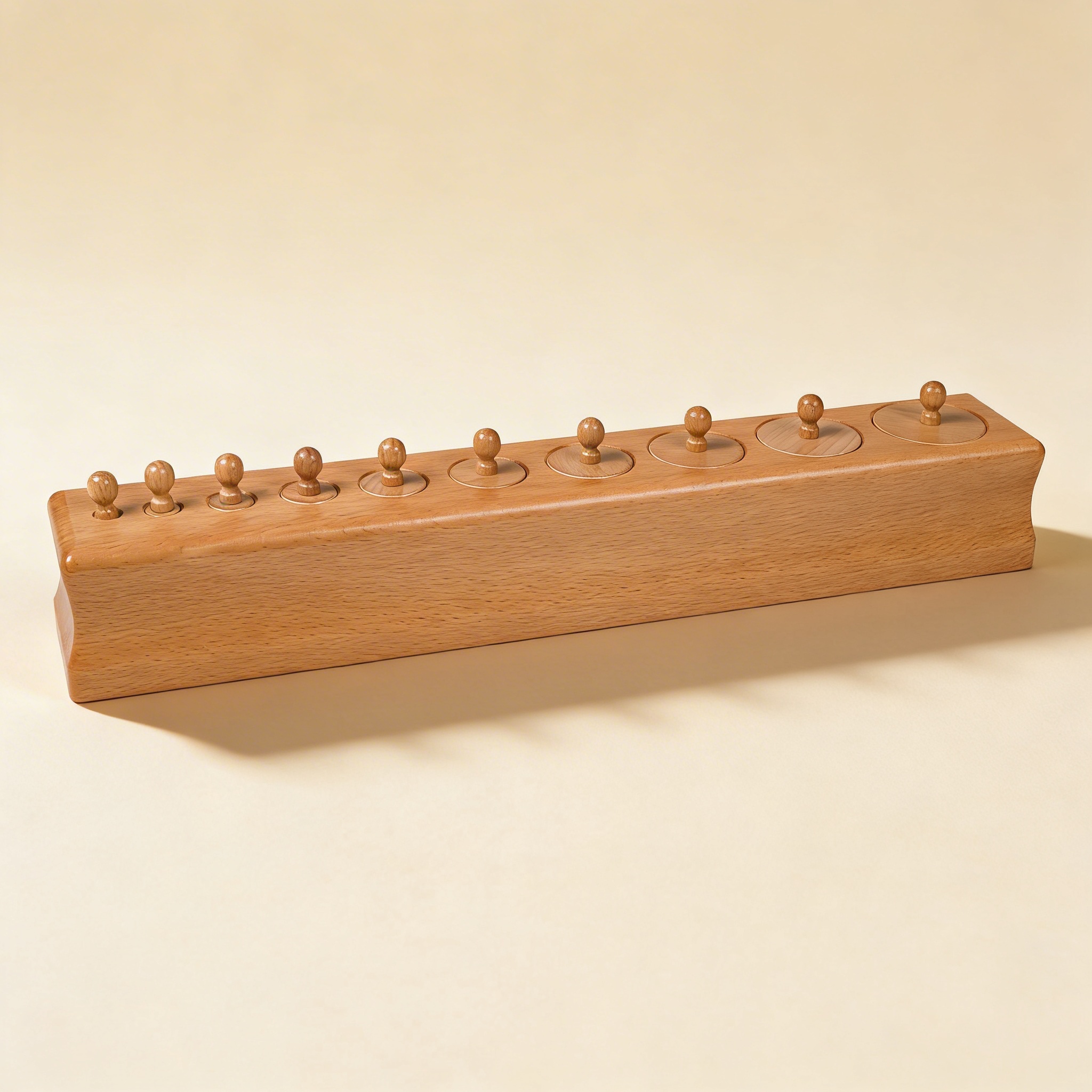
The Cylinder Block No. 1 — Varying Diameter, Constant Height is a Sensorial Montessori material designed for children aged 3-6, crafted by Nienhuis Montessori to AMI standards.
The Cylinder Block No. 1 introduces dimensional variations through cylinders that differ in diameter while maintaining constant height. This fundamental Sensorial material develops visual discrimination, fine motor control, and prepares the hand for writing through the precise three-finger grip of the cylinder knobs. Part of the classic Montessori cylinder block series, it isolates the concept of thickness for focused exploration.
“The hands are the instruments of man's intelligence.”— Maria MontessoriThe Absorbent Mind
“The senses, being explorers of the world, open the way to knowledge.”
— Maria Montessori, The Discovery of the Child
The Cylinder Block No. 1 embodies Maria Montessori's principle of isolation of difficulty by presenting only one variable—diameter—while height remains constant. This material represents the child's first encounter with dimensional discrimination in the Sensorial curriculum, offering concrete experiences that build the foundation for mathematical thinking. Through repeated manipulation of these cylinders, children develop what Montessori called the 'muscular memory' of dimension, while simultaneously refining their pincer grasp essential for writing. The material's self-correcting nature honors the child's inner teacher, as each cylinder fits perfectly in only one socket, allowing for immediate feedback without adult intervention. This fosters independence and builds the child's confidence in their own judgment, while the aesthetic precision of the material calls to the child's natural sense of order during the sensitive period for refinement of the senses.
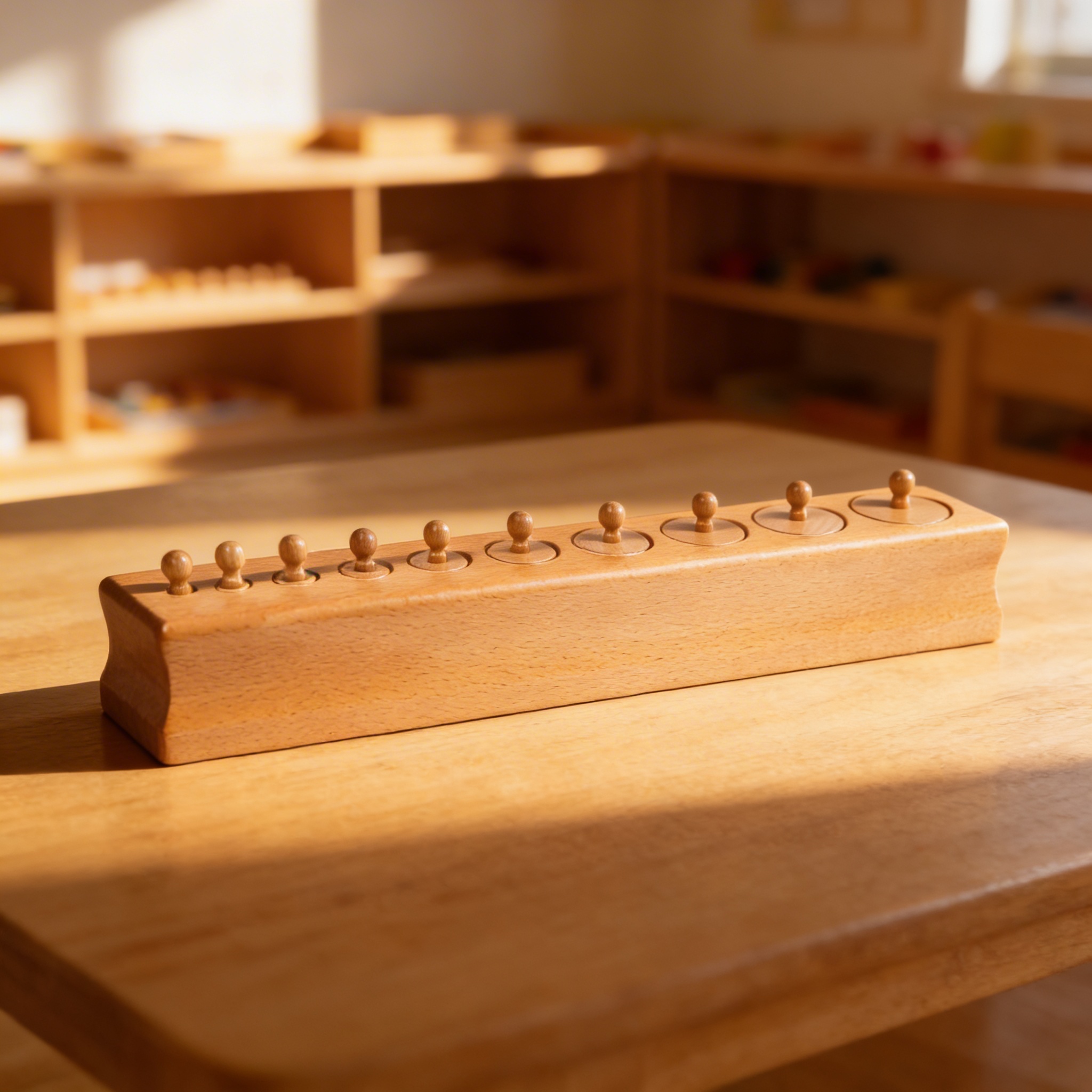
Each order includes everything needed for proper presentation and long-term use.
Follow the Montessori method of presentation for optimal child development.
Using your dominant hand, grasp the knob of the thickest cylinder with three fingers (thumb, index, middle). Lift it slowly and deliberately from its socket.
Place the cylinder gently on the mat in front of the block. Continue removing all cylinders one by one, mixing their order on the mat.
Select one cylinder, lift it carefully, and hover it over each socket until finding where it fits perfectly. Lower it slowly into place.
Continue replacing cylinders one by one. If a cylinder doesn't fit, try another socket without forcing it.
When all cylinders are replaced, run your finger along the tops to check they're flush with the block surface.
Every material is carefully selected for durability, safety, and authentic Montessori experience.
Selected for its fine grain and durability, beech wood provides the perfect weight and smooth texture for sensorial exploration while developing proper pencil grip.
Each material supports multiple areas of child development simultaneously.
Develops the ability to perceive subtle differences in dimension through systematic comparison of cylinder diameters.
The knobbed cylinders strengthen the three-finger grip essential for writing, while precise placement refines hand-eye coordination.
Introduces concepts of gradation, seriation, and dimensional relationships that prepare for later mathematical understanding.
The self-correcting nature of the material encourages focused attention and systematic problem-solving skills.
Designed for child-sized hands
Professional tips from AMI-trained guides to maximize the educational value of this material.
“Present this material only when the child shows readiness through successful work with practical life activities requiring finger control”
Observe without correcting—let the cylinders teach through their perfect fit or misfit in the sockets
Note which cylinders the child struggles with most; this reveals their current level of visual discrimination
Store at eye level on the sensorial shelf, always in the same location to support the child's sense of order
Everything you need to know about this material.
Cylinder Block No. 1 specifically isolates the concept of diameter/thickness. All cylinders have the same height but vary in diameter from thin to thick. This isolation of a single variable helps children focus on one dimensional change at a time, following Montessori's principle of isolating difficulty.
The small knobs on each cylinder require children to use the three-finger grip (thumb, index, and middle finger) - the same grip used for holding a pencil. Repeatedly grasping and placing the cylinders strengthens these fingers and develops the fine motor control essential for writing.
Children develop visual discrimination of size, hand-eye coordination, concentration, problem-solving skills, and order. They also build vocabulary (thick/thin, thicker/thinner, thickest/thinnest) and learn to make careful observations and self-correct their work.
While Cylinder Block No. 1 is valuable on its own for introducing diameter variation, it's traditionally part of a four-block series. Each block isolates different dimensions. Using all four blocks allows children to explore relationships between diameter and height in increasingly complex ways.
Most children are ready for Cylinder Block No. 1 around age 3-3.5, when they have developed sufficient hand control and can concentrate for short periods. It's typically one of the first Sensorial materials introduced, as it provides concrete, manipulative learning that matches young children's developmental needs.
Can't find what you're looking for?
Contact Our Experts
Share your experience with this material and help other educators and parents.
Bundle related materials and save. Free curriculum guide included with every set.


