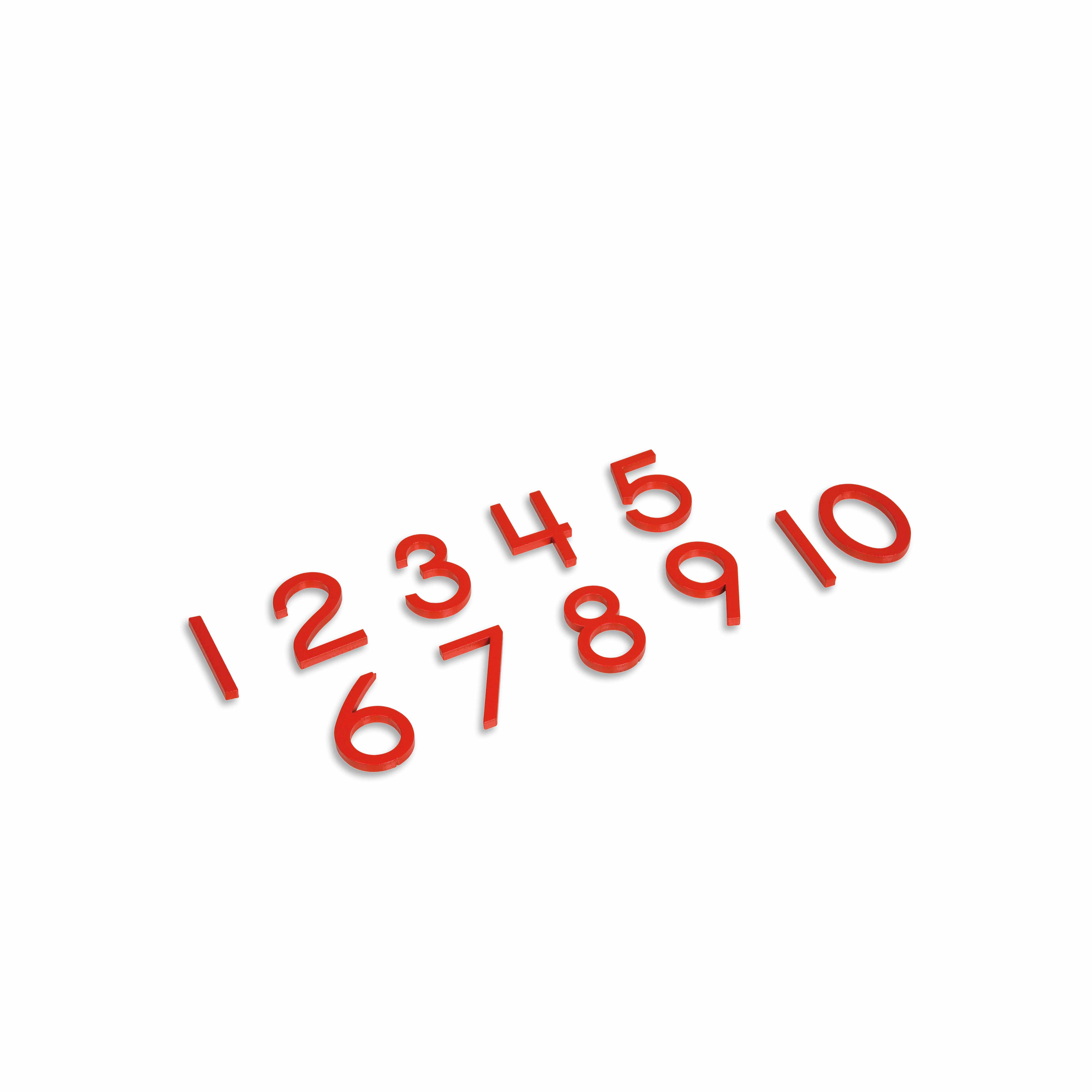
The Cut-Out Numerals: US Version is a Educational Materials Montessori material designed for children aged 3-6, crafted by Nienhuis Montessori to AMI standards.
These Cut-Out Numerals provide a tactile introduction to numbers 1-10, featuring raised acrylic forms that children can trace with their fingers to develop muscle memory for number formation. The uniform red color and clean sans-serif design help isolate the concept of numerical symbols, supporting the Montessori principle of presenting one concept at a time for clear understanding.
“The child is both a hope and a promise for mankind.”— Maria MontessoriEducation and Peace
“The hands are the instruments of man's intelligence.”
— Maria Montessori, The Absorbent Mind
The Cut-Out Numerals address the child's need to understand quantity through symbolic representation, introducing numbers 1-10 as distinct acrylic forms. Each raised numeral invites finger tracing, connecting the abstract concept of number to physical movement and sensory experience. The uniform red color of these numerals eliminates visual distraction, allowing complete focus on the shape and formation of each digit. Unlike traditional flat number cards, these cut-out forms provide depth and dimension that fingers naturally follow, building the precise motor patterns needed for later numeral writing. The clean sans-serif design presents numbers in their essential form, free from decorative elements that might confuse beginning learners. By isolating numerical symbols from quantity, these acrylic numerals prepare children to recognize that '5' represents five objects, whether stones, beads, or fingers. This material bridges the gap between concrete counting materials and abstract mathematical symbols, serving as a crucial link in the child's mathematical development.
Each order includes everything needed for proper presentation and long-term use.
Follow the Montessori method of presentation for optimal child development.
Introduce numerals 1, 2, and 3 using the three-period lesson. Hold each numeral, trace it slowly with two fingers while naming it: 'This is one.'
Invite the child to trace each introduced numeral while saying its name. Watch for correct finger positioning and tracing direction.
Mix the three numerals and ask the child to identify each one: 'Can you show me two?' Then 'Can you trace two?'
Once comfortable with 1-3, gradually introduce remaining numerals in small groups (4-6, then 7-9, finally 0 and 10).
Each material supports multiple areas of child development simultaneously.
Clear, isolated numerals help children associate symbols with quantities and develop visual discrimination of number forms.
Tracing raised edges with fingers prepares hand muscles for writing and establishes correct number formation patterns.
Concrete manipulation of number symbols bridges the gap between quantity concepts and abstract numerical representation.
Tactile exploration through touch reinforces visual learning, creating multiple pathways for number comprehension.
Designed for child-sized hands
Professional tips from AMI-trained guides to maximize the educational value of this material.
“Store numerals in sequential order so children can self-check their work and maintain the material independently”
Observe which numerals children confuse (often 6 and 9) and provide targeted practice with just those forms
Create a number line on the floor using these numerals for whole-body learning through movement games
always trace before naming to establish the sensory impression first
Everything you need to know about this material.
The US version follows American numeral formation standards, particularly for numbers 1, 4, and 7, which may have different stroke patterns compared to European versions. This ensures consistency with US educational materials and handwriting curricula.
Children trace the raised acrylic numerals with their index and middle fingers, following the correct formation pattern. This tactile experience builds muscle memory before writing. They can also match numerals to quantity cards, sequence numbers, or use them for sandpaper numeral extensions.
The uniform red color follows Montessori's principle of isolation of difficulty. By keeping all numerals the same color, children focus solely on the shape and form of each number without color distractions, allowing for clearer concept absorption.
The numerals are made from durable acrylic with a raised surface, typically measuring 3-4 inches in height. The smooth, raised edges provide clear tactile feedback while being safe for small hands to trace repeatedly.
Yes, these numerals integrate perfectly with number rods, spindle boxes, cards and counters, and golden bead materials. They serve as a bridge between concrete quantity work and abstract symbol recognition, supporting the complete Montessori math sequence.
Can't find what you're looking for?
Contact Our Experts
Share your experience with this material and help other educators and parents.

