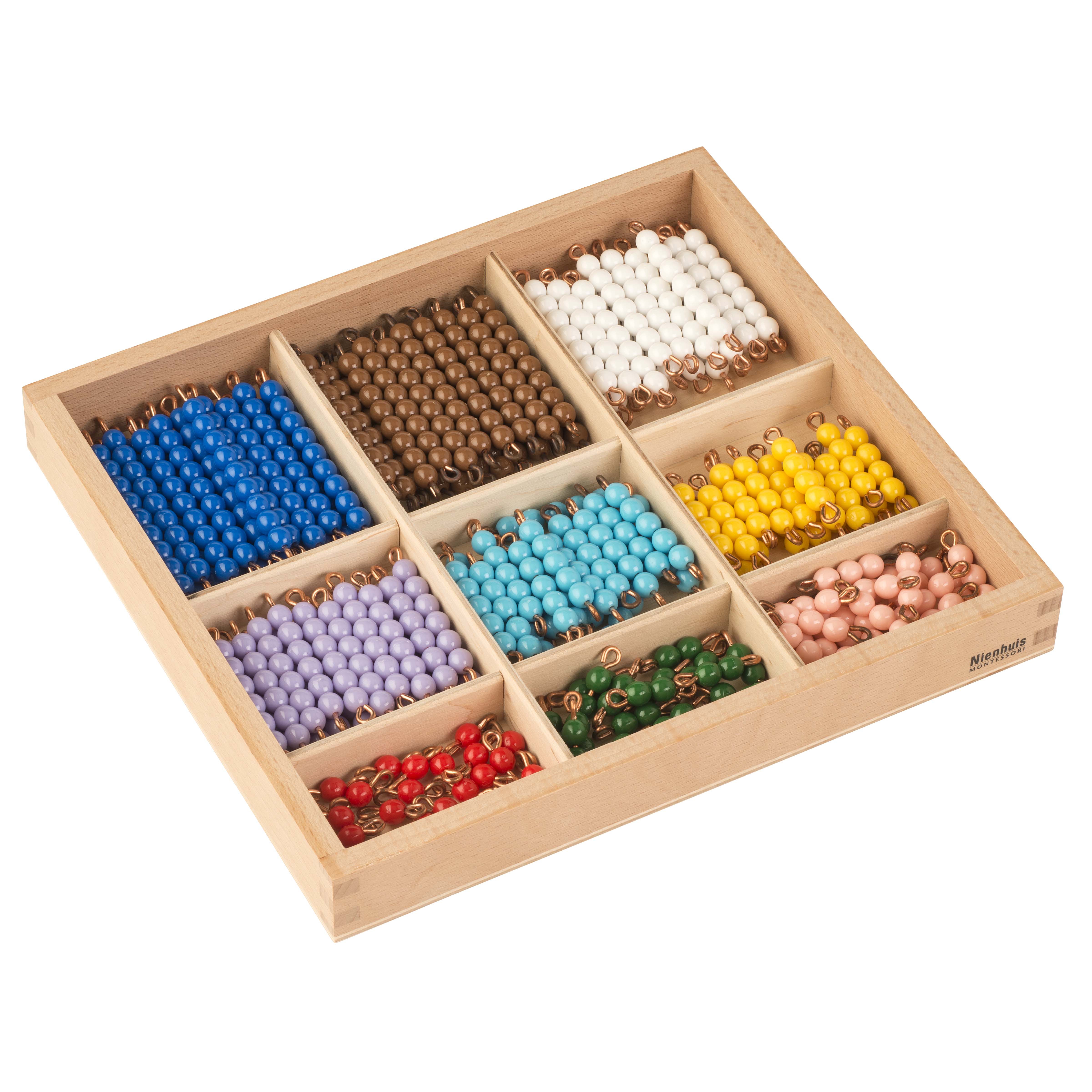
The Checker Board Beads: Individual Beads Nylon is a Mathematics Montessori material designed for children aged 6-12, crafted by Nienhuis Montessori to AMI standards.
Essential companion to the Montessori Checker Board, this set of individual nylon beads provides the concrete manipulatives needed for advanced multiplication work. The beads are organized in a wooden compartmented tray with nine sections, each containing color-coded beads strung on metal wires that correspond to different place values in the decimal system.
“Children display a universal love of mathematics, which is par excellence the science of precision, order, and intelligence.”— Maria MontessoriThe Discovery of the Child
“The greatest sign of success for a teacher is to be able to say, 'The children are now working as if I did not exist.'”
— Maria Montessori, The Absorbent Mind
The Checker Board Beads represent the culmination of years of mathematical preparation in the Montessori classroom. These nylon beads on metal wires transform abstract multiplication into tangible exploration, allowing children to physically manipulate quantities that would otherwise remain theoretical. Each color-coded bead corresponds to a specific place value, from units through millions, enabling the child to build large products bead by bead. The wooden compartmented tray organizes nine distinct hierarchies, making visible the decimal system's structure while the child works. When paired with the Checker Board itself, these beads create a bridge between the concrete operations children have mastered with golden bead material and the abstraction they will achieve in upper elementary. The individual beads allow for precise calculation work, where each exchanged ten becomes a meaningful mathematical discovery rather than an arbitrary rule.
Each order includes everything needed for proper presentation and long-term use.
Follow the Montessori method of presentation for optimal child development.
Write the multiplicand across the top of the Checker Board and the multiplier down the right side
Begin with the units digit of the multiplier, placing corresponding beads in each square
Continue with tens, hundreds, etc., placing beads diagonally across the board
Exchange beads when any square contains ten or more, moving one bead to the next hierarchy
Count the final arrangement of beads to determine the product
Every material is carefully selected for durability, safety, and authentic Montessori experience.
The wooden compartmented tray provides organized storage while reinforcing the systematic nature of mathematical work
Each material supports multiple areas of child development simultaneously.
Bridges concrete bead manipulation with abstract multiplication concepts through systematic place value work
Supports understanding of multi-digit multiplication through visual and tactile exploration of the decimal system
Develops planning and organizational skills through complex, multi-step mathematical operations
Extended work with the Checker Board and beads builds sustained focus and attention to detail
Designed for child-sized hands
Professional tips from AMI-trained guides to maximize the educational value of this material.
“Store extra beads separately - children often need more units and tens during exchanges”
Create a 'bead check' routine where children verify each compartment before beginning
Demonstrate the exchange process slowly, emphasizing the one-to-ten relationship
Use graph paper for children to record their bead placements before computing
Everything you need to know about this material.
The set includes nine compartments of color-coded nylon beads strung on metal wires, organized in a wooden tray. Each compartment represents a different place value in the decimal system, providing all the beads needed for multiplication work with the Montessori Checker Board.
The Checker Board must be purchased separately. This bead set is specifically designed as the essential companion material to work with the Montessori Checker Board for multiplication exercises.
Each of the nine sections contains beads in hierarchical colors following the Montessori decimal system: green (units/thousands/millions), blue (tens), and red (hundreds). The colors repeat in cycles representing units, thousands, and millions places.
Children can solve complex multi-digit multiplication problems, typically up to multiplicands and multipliers in the millions. The beads allow for concrete manipulation of large numbers, making abstract multiplication concepts visible and tangible for ages 6-12.
Nylon beads are more durable and safer for classroom use than traditional glass beads. They maintain the same size and color coding while being lightweight, chip-resistant, and suitable for frequent handling by children during extended multiplication work.
Can't find what you're looking for?
Contact Our Experts
Share your experience with this material and help other educators and parents.


