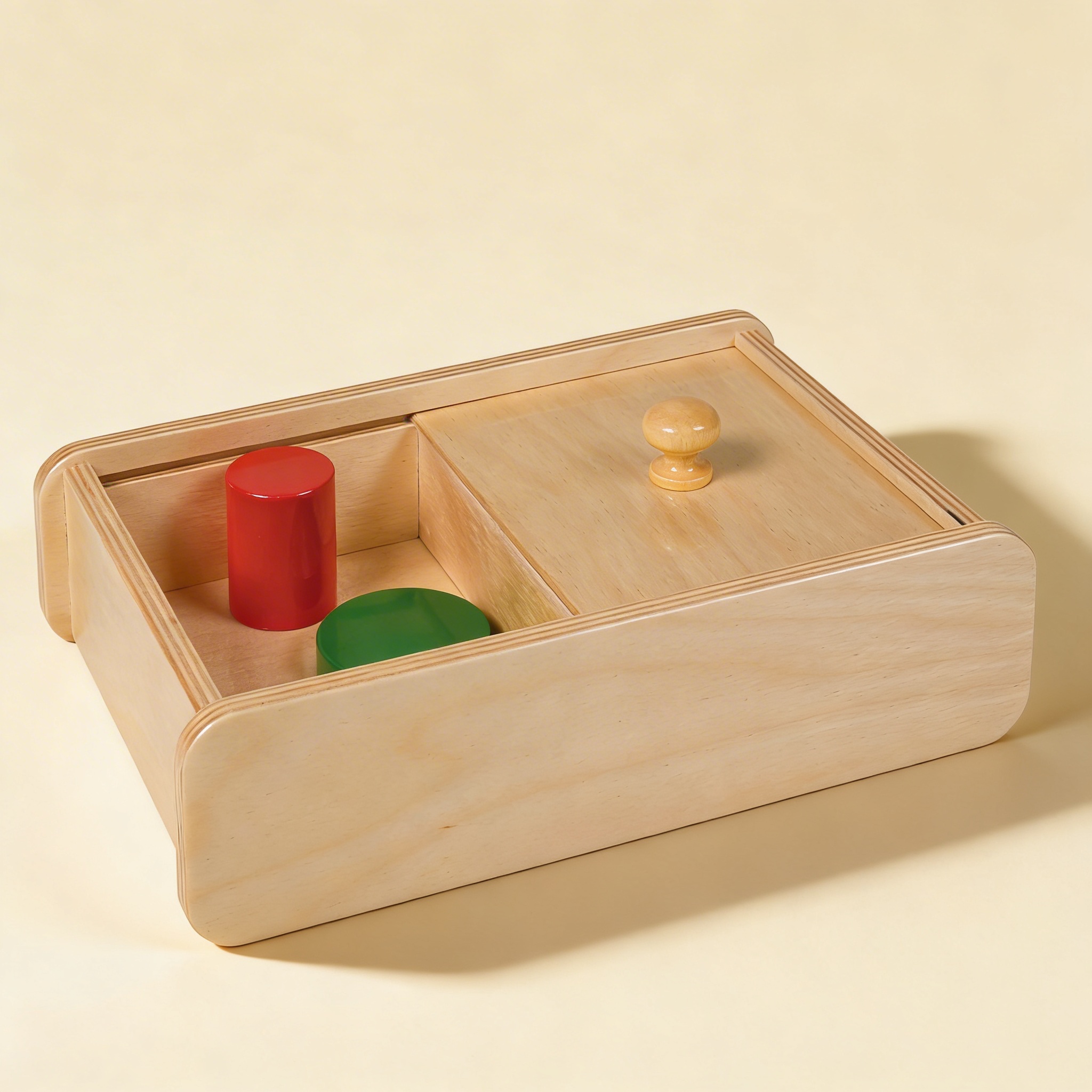
The Sliding Lid Box — Object Permanence & Fine Motor Control is a Sensorial Montessori material designed for children aged 0-3, crafted by Nienhuis Montessori to AMI standards.
This beautifully crafted wooden box with sliding lid introduces young children to object permanence and fine motor control through purposeful manipulation. The compartmented interior containing geometric shapes provides opportunities for matching, sorting, and exploring spatial relationships while developing the pincer grasp through the sliding mechanism.
“The child is both a hope and a promise for mankind.”— Maria MontessoriEducation and Peace
“The hands are the instruments of man's intelligence.”
— Maria Montessori, The Absorbent Mind
The Box with Sliding Lid embodies Maria Montessori's principle that the hand is the instrument of intelligence. This material respects the infant's need to explore through manipulation while supporting the development of object permanence - the understanding that objects exist even when out of sight. The sliding mechanism offers just the right amount of resistance to challenge without frustrating the young child, promoting what Montessori called 'purposeful repetition.' The compartmented design with geometric shapes introduces early classification skills, allowing the child to create order from their sensorial experiences. This material bridges the gap between simple grasping toys and more complex manipulative work, honoring the child's developmental need for increasingly refined hand movements while maintaining the isolation of difficulty principle.
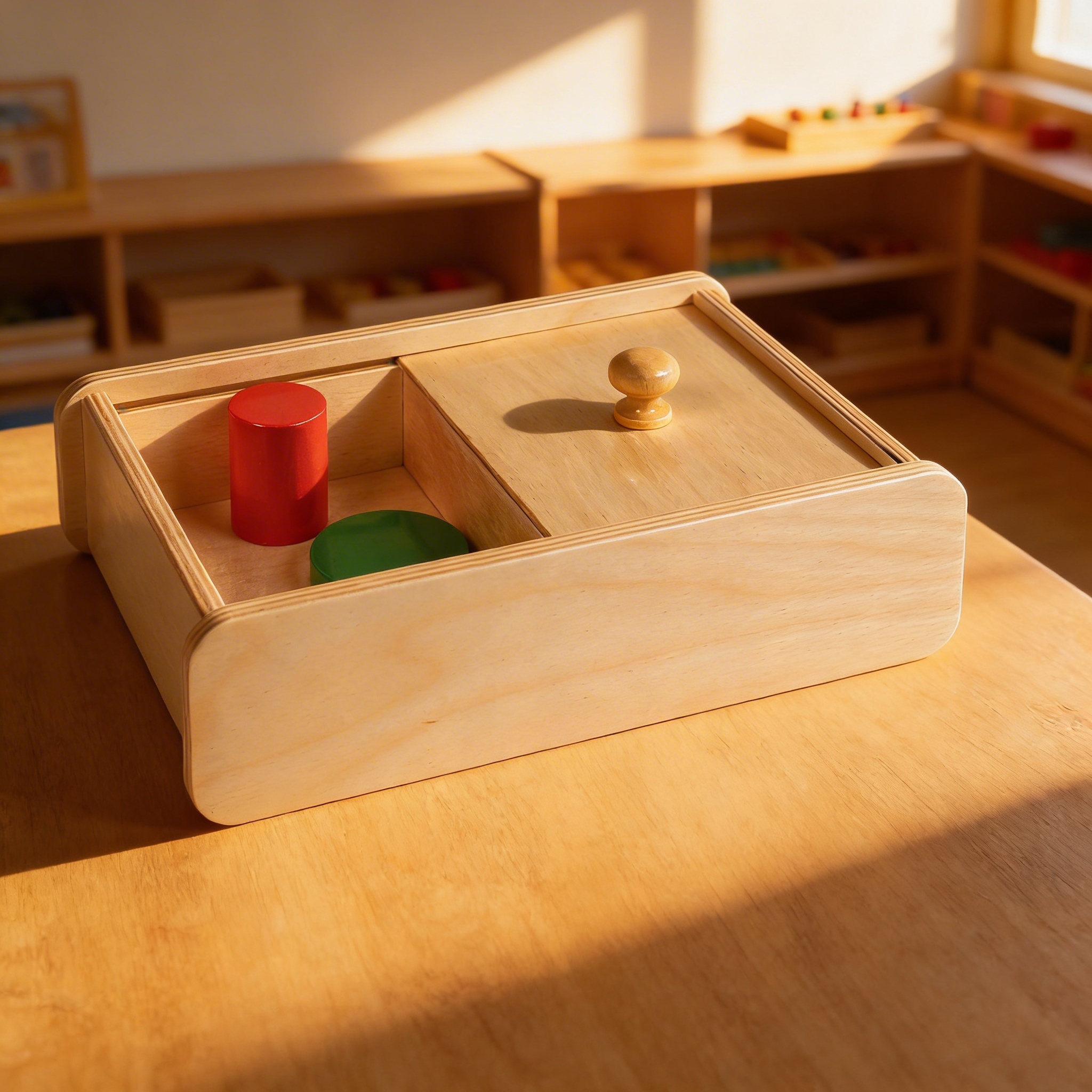
Each order includes everything needed for proper presentation and long-term use.
Follow the Montessori method of presentation for optimal child development.
Sit beside the child and slowly slide the lid open using thumb and index finger
Express wonder at discovering the shapes inside, naming them simply
Remove one shape, examine it briefly, then return it to its compartment
Slide the lid closed with the same careful pincer grasp
Offer the box to the child with both hands
Every material is carefully selected for durability, safety, and authentic Montessori experience.
The natural wood provides sensory feedback through weight and texture, helping children understand the permanence of objects even when hidden from view.
Each material supports multiple areas of child development simultaneously.
Sliding the lid to reveal and conceal objects helps infants understand that objects continue to exist even when out of sight.
Grasping the knob and sliding the lid refines pincer grasp and hand-eye coordination essential for later writing.
Matching shapes to compartments develops understanding of spatial relationships and problem-solving skills.
The purposeful activity of opening, exploring, and closing the box builds sustained attention and focus.
Designed for child-sized hands
Professional tips from AMI-trained guides to maximize the educational value of this material.
“Observe without intervening unless the child shows frustration with the sliding mechanism”
Rotate shapes weekly to maintain interest while keeping some familiar ones
Present during the child's optimal attention period, typically mid-morning
Keep the material accessible on a low shelf for spontaneous repetition
Everything you need to know about this material.
This material is designed for children ages 6 months to 3 years. Young infants around 6-8 months can begin exploring the sliding motion, while older toddlers up to age 3 continue to refine their skills through sorting and matching the geometric shapes inside.
When children slide the lid closed, objects inside disappear from view but still exist. This hands-on experience helps them understand that objects continue to exist even when not visible, a crucial cognitive milestone typically developed between 4-8 months of age.
The sliding lid specifically develops the pincer grasp, hand-eye coordination, and wrist rotation. Children must use controlled, precise movements to grasp the lid's edge and slide it horizontally, preparing their hands for later writing and practical life activities.
While specific shapes vary by manufacturer, typical sets include basic geometric solids like spheres, cubes, cylinders, and prisms. These shapes are sized appropriately for small hands and provide sensorial experiences of different forms, edges, and surfaces.
Sit with your child and slowly demonstrate sliding the lid open and closed using deliberate movements. Once open, explore one shape at a time, allowing them to feel and examine each piece before placing it in its compartment. Let the child repeat the process at their own pace.
Can't find what you're looking for?
Contact Our Experts
Share your experience with this material and help other educators and parents.
Bundle related materials and save. Free curriculum guide included with every set.


