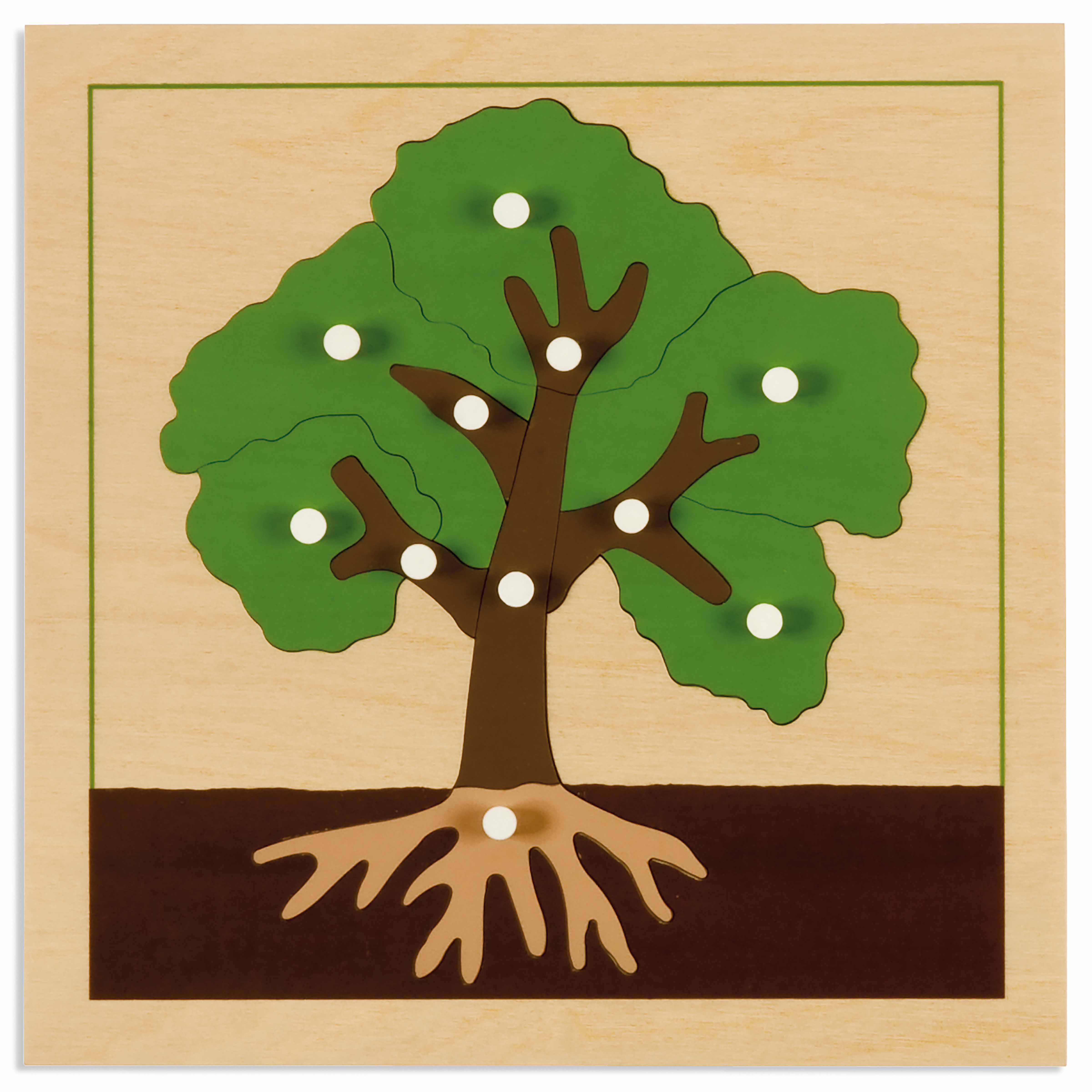
The Botany Puzzle: Tree is a category.biology Montessori material designed for children aged 3-6, crafted by Nienhuis Montessori to AMI standards.
This Botany Puzzle introduces children to the fundamental parts of a tree through hands-on exploration. The wooden puzzle features distinct pieces representing the crown, trunk, and root system, with white knobs for easy manipulation. Children develop botanical vocabulary while building understanding of how trees grow both above and below ground.
“Education is a natural process spontaneously carried out by the human individual, and is acquired not by listening to words but by experiences upon the environment.”— Maria MontessoriEducation for a New World
“The child is both a hope and a promise for mankind.”
— Maria Montessori, Education and Peace
The Botany Puzzle: Tree addresses the child's fundamental need to understand the living world through concrete manipulation. Each wooden piece—crown, trunk, and root system—isolates a specific part of the tree structure, allowing children to build botanical knowledge through their hands. The white knobs on each puzzle piece enable independent exploration, as three-year-olds can grasp and position the pieces without adult assistance. By separating the tree into its three essential components, this puzzle transforms an abstract concept into tangible parts that young children can examine, name, and reassemble. The puzzle's design reflects how trees actually grow: roots extending downward, trunk rising upward, and crown spreading outward. This material bridges the child's sensorial exploration with scientific vocabulary, as they physically handle the crown while learning its name and function. The wooden construction provides the weight and texture that helps children form lasting impressions of each tree component.
Each order includes everything needed for proper presentation and long-term use.
Follow the Montessori method of presentation for optimal child development.
Remove each piece slowly by grasping the white knob, starting with the crown
Place removed pieces to the right of the frame in order: crown, trunk, roots
Name each part as you point: 'This is the crown of the tree'
Invite the child to feel the outline of each cavity in the frame
Return pieces one at a time, naming each as it's placed
Offer a three-period lesson with the vocabulary: crown, trunk, roots
Every material is carefully selected for durability, safety, and authentic Montessori experience.
Crafted from smooth wood to provide authentic sensorial experience while children explore botanical concepts.
Each material supports multiple areas of child development simultaneously.
Introduces scientific vocabulary for tree parts including crown, trunk, and root system through concrete manipulation.
White grip knobs promote proper pencil grip while developing hand strength and coordination.
Children learn to identify and match shapes while understanding how tree parts connect to form a whole.
Cross-sectional view develops understanding of visible and hidden parts of natural structures.
Designed for child-sized hands
Professional tips from AMI-trained guides to maximize the educational value of this material.
“Present this puzzle after children have worked with simpler knobbed puzzles to ensure proper grip development”
Keep a real branch with leaves nearby to show the connection between the wooden puzzle and living trees
Introduce only one or two vocabulary words initially if the child is younger than four
Use this puzzle as preparation for the Botany Cabinet work with more detailed plant studies
Everything you need to know about this material.
The puzzle features three main parts: the crown (branches and leaves), trunk (main stem), and root system (underground roots). Each piece is designed to help children understand how these parts work together to form a complete tree.
This puzzle follows Montessori principles by offering concrete, hands-on learning with self-correcting pieces. The white knobs promote proper pencil grip development, while the realistic representation helps children connect abstract concepts to real-world observations.
While designed for ages 3-6, children as young as 2.5 may enjoy it with supervision. Three-year-olds typically focus on the puzzle mechanics, while 4-6 year olds engage more deeply with botanical vocabulary and tree life cycle concepts.
Pair the puzzle with nature walks to identify tree parts outdoors, create bark rubbings, collect leaves for matching activities, or plant seeds to observe root and shoot development. Three-part cards with tree vocabulary enhance language learning.
Children develop fine motor control, hand-eye coordination, spatial awareness, and vocabulary. The puzzle also builds observation skills, logical thinking, and prepares for later scientific classification work in elementary years.
Can't find what you're looking for?
Contact Our Experts
Share your experience with this material and help other educators and parents.


