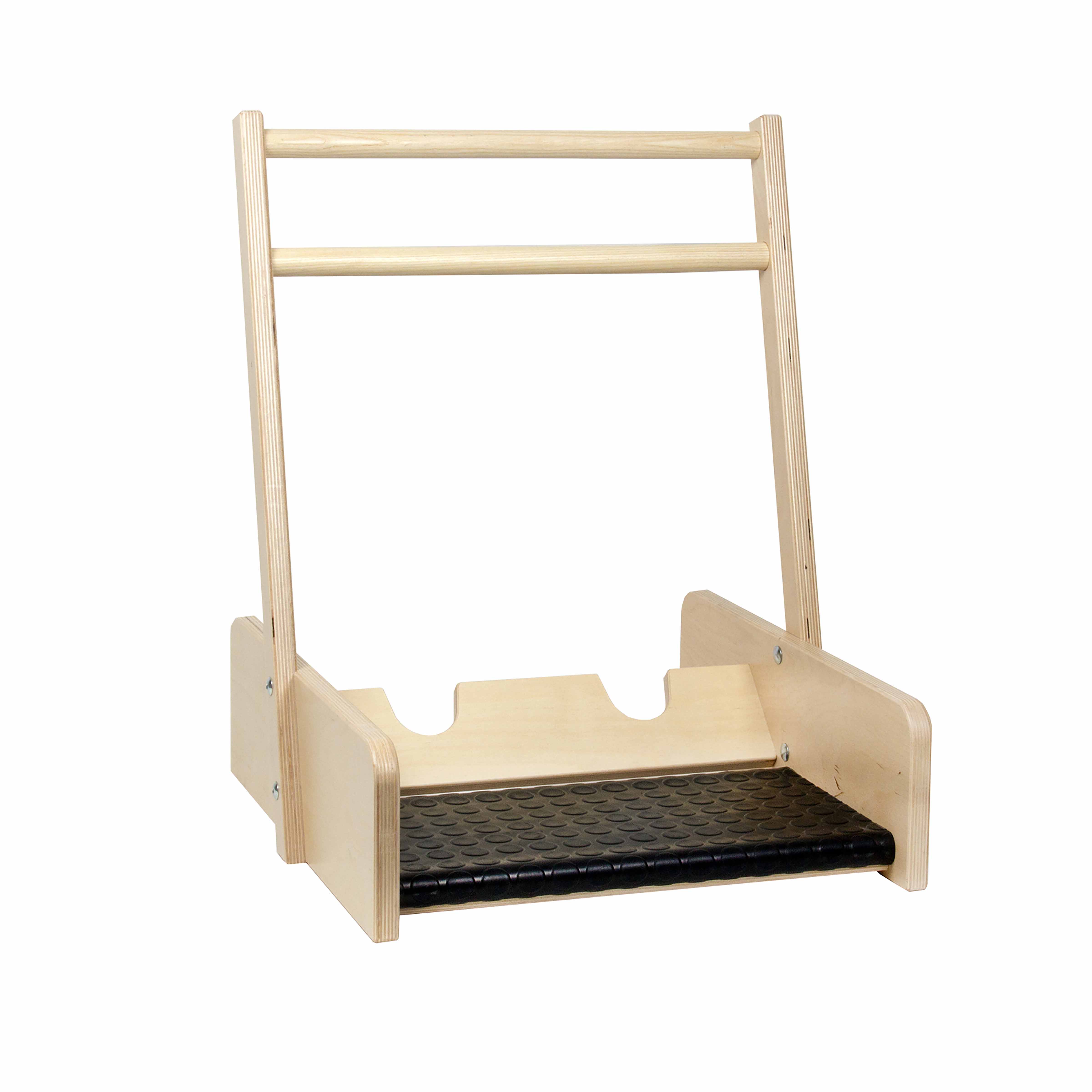
The Boot Jack is a Educational Materials Montessori material designed for children aged 0-3, crafted by Nienhuis Montessori to AMI standards.
This practical boot jack supports independence in self-care routines, enabling young children to remove their boots without assistance. The sturdy plywood frame features a V-shaped notch for heel placement and a textured rubber base that provides stability during use, promoting confidence in daily dressing activities.
“The child is both a hope and a promise for mankind.”— Maria MontessoriEducation and Peace
“The hands are the instruments of man's intelligence.”
— Maria Montessori, The Absorbent Mind
The Boot Jack embodies the Montessori principle of independence through practical life activities by transforming a challenging daily task into an achievable milestone. Young children naturally desire autonomy in dressing themselves, yet removing boots requires physical strength and coordination beyond their developing capabilities. The Boot Jack's V-shaped notch cradles the boot heel at precisely the right angle, allowing children to use their body weight rather than hand strength to remove footwear. This plywood tool addresses a specific developmental need: the gap between a child's desire for independence and their physical limitations. By placing the Boot Jack in the entryway or dressing area, we acknowledge that true independence comes not from struggling alone, but from having appropriate tools sized for small bodies. The textured rubber base ensures stability during use, eliminating frustration and building confidence as children master this essential self-care skill without adult intervention.
Each order includes everything needed for proper presentation and long-term use.
Follow the Montessori method of presentation for optimal child development.
Demonstrate placing one boot heel into the V-shaped notch
Hold the opposite foot on the base for stability
Gently pull the foot upward while the notch holds the heel
Switch feet and repeat for the second boot
Every material is carefully selected for durability, safety, and authentic Montessori experience.
Smooth, splinter-free plywood provides durability while maintaining a warm, natural aesthetic that complements the Montessori environment
Each material supports multiple areas of child development simultaneously.
Enables children to remove boots without adult assistance, fostering autonomy in daily routines
Standing on one foot while removing boots develops balance and coordination
Builds confidence in managing personal belongings and self-dressing activities
Learning the proper sequence of placing heel, pulling, and balancing develops procedural thinking
Designed for child-sized hands
Professional tips from AMI-trained guides to maximize the educational value of this material.
“Model the process during arrival time when children naturally need to remove outdoor footwear”
Create a visual sequence card showing boot removal steps to support independent practice
Position near a low bench or wall for children who need additional balance support
Regularly check the rubber base for wear to maintain stability and safety
Everything you need to know about this material.
The boot jack is designed for children ages 2-3 years who are developing independence in dressing skills. Children should be able to stand steadily on one foot before using it independently.
The boot jack supports the Montessori principles of independence and practical life skills by enabling children to remove their boots without adult assistance, fostering self-reliance and confidence in daily care routines.
The boot jack measures approximately 30cm x 20cm x 15cm and is constructed from sturdy plywood. The textured rubber base ensures stability for children up to 30kg while removing boots.
The V-shaped notch is specifically designed for boots with a defined heel. It works best with rain boots, snow boots, and sturdy shoes but is not suitable for sneakers, sandals, or slip-on shoes.
Start by demonstrating slowly: place the boot heel in the V-notch, hold onto a wall or chair for balance, then lift the foot out. Practice with sitting first, then progress to standing use as balance improves.
Can't find what you're looking for?
Contact Our Experts
Share your experience with this material and help other educators and parents.


