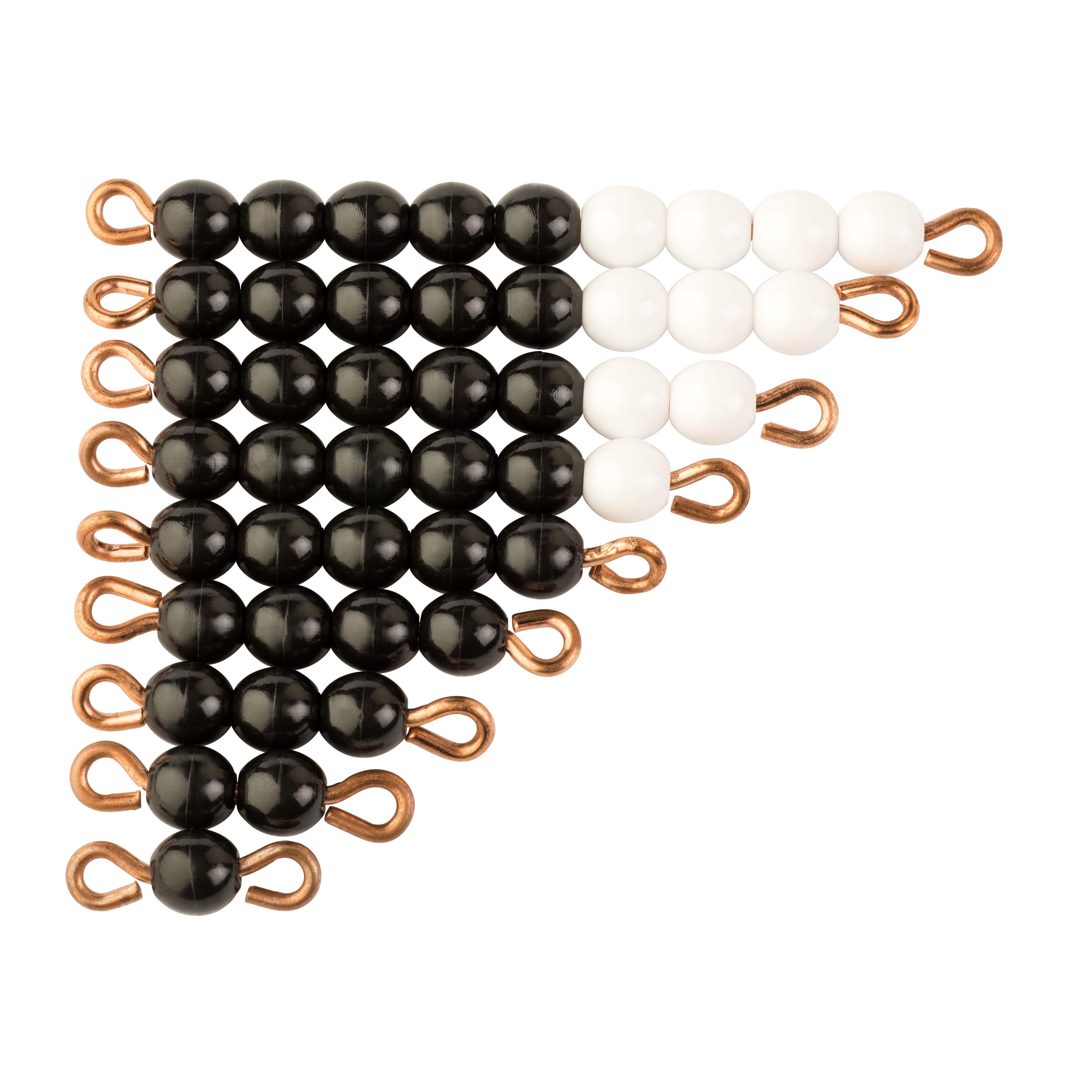
The Black And White Bead Stairs - Individual Beads Nylon: 1 Set is a Mathematics Montessori material designed for children aged 3-6, crafted by Nienhuis Montessori to AMI standards.
These Black and White Bead Stairs introduce children to numerical quantities through visual and tactile exploration. Each bead bar represents numbers 1-9 with alternating black and white plastic beads on sturdy wire, allowing children to physically experience the progression of quantity while developing their understanding of the decimal system.
“Children display a universal love of mathematics, which is par excellence the science of precision, order, and intelligence.”— Maria MontessoriThe Discovery of the Child
“The greatest sign of success for a teacher is to be able to say, 'The children are now working as if I did not exist.'”
— Maria Montessori, The Absorbent Mind
The Black and White Bead Stairs transform abstract numbers into concrete experiences through alternating colored beads that children can touch, count, and compare. Each bead bar's distinct length—from one single bead to nine beads strung on wire—gives physical form to quantity relationships that young minds struggle to grasp through symbols alone. The alternating black and white pattern on each bar creates visual rhythm that helps children track their counting, while the wire construction allows flexible handling during mathematical explorations. These nylon bead bars address the developmental need for concrete manipulation before abstraction, as children between three and six require tangible objects to understand that 'five' represents a specific quantity, not just a symbol. The color contrast between black and white beads eliminates distractions, focusing attention purely on quantity rather than color coding, which prepares children for more advanced mathematical concepts where quantity relationships matter more than visual cues.
Each order includes everything needed for proper presentation and long-term use.
Follow the Montessori method of presentation for optimal child development.
Invite the child to arrange the bead bars from shortest to longest, creating a stair formation
Count each bar together, touching each bead as you count
Select two bars and count their combined beads
Ask the child to close their eyes while you remove one bar, then identify which is missing
Each material supports multiple areas of child development simultaneously.
Children develop concrete understanding of quantities 1-9 through visual and tactile exploration of the bead bars.
Establishes foundation for skip counting, addition, and understanding of the decimal system through hands-on manipulation.
The alternating black and white pattern helps children clearly distinguish individual units within each quantity.
Arranging beads in stair formation reinforces understanding of numerical order and progression.
Designed for child-sized hands
Professional tips from AMI-trained guides to maximize the educational value of this material.
“Store bead bars in a designated container where children can access them independently throughout the work period”
Model careful handling of the wire ends to prevent bending or loosening of beads
Observe which quantities children gravitate toward—this reveals their current numerical understanding
Use the bead stairs alongside other mathematical materials to reinforce quantity concepts through varied presentations
Everything you need to know about this material.
This set includes 9 bead bars representing numbers 1 through 9. Each bar contains the corresponding number of alternating black and white plastic beads strung on durable wire. The beads are made from nylon material for longevity and repeated classroom use.
Unlike traditional colored bead stairs where each number has a specific color, these use alternating black and white beads throughout all bars. This design helps children focus purely on quantity without color associations, making it easier to see odd/even patterns and count individual units.
Children develop understanding of quantities 1-9, one-to-one correspondence, number sequence, skip counting, odd and even numbers, and early addition/subtraction. The alternating colors make it easy to count and verify quantities, preparing children for more advanced mathematical work.
These beads are designed for ages 3-6. Younger children (3-4) typically begin by matching quantities and learning number names, while older children (5-6) use them for skip counting, composing numbers, and understanding number relationships within the decimal system.
The nylon beads are specifically chosen for their durability and resistance to wear. They maintain their shape and color contrast even with frequent handling by multiple children. The wire construction prevents beads from coming loose, ensuring the materials remain intact for years of classroom use.
Can't find what you're looking for?
Contact Our Experts
Share your experience with this material and help other educators and parents.

