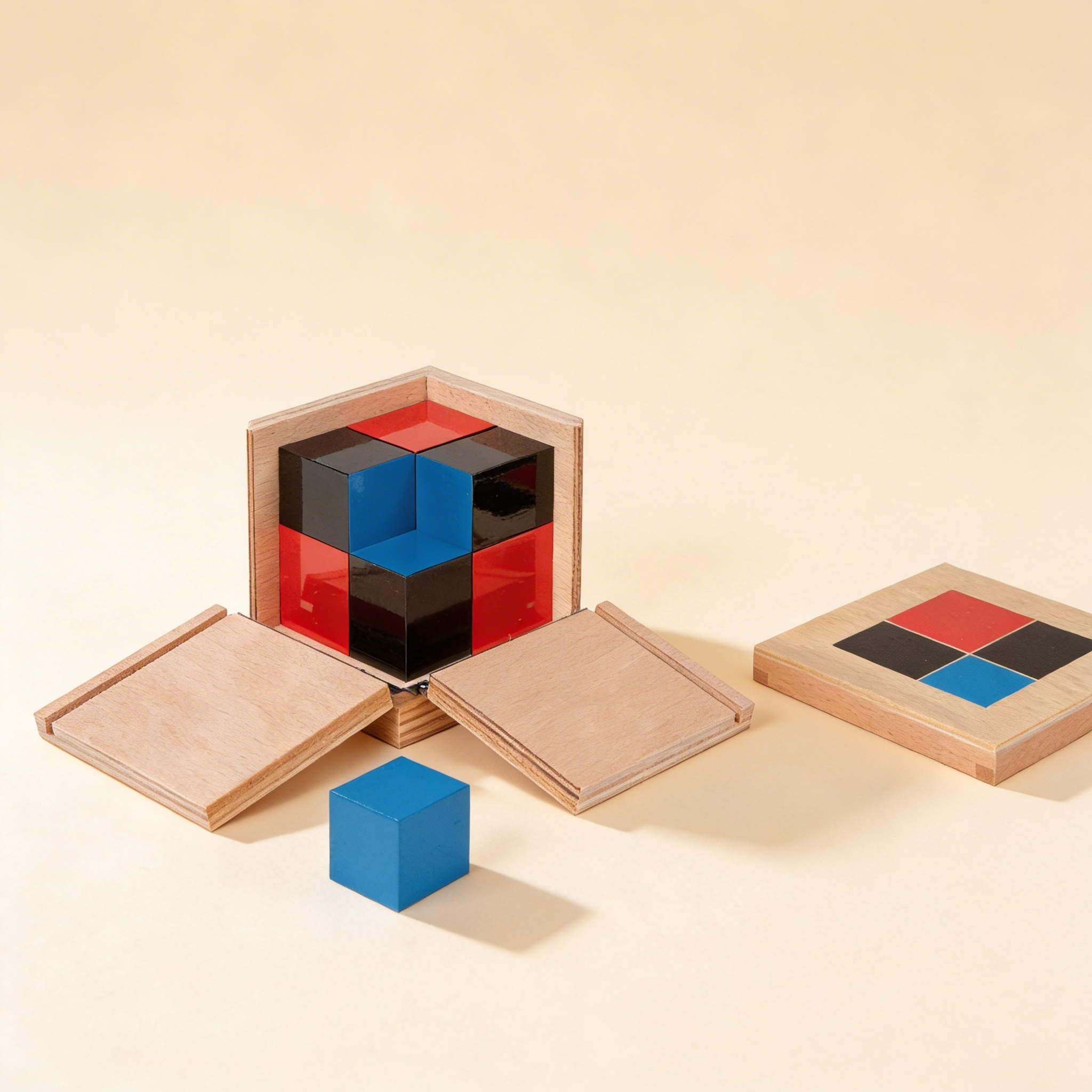
The Binomial Cube — Algebraic Concepts Through Sensorial Exploration is a Sensorial Montessori material designed for children aged 3-6, crafted by Nienhuis Montessori to AMI standards.
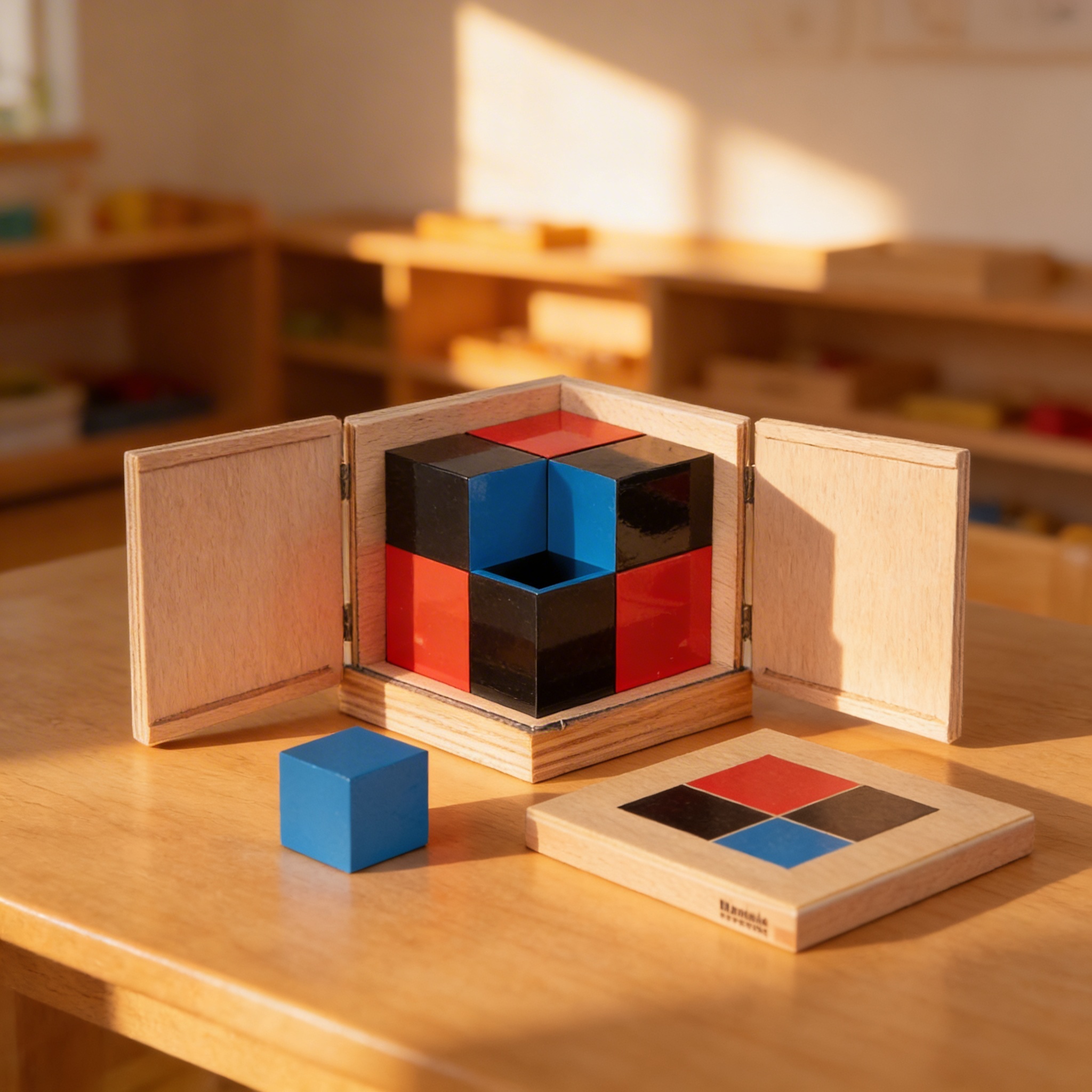
The Binomial Cube is a fundamental Montessori sensorial material that introduces children to algebraic concepts through concrete manipulation. This precision-crafted wooden puzzle consists of eight color-coded blocks that, when correctly assembled, form a perfect cube representing the algebraic equation (a+b)³. The hinged storage box serves as both a work surface and organizational tool, supporting the child's natural order and concentration.
“The hands are the instruments of man's intelligence.”— Maria MontessoriThe Absorbent Mind
“The senses, being explorers of the world, open the way to knowledge.”
— Maria Montessori, The Discovery of the Child
The Binomial Cube embodies Dr. Montessori's principle of indirect preparation, where children absorb complex mathematical concepts through sensorial exploration years before formal instruction. This material respects the child's mathematical mind—the human tendency to think in patterns, relationships, and order. Through self-correcting design, it honors the child's need for independence and intrinsic motivation. The cube's visual and tactile qualities engage multiple senses simultaneously, creating neural pathways that support later abstract thinking. By manipulating concrete objects that represent algebraic relationships, children build a sensorial impression of mathematical laws, demonstrating Montessori's belief that the hand is the instrument of the mind. This material bridges the sensorial and mathematical areas, revealing the interconnectedness of the Montessori curriculum.
Each order includes everything needed for proper presentation and long-term use.
Follow the Montessori method of presentation for optimal child development.
Carefully open the box and remove blocks one by one, placing them randomly on the mat
Begin reconstruction by finding the largest red cube (a³) and placing it in the corner of the box
Add the three red and black rectangular prisms (3a²b) adjacent to the red cube
Place the three black and red rectangular prisms (3ab²) in their positions
Complete with the small black cube (b³) in the remaining corner
Close the box to verify correct assembly, then invite the child to try
Every material is carefully selected for durability, safety, and authentic Montessori experience.
Each block is crafted from solid wood with exact dimensions, ensuring the mathematical relationships are tangibly experienced through the child's hands.
Each material supports multiple areas of child development simultaneously.
Children refine their ability to perceive differences in dimension and color through systematic exploration.
Concrete preparation for algebra by physically building the binomial theorem (a+b)³.
The challenging yet achievable task promotes sustained focus and problem-solving skills.
Develops logical thinking through the specific sequence required for successful assembly.
Designed for child-sized hands
Professional tips from AMI-trained guides to maximize the educational value of this material.
“Present this material only after the child has worked extensively with the Pink Tower and Brown Stair to ensure readiness for complex spatial relationships”
During initial presentations, work in complete silence to emphasize visual discrimination and concentration
Store the Binomial Cube between the Color Box 3 and Trinomial Cube on the sensorial shelf to show progression
Observe for signs of frustration and offer indirect help by re-presenting slowly rather than correcting directly
Everything you need to know about this material.
The Binomial Cube serves multiple purposes: it develops visual discrimination, fine motor skills, and spatial reasoning while indirectly preparing children for understanding algebraic concepts. Through hands-on exploration, children internalize the mathematical formula (a+b)³ without abstract instruction, building a concrete foundation for later mathematical learning.
Children begin by removing all blocks from the hinged box and examining the pattern on the box lid. They then reconstruct the cube by matching colors and sizes, starting with the largest piece. The material is self-correcting - blocks only fit together properly when placed correctly. Children work independently, developing concentration and problem-solving skills through repeated practice.
The Binomial Cube is typically introduced between ages 3.5-4 years, after children have worked with other sensorial materials like the Pink Tower and Brown Stair. The child should demonstrate good visual discrimination skills and the ability to concentrate for extended periods. Some children may be ready earlier or later depending on their individual development.
The Binomial Cube develops visual perception, color discrimination, spatial awareness, fine motor control, logical thinking, and concentration. It also builds mathematical readiness by introducing pattern recognition, sequencing, and the concept of parts making a whole. These foundational skills support later academic learning in geometry and algebra.
Yes, the Binomial Cube is a worthwhile investment as it grows with your child. Initially used as a sensorial puzzle, it later becomes a concrete representation of mathematical concepts. The high-quality wooden construction ensures durability for years of use, and the material can be passed to younger siblings. Its multi-layered learning opportunities provide excellent educational value.
Can't find what you're looking for?
Contact Our Experts
Share your experience with this material and help other educators and parents.
Bundle related materials and save. Free curriculum guide included with every set.


