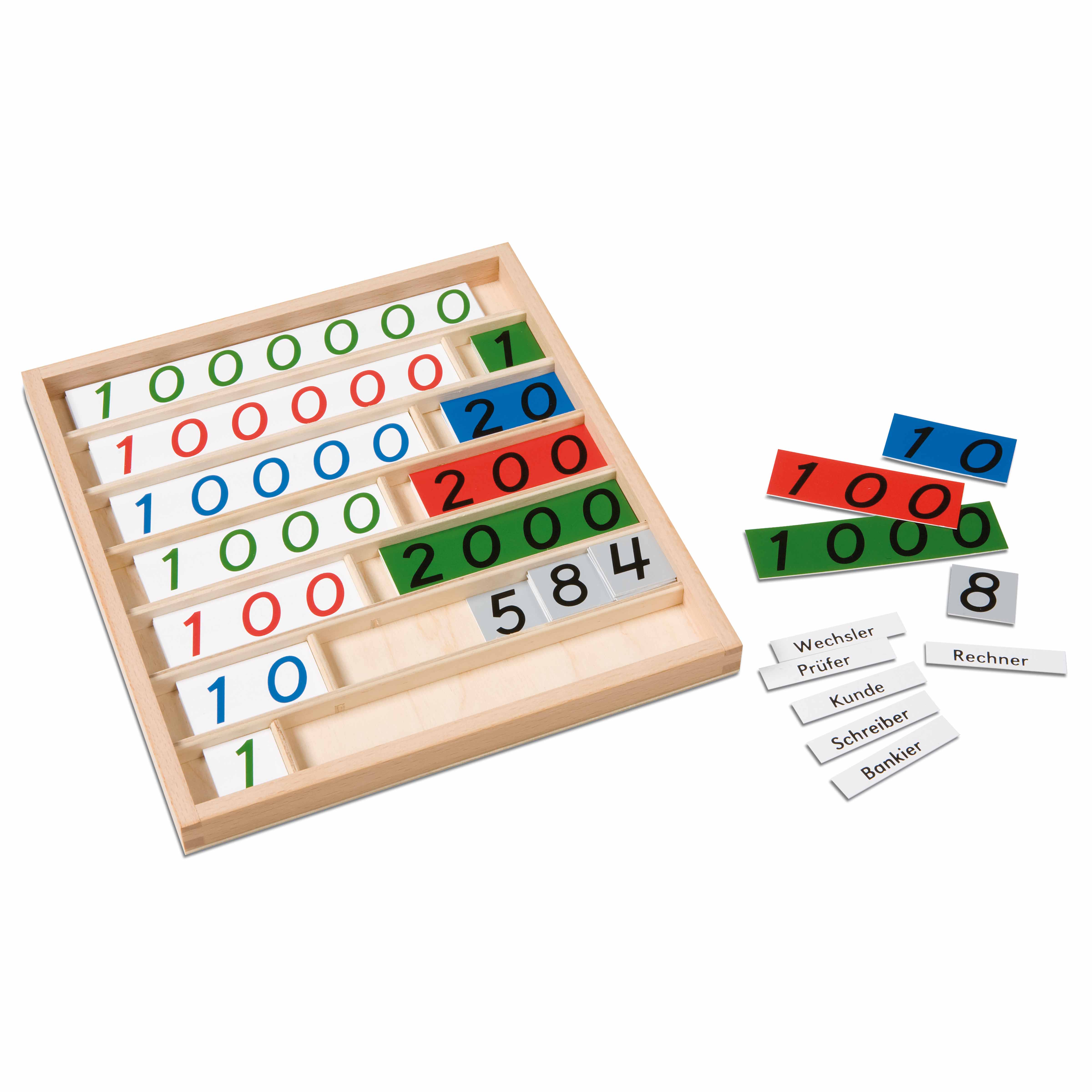
The Bank Game is a Educational Materials Montessori material designed for children aged 6-12, crafted by Nienhuis Montessori to AMI standards.
The Bank Game is a fundamental Montessori mathematics material that transforms abstract place value concepts into concrete, manipulable experiences. Children use color-coded number cards representing units, tens, hundreds, and thousands to perform complex mathematical operations, building a deep understanding of the decimal system through hands-on exploration.
“The child is both a hope and a promise for mankind.”— Maria MontessoriEducation and Peace
“The hands are the instruments of man's intelligence.”
— Maria Montessori, The Absorbent Mind
The Bank Game emerges from Montessori's recognition that children aged 6-12 need concrete experiences to understand abstract mathematical relationships. The color-coded number cards—green units, blue tens, red hundreds, and green thousands—create a visual and tactile system that makes place value tangible. Each card in the Bank Game represents a specific quantity, allowing children to physically exchange ten unit cards for one ten card, experiencing the decimal system through their hands. The Bank Game's design reflects children's developmental need to move from concrete manipulation toward abstraction. By physically handling cards representing different place values, children internalize how our number system operates before encountering traditional algorithms. The Bank Game transforms addition, subtraction, multiplication, and division from abstract procedures into concrete exchanges, meeting the elementary child's need to understand the 'why' behind mathematical operations.
Each order includes everything needed for proper presentation and long-term use.
Follow the Montessori method of presentation for optimal child development.
Begin with a simple addition problem like 2,345 + 1,234. Have the child lay out both numbers using the appropriate colored cards.
Combine like place values by gathering all unit cards together, all ten cards together, and so on.
Exchange when necessary—trade 10 unit cards for 1 ten card, 10 tens for 1 hundred.
Arrange the final answer from left to right, reading the complete sum.
Every material is carefully selected for durability, safety, and authentic Montessori experience.
The storage tray is crafted from smooth natural wood, providing a durable foundation that respects the child's need for order while showcasing the beauty of natural materials.
Each material supports multiple areas of child development simultaneously.
Color-coded cards provide visual and tactile representation of the decimal system, making abstract concepts concrete and manipulable.
Supports addition, subtraction, multiplication, and division with large numbers through hands-on manipulation.
Bridges the gap between concrete golden bead material and abstract mathematical notation.
Bilingual labels support vocabulary development while reinforcing mathematical concepts across languages.
Designed for child-sized hands
Professional tips from AMI-trained guides to maximize the educational value of this material.
“Present addition first, ensuring mastery before introducing subtraction—the physical exchange process needs to be automatic”
Use graph paper for recording problems to maintain proper column alignment with place values
Create a 'bank' area where children retrieve cards, reinforcing the material's name and exchange concept
Observe whether children are ready to work with fewer concrete cards, gradually transitioning to written work
Everything you need to know about this material.
The Bank Game teaches place value, the decimal system, addition, subtraction, multiplication, and division with multi-digit numbers. It helps children understand exchanging between units, tens, hundreds, and thousands while building a concrete foundation for abstract mathematical operations.
While both teach the decimal system, the Bank Game uses color-coded number cards instead of physical beads, allowing for work with larger numbers and more complex operations. It serves as a bridge between the concrete Golden Beads and abstract written mathematics.
The Bank Game is typically introduced around age 6-7, after children have mastered the Golden Bead Material and understand basic place value concepts. Children continue using it through ages 10-12 for increasingly complex operations.
A complete Bank Game set includes color-coded number cards (green units, blue tens, red hundreds, green thousands), small number cards for individual work, and often a wooden box or tray for organization. Some sets include operation cards and answer tiles.
Yes, the Bank Game is excellent for collaborative learning. Children can work in groups of 2-4, with roles like banker, customer, and recorder. This social aspect reinforces mathematical concepts while developing communication and teamwork skills.
Can't find what you're looking for?
Contact Our Experts
Share your experience with this material and help other educators and parents.


