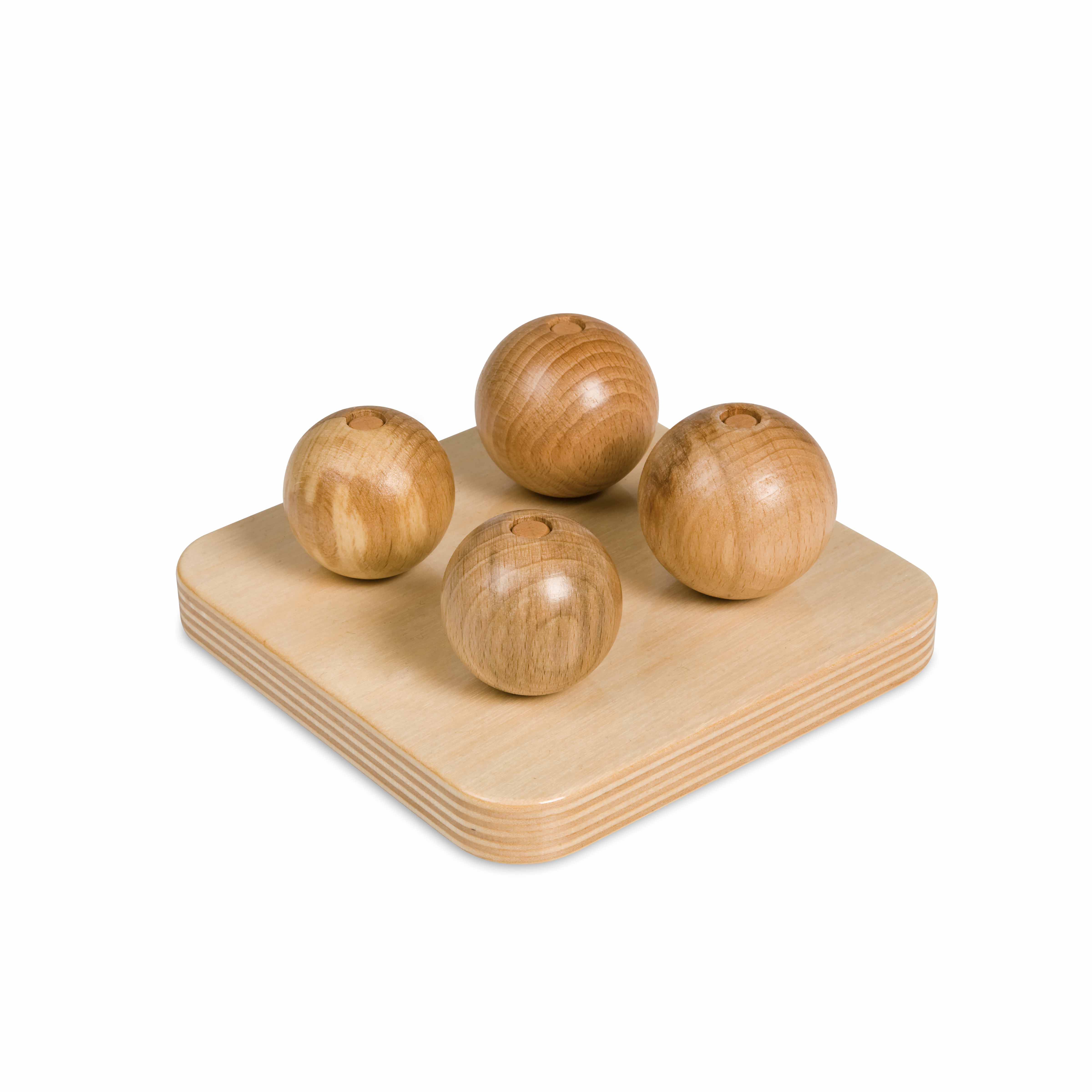
The Balls On Small Pegs is a Educational Materials Montessori material designed for children aged 3-6, crafted by Nienhuis Montessori to AMI standards.
The Balls On Small Pegs material develops precise hand movements and spatial awareness through a focused peg-and-ball activity. Children refine their pincer grasp and hand-eye coordination by carefully placing each wooden ball onto its corresponding vertical peg, building concentration and control essential for later writing work.
“The child is both a hope and a promise for mankind.”— Maria MontessoriEducation and Peace
“The hands are the instruments of man's intelligence.”
— Maria Montessori, The Absorbent Mind
The Balls On Small Pegs exists in Montessori environments to isolate and refine the pincer grasp movement that children will later use for writing. Each wooden ball requires precise finger positioning as the child grasps it between thumb and index finger, then carefully lowers it onto a vertical peg. This peg-and-ball design creates a clear visual feedback system - when the ball sits perfectly on its peg, the child experiences immediate success. The vertical pegs demand controlled hand movements from above, training the same downward motion used when forming letters. Through repetitive placement of balls onto pegs, children build the finger strength and coordination needed for pencil control. The material's simplicity - just balls and pegs - allows complete focus on the hand movement itself, without distraction from color matching or complex patterns. This concentrated practice with the Balls On Small Pegs transforms the abstract skill of 'preparing for writing' into a concrete, satisfying activity that children can master independently.
Each order includes everything needed for proper presentation and long-term use.
Follow the Montessori method of presentation for optimal child development.
Demonstrate grasping one ball with thumb and index finger, holding it directly above a peg
Lower the ball straight down onto the peg, releasing when it sits securely
Continue placing balls one at a time, working systematically across the board
Once all balls are placed, remove them one at a time back to the basket
Every material is carefully selected for durability, safety, and authentic Montessori experience.
The smooth wooden balls and sturdy plywood base provide authentic tactile feedback, helping children develop sensitivity to weight, texture, and temperature while supporting sustainable practices.
Each material supports multiple areas of child development simultaneously.
Lifting and placing the balls strengthens the thumb and index finger muscles essential for pencil holding.
Aligning the ball's hole with the peg requires precise visual-motor integration and spatial judgment.
The focused nature of the activity helps children develop sustained attention and task completion skills.
Children naturally create patterns and sequences, supporting mathematical thinking and logical reasoning.
Designed for child-sized hands
Professional tips from AMI-trained guides to maximize the educational value of this material.
“Present this work after the child has mastered larger grasping materials like the cylinder blocks”
Observe which fingers the child uses - guide toward thumb and index finger if needed
Keep extra balls available as they may roll off the table during early practice
Note if a child consistently skips certain pegs - this may indicate visual tracking needs
Everything you need to know about this material.
This material primarily develops pincer grasp, hand-eye coordination, spatial awareness, and concentration. It strengthens the small muscles in the hand needed for writing, while teaching precise controlled movements and visual-motor integration.
The set typically includes 5-10 wooden balls with corresponding vertical pegs mounted on a wooden base. Each ball fits precisely onto its designated peg, providing clear visual feedback for successful placement.
Unlike stacking toys, this material focuses on precise vertical placement using a refined pincer grasp. The small pegs require careful coordination and control, making it an excellent pre-writing exercise that isolates hand movements.
While designed for ages 3-6, always supervise younger children. The balls should be large enough to prevent choking hazards, but the activity requires developed fine motor skills typically present around age 3.
By strengthening the pincer grasp and developing hand control, this material directly prepares the hand muscles for holding a pencil. The precise movements required mirror the control needed for forming letters and numbers.
Can't find what you're looking for?
Contact Our Experts
Share your experience with this material and help other educators and parents.


