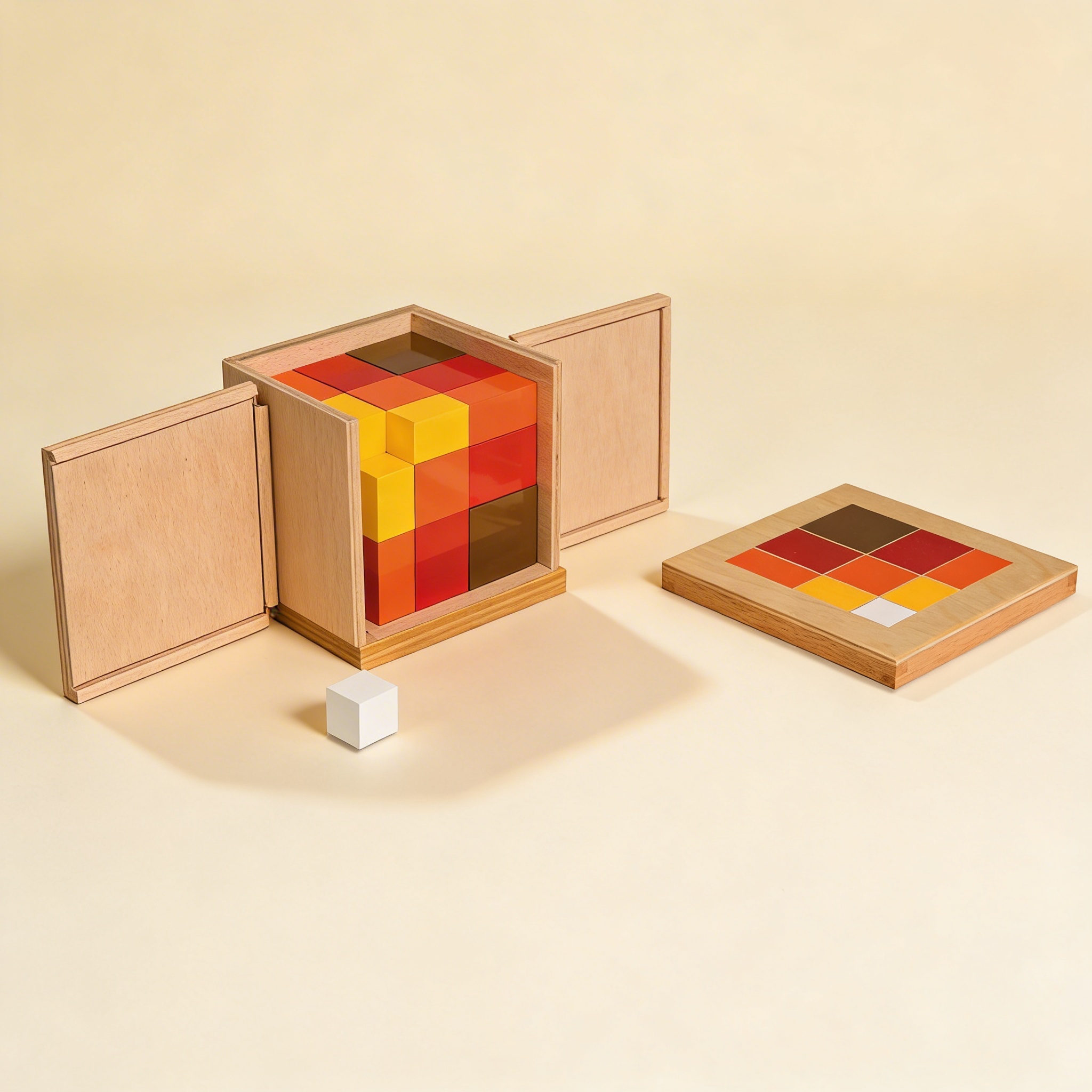
The Arithmetic Trinomial Cube — Advanced Mathematical Formula Exploration is a Sensorial Montessori material designed for children aged 6-12, crafted by Nienhuis Montessori to AMI standards.
The Arithmetic Trinomial Cube is an advanced Montessori sensorial material that bridges the gap between concrete manipulation and abstract mathematical thinking. This color-coded wooden puzzle represents the algebraic formula (a+b+c)³ in three dimensions, allowing children to explore complex mathematical relationships through hands-on exploration and pattern recognition.
“The child is both a hope and a promise for mankind.”— Maria MontessoriEducation and Peace
“The hands are the instruments of man's intelligence.”
— Maria Montessori, The Absorbent Mind
The Arithmetic Trinomial Cube embodies Dr. Montessori's principle that children possess mathematical minds capable of understanding complex concepts when presented through concrete materials. This material represents the transition from sensorial exploration to mathematical abstraction, allowing children to discover algebraic relationships through manipulation rather than memorization. By working with the cube, children experience the formula (a+b+c)³ as a tangible reality before encountering it symbolically. The material respects the child's need for repetition and self-correction, as the cube can only be assembled correctly when mathematical relationships are properly understood. This bridges the elementary child's growing capacity for abstraction while honoring their continued need for concrete experiences, demonstrating that advanced mathematics emerges naturally from sensorial foundations.
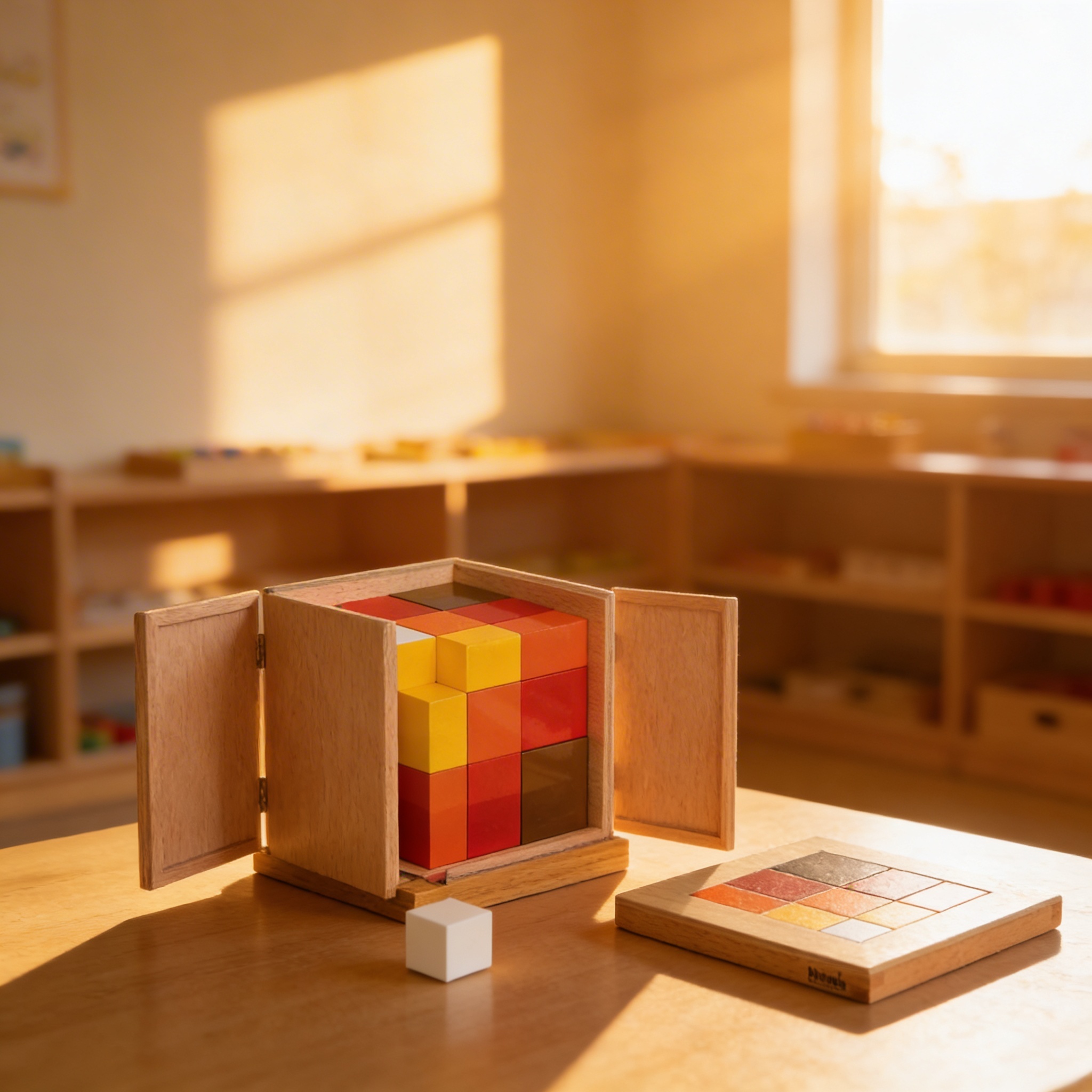
Each order includes everything needed for proper presentation and long-term use.
Follow the Montessori method of presentation for optimal child development.
Open the box and carefully remove all 27 pieces, laying them out systematically on the mat
Identify the three different edge lengths representing a, b, and c values through careful observation
Begin reconstruction by placing the a³ cube in one corner, then systematically add pieces that share common faces
Notice how each piece represents a term in the expansion: a³, 3a²b, 3a²c, 3ab², 6abc, etc.
Complete the cube and verify all faces show the characteristic pattern of the trinomial square
Record the completed cube pattern and write the algebraic expansion: (a+b+c)³
Every material is carefully selected for durability, safety, and authentic Montessori experience.
Each block is crafted to exact specifications, ensuring perfect fit and alignment when constructing the cube, essential for understanding mathematical relationships.
Each material supports multiple areas of child development simultaneously.
Prepares children for algebra by providing concrete representation of abstract mathematical concepts through sensorial exploration.
Develops three-dimensional thinking and spatial reasoning through manipulation of geometric forms and pattern recognition.
Requires sustained focus and exact placement of blocks, refining fine motor control and attention to detail.
Strengthens ability to identify and reproduce complex patterns, fundamental for advanced mathematical thinking.
Designed for child-sized hands
Professional tips from AMI-trained guides to maximize the educational value of this material.
“Present this material only after the child has mastered the Binomial Cube and shows readiness for more complex challenges”
Allow extensive exploration time - some children need multiple sessions to internalize the relationships
Connect the material to other mathematical work by showing how the trinomial expansion appears in various contexts
Use the control of error inherent in the material - avoid correcting; let children discover mistakes through the puzzle's self-correcting nature
Everything you need to know about this material.
The Arithmetic Trinomial Cube visually represents the algebraic formula (a+b+c)³, teaching cube expansion, algebraic expressions, spatial relationships, and advanced mathematical patterns. Children explore volume, surface area, and the relationship between 2D and 3D representations while developing abstract thinking skills.
While the Sensorial Trinomial Cube focuses on visual discrimination and pattern recognition for younger children, the Arithmetic version introduces mathematical notation, algebraic formulas, and numerical relationships. It includes labels and requires children to understand the mathematical significance of each piece's dimensions.
Children should have mastered the Binomial Cube, understand basic multiplication and exponents, and be comfortable with abstract thinking. Typically introduced around age 9-10, students should have experience with the sensorial version and be ready to connect concrete manipulation with algebraic concepts.
Children begin by physically building the cube, then match pieces to algebraic expressions, create 2D representations on paper, and eventually work with the formula abstractly. This progression allows them to internalize complex mathematical relationships through repeated hands-on experience before moving to purely symbolic work.
Extensions include calculating the volume of individual pieces, exploring the expanded formula term by term, creating algebraic equations for each layer, connecting to Pascal's triangle, and preparing for polynomial multiplication. Children can also explore patterns in coefficients and prepare for advanced algebra.
Can't find what you're looking for?
Contact Our Experts
Share your experience with this material and help other educators and parents.
Bundle related materials and save. Free curriculum guide included with every set.


