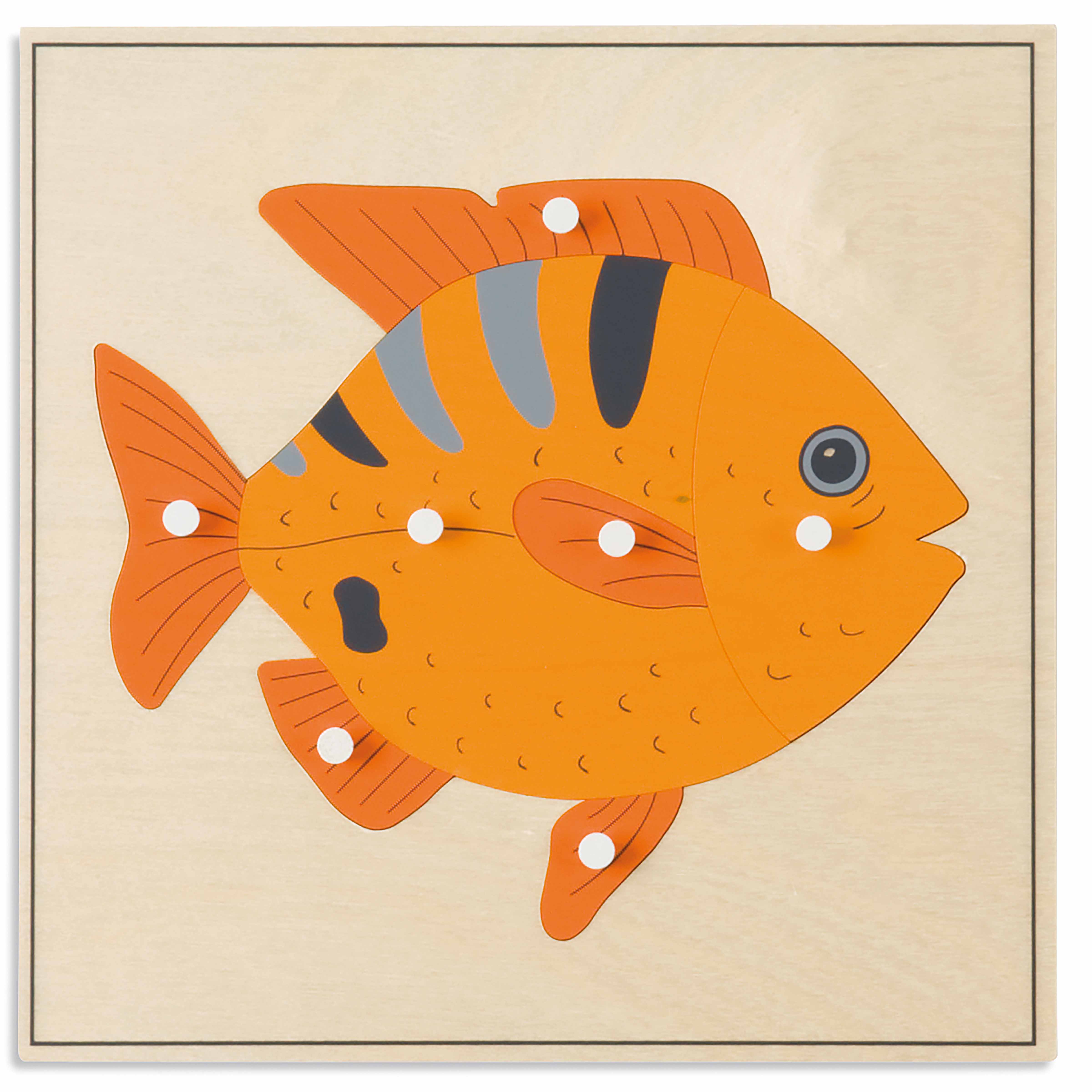
The Animal Puzzle: Fish is a category.biology Montessori material designed for children aged 3-6, crafted by Nienhuis Montessori to AMI standards.
This beautifully crafted wooden fish puzzle introduces young children to vertebrate anatomy through hands-on exploration. Each precisely cut piece represents a different part of the fish's body, allowing children to build understanding of animal structure while developing fine motor skills through the white knobs designed for easy manipulation.
“Education is a natural process spontaneously carried out by the human individual, and is acquired not by listening to words but by experiences upon the environment.”— Maria MontessoriEducation for a New World
“The child is both a hope and a promise for mankind.”
— Maria Montessori, Education and Peace
The Fish Puzzle serves as the child's first concrete exploration of vertebrate anatomy in the Montessori biology curriculum. Each wooden piece of the fish puzzle corresponds to an observable part of a real fish - the head, fins, tail, and body segments - allowing children to construct their understanding of animal structure through direct manipulation. The white knobs on each puzzle piece enable independent work, as three-year-olds can successfully grasp and position the pieces without adult assistance. This fish puzzle bridges the gap between the child's sensorial experiences with living creatures and their emerging capacity for scientific classification. By assembling the fish repeatedly, children internalize the relationship between parts and whole, preparing them for later work with more complex animal puzzles and classification materials. The puzzle's design reflects Maria Montessori's principle that biological study begins with concrete, manipulable representations before moving to abstract concepts.
Each order includes everything needed for proper presentation and long-term use.
Follow the Montessori method of presentation for optimal child development.
Invite the child to explore the empty puzzle frame, tracing the outline with their finger
Select the head piece first, grasping the white knob with thumb and index finger
Continue with the body sections, working from head to tail in sequence
Add the fins last - dorsal (top), pectoral (sides), and pelvic fins
Once complete, invite the child to remove and replace pieces independently
Every material is carefully selected for durability, safety, and authentic Montessori experience.
Selected for durability and smooth texture, the wood provides natural warmth while supporting repeated use in the classroom.
Each material supports multiple areas of child development simultaneously.
Introduces vertebrate anatomy and fish characteristics through concrete manipulation.
White knobs promote proper pencil grip while assembling intricate puzzle pieces.
Children learn to identify subtle differences in shape and pattern while matching pieces.
Multi-piece assembly requires sustained focus and sequential thinking skills.
Designed for child-sized hands
Professional tips from AMI-trained guides to maximize the educational value of this material.
“Present this puzzle after children have observed real fish in an aquarium or during a nature walk”
Keep a laminated control chart showing the completed puzzle for independent reference
Integrate with practical life by having children draw or paint fish after mastering the puzzle
Create a connection to cultural studies by exploring fish important to different world regions
Everything you need to know about this material.
This puzzle is designed for children ages 3-6 years old. The white knobs make it accessible for younger children still developing pincer grip, while the anatomical concepts provide learning opportunities that grow with the child through age 6.
The puzzle features precisely cut wooden pieces representing different anatomical parts of a fish, including the head, body segments, fins, and tail. Each piece is designed to teach children about vertebrate structure and how the parts work together.
This puzzle follows Montessori principles by offering concrete, hands-on learning about abstract concepts. Children can manipulate real objects to understand fish anatomy, supporting sensorial learning and the movement from concrete to abstract thinking characteristic of Montessori education.
This puzzle develops multiple skills including fine motor control through knob manipulation, spatial reasoning through piece placement, scientific vocabulary related to animal anatomy, and early biology concepts about vertebrate structure and body parts.
Yes, the puzzle is self-correcting. Each piece fits only in its correct position, allowing children to work independently and learn through trial and error. This built-in control of error helps children develop problem-solving skills and confidence in their abilities.
Can't find what you're looking for?
Contact Our Experts
Share your experience with this material and help other educators and parents.


