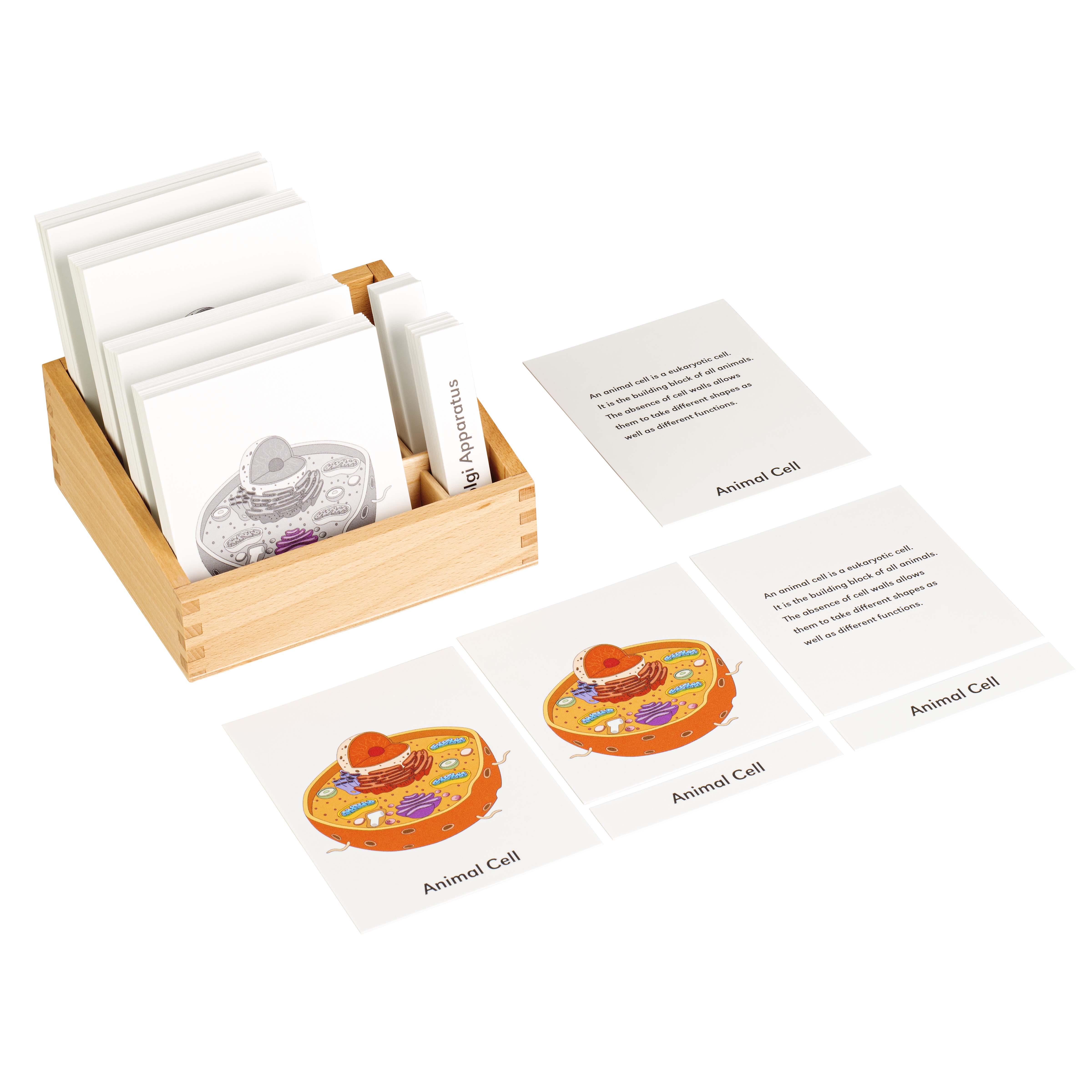
The Animal Cell Nomenclature Cards is a category.biology Montessori material designed for children aged 3-6, crafted by Nienhuis Montessori to AMI standards.
These Animal Cell Nomenclature Cards introduce children to cellular biology through beautifully illustrated diagrams and corresponding labels. The laminated cards feature detailed animal cell structures with separate definition cards, allowing children to match parts to names and learn scientific vocabulary. Stored in a practical wooden box with dividers, this material supports the Montessori approach to introducing complex scientific concepts through concrete, manipulable materials.
“Education is a natural process spontaneously carried out by the human individual, and is acquired not by listening to words but by experiences upon the environment.”— Maria MontessoriEducation for a New World
“The child is both a hope and a promise for mankind.”
— Maria Montessori, Education and Peace
The Animal Cell Nomenclature Cards serve the young child's innate scientific interest by presenting cellular structures as concrete, visible entities rather than abstract concepts. These laminated cards transform microscopic cellular components into tangible learning materials that children can hold, examine, and organize. The detailed diagrams on each card satisfy the child's need for precision while the separate definition cards engage their emerging reading abilities. By matching cellular structures to their scientific names, children build vocabulary through visual association rather than rote memorization. The wooden storage box with dividers reflects the Montessori principle of order, allowing children to maintain and return the cards systematically. These nomenclature cards bridge the child's sensorial exploration with scientific classification, introducing complex biological concepts when the child demonstrates readiness for detailed observation. The material respects the child's capacity to understand sophisticated ideas when presented through appropriate concrete representations.
Each order includes everything needed for proper presentation and long-term use.
Follow the Montessori method of presentation for optimal child development.
Present the complete cell diagram, pointing to and naming 2-3 main structures
Match the corresponding label cards to each structure you've introduced
Read the definition cards for these structures, placing them next to their labels
Invite the child to continue matching remaining structures independently
Use the control card to verify correct matches
Every material is carefully selected for durability, safety, and authentic Montessori experience.
The wooden box provides durable, organized storage while connecting children to natural materials, reinforcing the Montessori principle of using authentic materials in the learning environment.
Each material supports multiple areas of child development simultaneously.
Introduces precise biological terminology through concrete visual representations, building a foundation for future scientific learning.
Matching activities develop the ability to identify and differentiate cellular structures and their corresponding labels.
Definition cards support emerging readers in connecting scientific concepts to written descriptions.
Organizing and categorizing cell parts develops logical thinking and systematic approach to learning.
Designed for child-sized hands
Professional tips from AMI-trained guides to maximize the educational value of this material.
“Introduce this material after children have worked with simpler nomenclature cards like parts of a flower”
Connect to real experiences by discussing how our bodies are made of cells
Keep a magnifying glass nearby to examine other materials and reinforce the concept of tiny structures
Create a cell model using clay or other materials after card work for hands-on reinforcement
Everything you need to know about this material.
Yes, the cards work perfectly for non-readers through the three-period lesson approach. Children first match identical pictures, then progress to matching pictures with labels, building vocabulary through repetition and visual recognition before formal reading begins.
The cards typically include major animal cell structures such as nucleus, cell membrane, cytoplasm, mitochondria, endoplasmic reticulum, Golgi apparatus, ribosomes, and lysosomes, with age-appropriate definitions for each component.
Unlike textbooks, these cards allow hands-on manipulation and self-corrected learning. Children can physically match, sort, and arrange the cards, making abstract cellular concepts concrete and engaging for young learners.
Absolutely! These cards complement plant cell nomenclature cards beautifully, allowing children to compare and contrast cellular structures between plant and animal cells, deepening their understanding of living organisms.
Start with picture-to-picture matching, progress to label reading and matching, then introduce definition cards. Finally, children can create their own booklets or drawings, reinforcing learning through multiple sensory experiences.
Can't find what you're looking for?
Contact Our Experts
Share your experience with this material and help other educators and parents.


