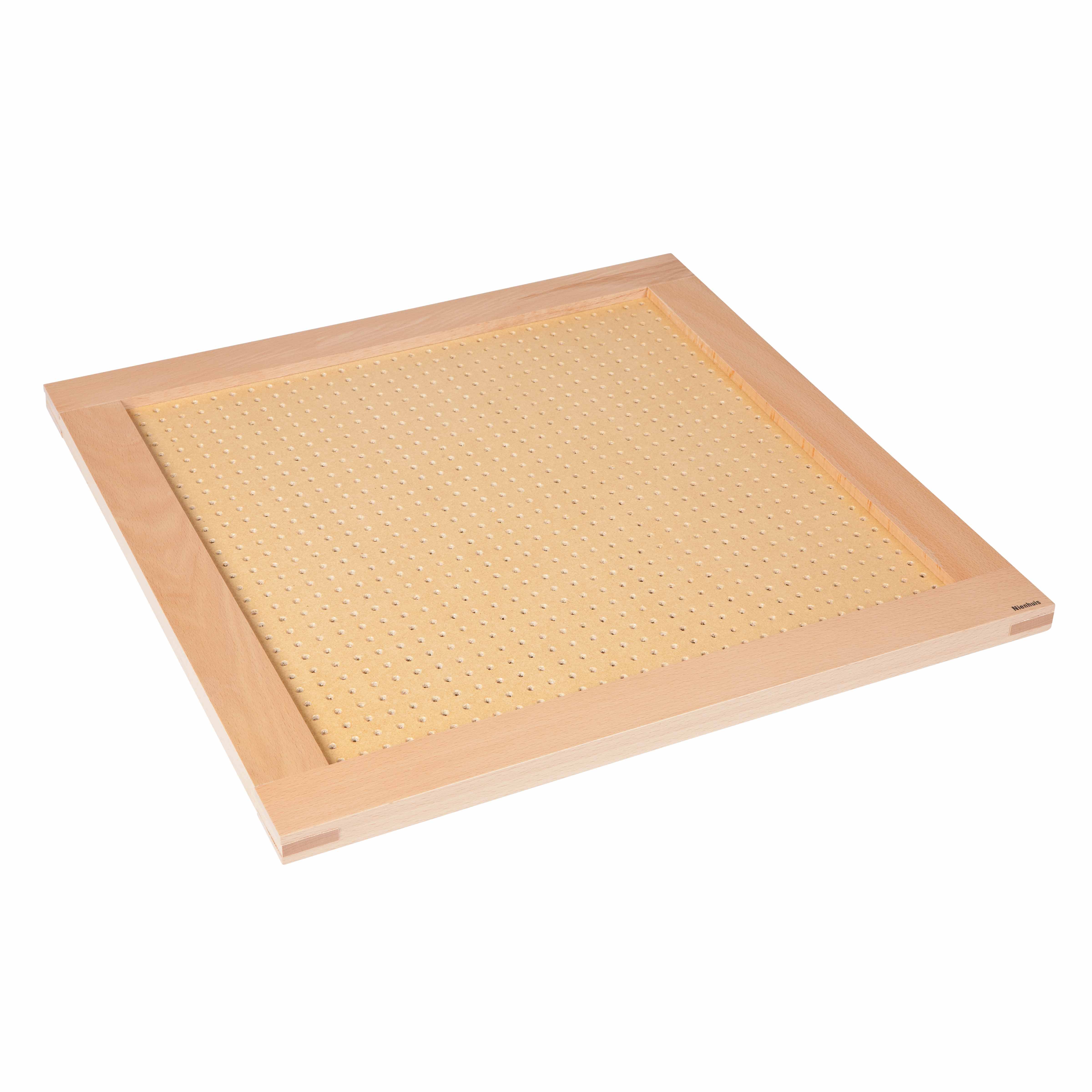
The Algebraic Peg Board is a Educational Materials Montessori material designed for children aged 6-12, crafted by Nienhuis Montessori to AMI standards.
The Algebraic Peg Board provides a concrete foundation for understanding algebraic concepts through hands-on manipulation. This precisely crafted board features a uniform grid of holes set within a smooth wooden frame, allowing children to create patterns, explore mathematical relationships, and visualize abstract algebraic principles using pegs or other manipulatives.
“The child is both a hope and a promise for mankind.”— Maria MontessoriEducation and Peace
“The hands are the instruments of man's intelligence.”
— Maria Montessori, The Absorbent Mind
The Algebraic Peg Board transforms abstract mathematical thinking into tangible exploration through its uniform grid of holes set within a smooth wooden frame. Maria Montessori recognized that children need concrete experiences before understanding abstractions, and the peg board's physical structure allows learners to build algebraic patterns with their hands before expressing them symbolically. Each hole in the grid represents a potential point in mathematical space, where children place pegs to discover relationships between quantities, explore geometric progressions, and investigate numerical patterns. The wooden frame provides boundaries that help organize mathematical thinking, while the open grid invites creative exploration of algebraic concepts. By manipulating pegs across the board's surface, children internalize fundamental algebraic principles like variables, expressions, and equations through repeated sensorial experience. The peg board bridges the critical gap between arithmetic operations and algebraic reasoning, allowing the child to literally see and touch mathematical relationships before moving to written notation.
Each order includes everything needed for proper presentation and long-term use.
Follow the Montessori method of presentation for optimal child development.
Begin with simple repeating patterns using two colors of pegs in the first row
Create growing patterns where each row has one more peg than the previous
Explore skip counting by placing pegs in every 2nd, 3rd, or 5th hole
Build geometric shapes and calculate their perimeters using peg placement
Introduce coordinate pairs by labeling rows and columns with numbers
Every material is carefully selected for durability, safety, and authentic Montessori experience.
The solid wood frame provides durability while offering children a warm, natural tactile experience that connects mathematical learning with the natural world.
Each material supports multiple areas of child development simultaneously.
Bridges concrete manipulation with abstract algebraic concepts through visual and tactile pattern creation.
Develops logical thinking and problem-solving skills through hands-on exploration of mathematical relationships.
Enhances ability to identify, create, and extend patterns essential for algebraic understanding.
Strengthens spatial reasoning through grid-based activities and geometric pattern formation.
Designed for child-sized hands
Professional tips from AMI-trained guides to maximize the educational value of this material.
“Present the board after children are confident with bead chains and skip counting materials”
Keep a photograph record of interesting patterns children create for later algebraic discussions
Connect peg patterns to written expressions gradually, allowing concrete work to precede abstraction
Use the board for collaborative work where children create patterns for peers to continue
Everything you need to know about this material.
Children can explore patterns, sequences, geometric shapes, multiplication arrays, factors, algebraic expressions, and coordinate graphing. The board allows visual representation of abstract concepts like variables, equations, and mathematical relationships through hands-on manipulation.
The board includes a smooth wooden frame with a uniform grid of holes. Pegs or manipulatives for use with the board may need to be purchased separately. Check product specifications to confirm if pegs are included with your specific purchase.
The peg board bridges concrete and abstract learning by allowing children to physically create and manipulate mathematical patterns before moving to written equations. This hands-on approach helps children internalize algebraic concepts through sensorial experience before working with abstract symbols.
While suitable for ages 6-12, children typically begin with simple pattern work around age 6-7 and progress to more complex algebraic concepts by ages 9-12. The material grows with the child, offering increasingly sophisticated applications as mathematical understanding develops.
Yes, the Algebraic Peg Board is excellent for geometry exploration. Children can create geometric shapes, study symmetry, explore area and perimeter concepts, investigate transformations, and discover geometric patterns, making it a versatile mathematical tool beyond algebraic applications.
Can't find what you're looking for?
Contact Our Experts
Share your experience with this material and help other educators and parents.


