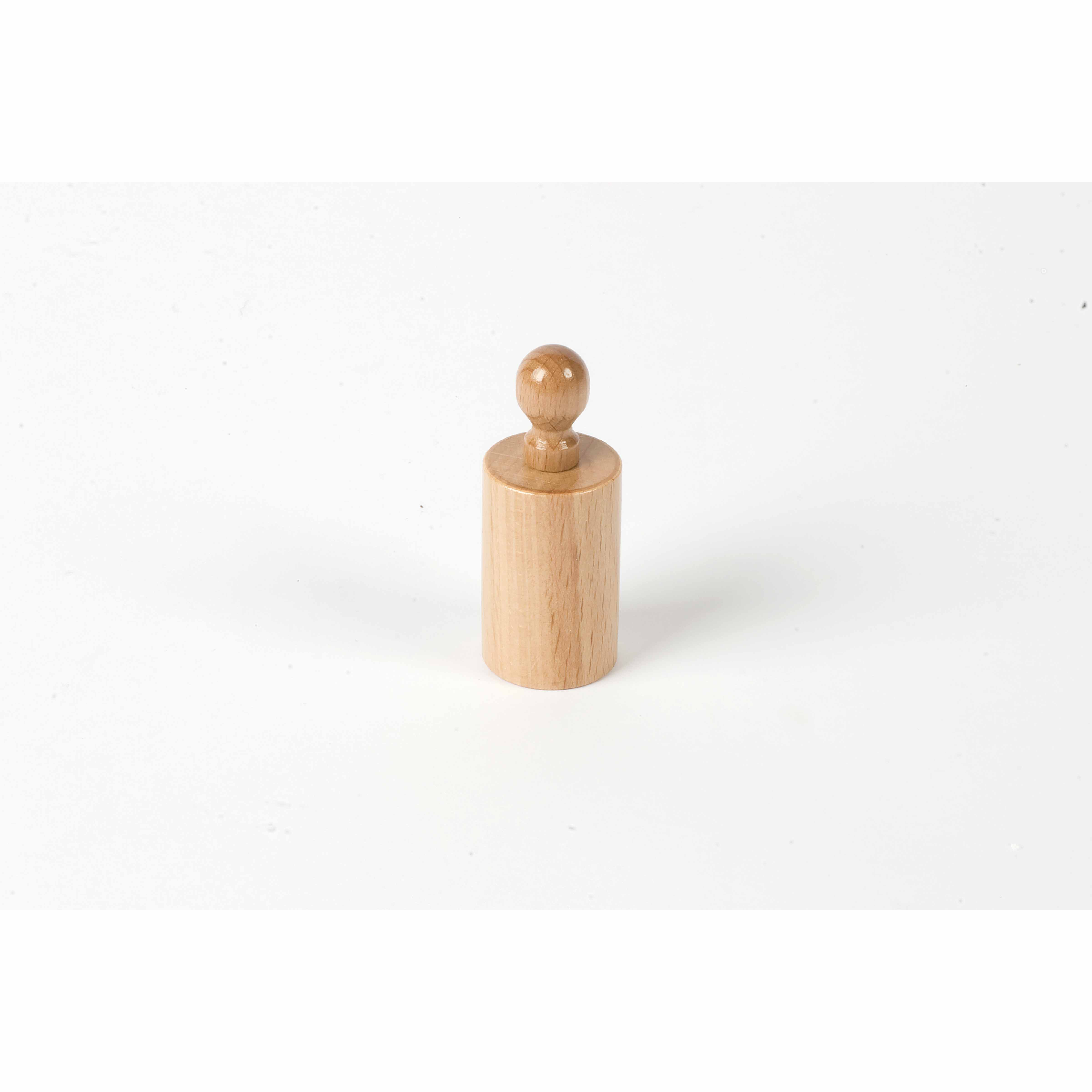
The 4th Cylinder Of Block No. 3 is a Sensorial Montessori material designed for children aged 3-6, crafted by Nienhuis Montessori to AMI standards.
This precision-crafted wooden cylinder represents one component of the iconic Cylinder Block No. 3 set, designed to refine visual discrimination and dimensional awareness. The smooth natural wood cylinder features a spherical knob handle, inviting young hands to explore variations in diameter while maintaining consistent height, a fundamental exercise in the Montessori sensorial curriculum.
“The senses, being explorers of the world, open the way to knowledge.”— Maria MontessoriThe Discovery of the Child
“Children display a universal love of mathematics, which is par excellence the science of precision, order, and intelligence.”
— Maria Montessori, The Discovery of the Child
The 4th Cylinder of Block No. 3 embodies Maria Montessori's principle of isolating a single quality for focused exploration. This wooden cylinder, with its specific diameter and spherical knob handle, creates a precise sensorial experience where children distinguish dimensional variations through touch and sight. The smooth wood surface and carefully calibrated size of this fourth cylinder provide exact feedback to small fingers learning to discriminate between subtle differences in diameter. By working with individual cylinders from Block No. 3, children build neural pathways for mathematical thinking through concrete manipulation of graduated dimensions. The spherical knob atop each cylinder serves as both a practical grip and a visual cue, helping young hands develop the pincer grasp essential for writing. This single cylinder's role within the complete Block No. 3 set demonstrates how isolated practice with one dimension—diameter variation with constant height—prepares the mind for understanding mathematical relationships and spatial concepts.
Each order includes everything needed for proper presentation and long-term use.
Follow the Montessori method of presentation for optimal child development.
Demonstrate holding the cylinder by its knob using thumb and first two fingers
If working with multiple cylinders, select two with noticeable diameter differences for initial comparison
Place cylinders side by side to visually compare diameters
Introduce comparative language: 'This one is thicker, this one is thinner'
Invite the child to feel the diameter difference with fingertips
Every material is carefully selected for durability, safety, and authentic Montessori experience.
Carefully selected hardwood provides the perfect weight and smooth texture for sensorial exploration, allowing children to focus on dimensional differences without distraction.
Each material supports multiple areas of child development simultaneously.
Refines the ability to perceive subtle differences in diameter while maintaining awareness of constant height.
The spherical knob handle develops precise pincer grip and controlled movement patterns.
Prepares for understanding of dimensional relationships and measurement concepts through concrete sensorial experience.
Designed for child-sized hands
Professional tips from AMI-trained guides to maximize the educational value of this material.
“Store individual cylinders in a designated container when separated from the block for focused work”
Pair diameter exploration with vocabulary lessons using three-period naming
Document which cylinder comparisons challenge each child for targeted practice
Create extension work by tracing cylinder bases to explore circular diameter differences
Everything you need to know about this material.
Cylinder Block No. 3 features cylinders that vary in diameter while maintaining the same height, allowing children to isolate and focus on one dimensional change at a time. This helps develop visual discrimination skills specific to width perception.
This is the 4th cylinder from Block No. 3, sold individually. It can serve as a replacement piece for an existing set or be purchased alongside other cylinders to complete or maintain your Cylinder Block No. 3.
As the 4th cylinder in Block No. 3, this piece has a specific diameter that fits precisely into the 4th hole of the block. All cylinders in Block No. 3 share the same height but vary in diameter from thinnest to thickest.
Individual cylinder work develops pincer grip, hand-eye coordination, and concentration. Children learn to visually discriminate size differences, understand serialization, and prepare indirectly for mathematical concepts like gradation and dimension.
Typically introduced around age 3-3.5, after children have mastered simpler knobbed puzzles. The child should demonstrate adequate pincer grip control and show interest in fitting objects into corresponding spaces before beginning cylinder block work.
Can't find what you're looking for?
Contact Our Experts
Share your experience with this material and help other educators and parents.


