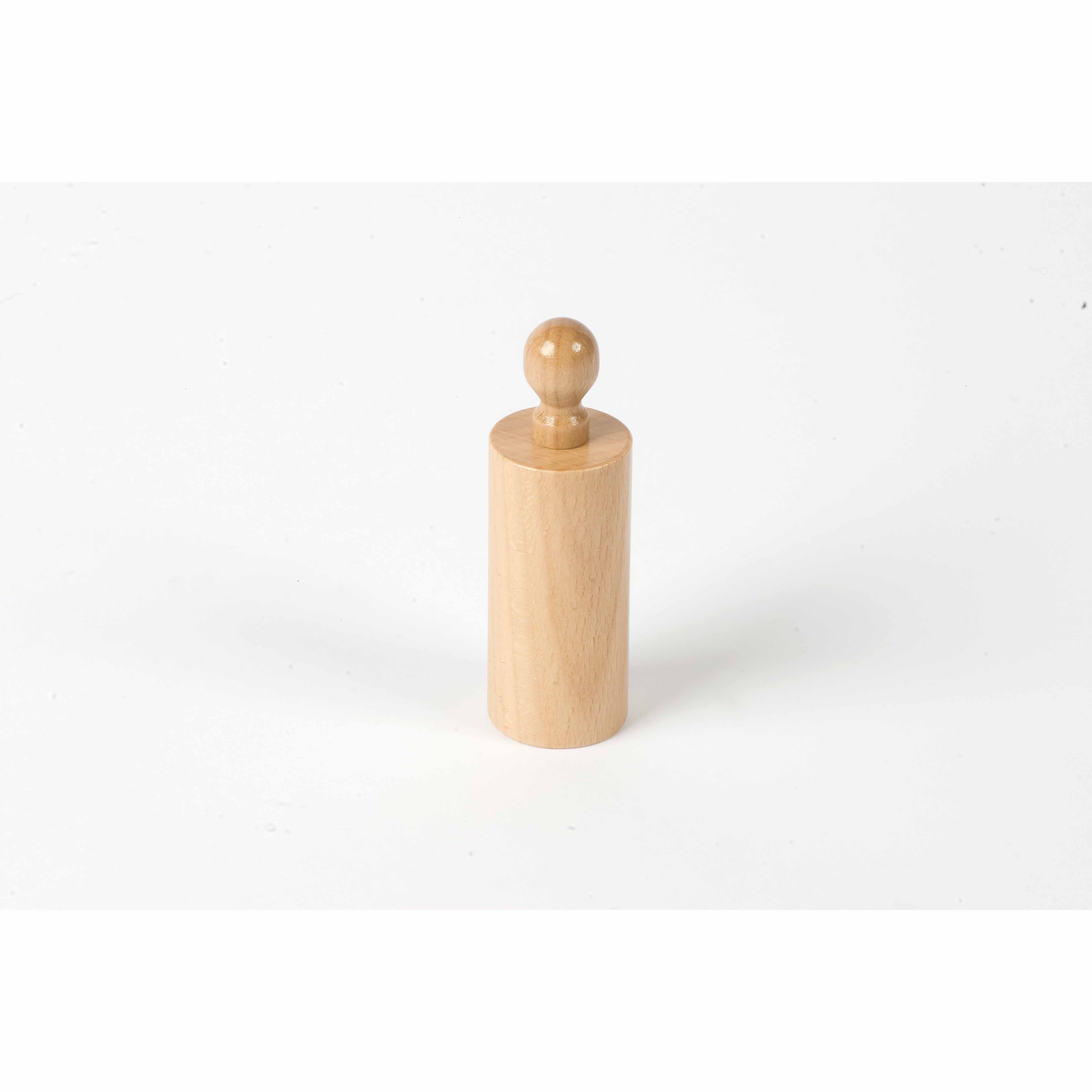
The 4th Cylinder Of Block No. 2 is a Sensorial Montessori material designed for children aged 3-6, crafted by Nienhuis Montessori to AMI standards.
This 4th Cylinder from Block No. 2 is part of the classic Montessori Cylinder Blocks material, designed to refine visual discrimination of dimension. The smooth wooden cylinder features a spherical knob handle that promotes proper pencil grip while children explore variations in height and diameter through precise manipulation.
“The senses, being explorers of the world, open the way to knowledge.”— Maria MontessoriThe Discovery of the Child
“Children display a universal love of mathematics, which is par excellence the science of precision, order, and intelligence.”
— Maria Montessori, The Discovery of the Child
The 4th Cylinder from Block No. 2 addresses the child's developmental need to organize sensory impressions through systematic exploration of dimension. This wooden cylinder's specific variations in both height and diameter require the child to make precise visual judgments that cannot be corrected through trial and error alone. The spherical knob handle of this cylinder serves a dual purpose: enabling the refinement of the pincer grasp essential for writing preparation while demanding careful observation of the cylinder's unique proportions. Unlike puzzles that offer immediate feedback, this individual cylinder from Block No. 2 requires the child to mentally hold and compare dimensional relationships, developing what Montessori termed the 'mathematical mind.' The smooth wooden surface and precise craftsmanship of the 4th cylinder allow the child to focus solely on the dimensional qualities without distraction, building the perceptual discrimination necessary for later work in mathematics and geometry.
Each order includes everything needed for proper presentation and long-term use.
Follow the Montessori method of presentation for optimal child development.
Demonstrate holding the spherical knob with thumb and two fingers, lifting the cylinder slowly
Place the cylinder vertically on the table, allowing the child to observe its proportions
Invite the child to lift and examine the cylinder, noting both height and diameter
Introduce vocabulary: 'tall/short' and 'thick/thin' while handling the cylinder
Every material is carefully selected for durability, safety, and authentic Montessori experience.
Carefully selected hardwood provides the perfect weight and smooth texture for sensorial exploration, allowing children to focus on dimensional differences.
Each material supports multiple areas of child development simultaneously.
Helps children perceive and understand subtle differences in dimension through hands-on exploration.
The spherical knob handle promotes proper pincer grasp essential for writing preparation.
Introduces concepts of gradation, serialization, and dimensional relationships through concrete manipulation.
Focused work with the cylinder develops sustained attention and precision in movement.
Designed for child-sized hands
Professional tips from AMI-trained guides to maximize the educational value of this material.
“Store this replacement cylinder with its corresponding block to maintain material completeness”
Check the spherical knob regularly for smooth finish to ensure proper grip development
Present this cylinder in isolation before reuniting with its block for focused dimension study
Observe whether children consistently confuse this cylinder's place - indicates need for more discrimination work
Everything you need to know about this material.
Block No. 2 cylinders vary in two dimensions simultaneously - both height and diameter change together. This 4th cylinder represents a specific size gradation within this series, helping children understand the relationship between multiple changing dimensions.
The knob handle is specifically designed to promote the three-finger pincer grip used for proper pencil holding. As children grasp and manipulate the cylinder, they naturally strengthen the muscles and develop the coordination needed for writing.
While designed as part of a complete set, individual cylinders can be used for matching activities, tracing exercises, or as replacement pieces. However, the full learning experience of comparing and grading dimensions requires multiple cylinders.
This material develops visual discrimination of dimension, fine motor control, hand-eye coordination, concentration, and problem-solving skills. It also indirectly prepares for mathematics by introducing concepts of gradation and seriation.
Children typically begin exploring cylinder blocks around age 3, when they have developed sufficient hand control and can focus on the task. The material remains engaging through age 6 as children refine their perception and discover mathematical relationships.
Can't find what you're looking for?
Contact Our Experts
Share your experience with this material and help other educators and parents.


