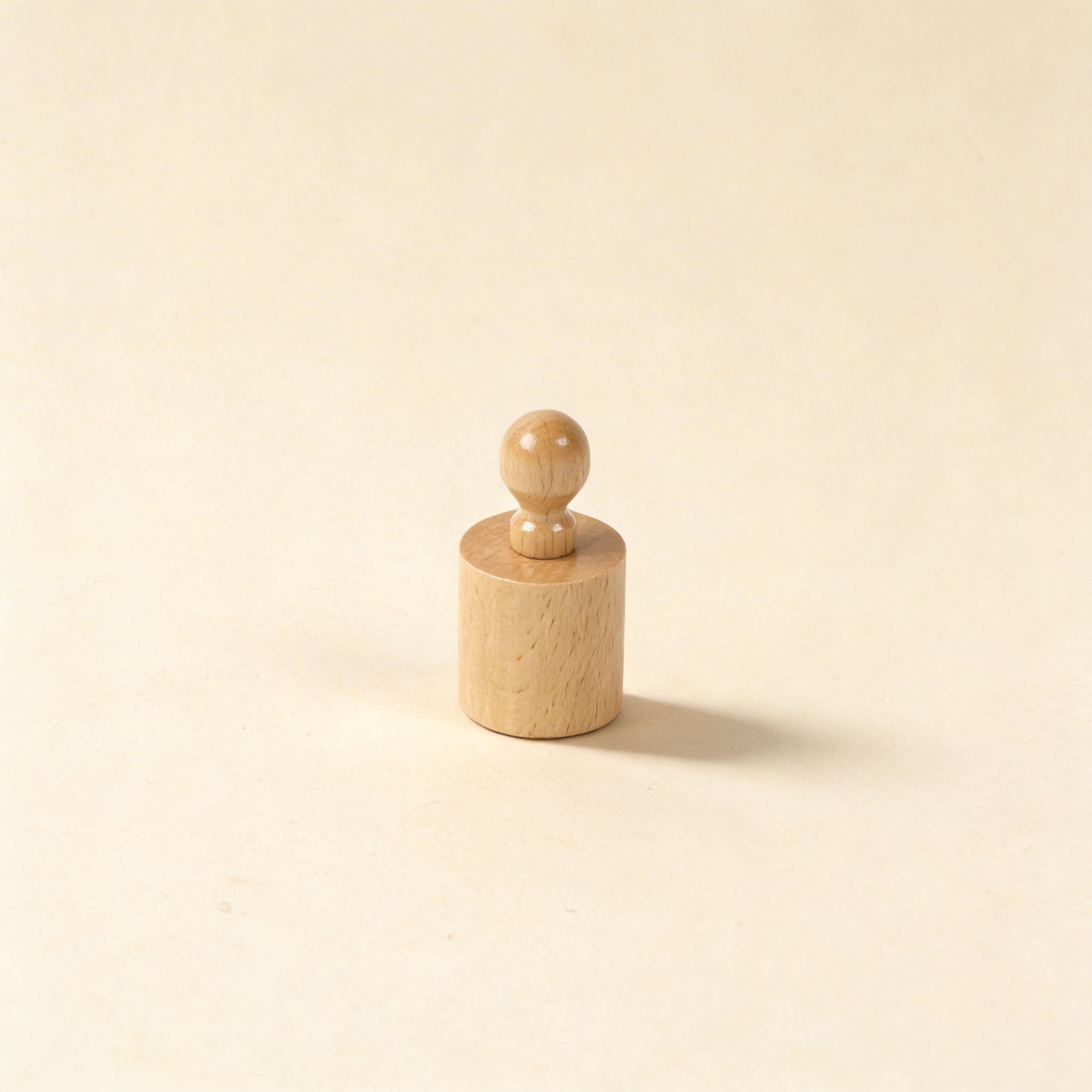
The Cylinder Block — 4th Individual Cylinder from Block No. 1 is a Sensorial Montessori material designed for children aged 3-6, crafted by Nienhuis Montessori to AMI standards.
This individual cylinder from the Montessori Cylinder Block No. 1 features a smooth natural wood construction with a spherical knob handle. Designed as a replacement piece or for extended sensorial exercises, it helps children refine their visual discrimination and pincer grasp while exploring dimensional relationships.
“Children display a universal love of mathematics, which is par excellence the science of precision, order, and intelligence.”— Maria MontessoriThe Discovery of the Child
“The greatest sign of success for a teacher is to be able to say, 'The children are now working as if I did not exist.'”
— Maria Montessori, The Absorbent Mind
The Cylinder Blocks embody Dr. Montessori's principle of isolation of difficulty, presenting one variable dimension while maintaining consistency in others. Block No. 1 specifically isolates variations in diameter while height remains constant, allowing the child to focus purely on visual discrimination of width. This material represents the refinement of the visual sense through concrete manipulation, moving from sensorial impression to abstract understanding. The smooth wood and precise dimensions offer immediate tactile and visual feedback, enabling self-correction without adult intervention. Through repeated exploration, the child internalizes concepts of gradation and develops the muscular memory essential for writing preparation. The individual cylinder serves as both a practical replacement and an opportunity for extended exploration, honoring the child's need for repetition during sensitive periods for order and refinement of movement.
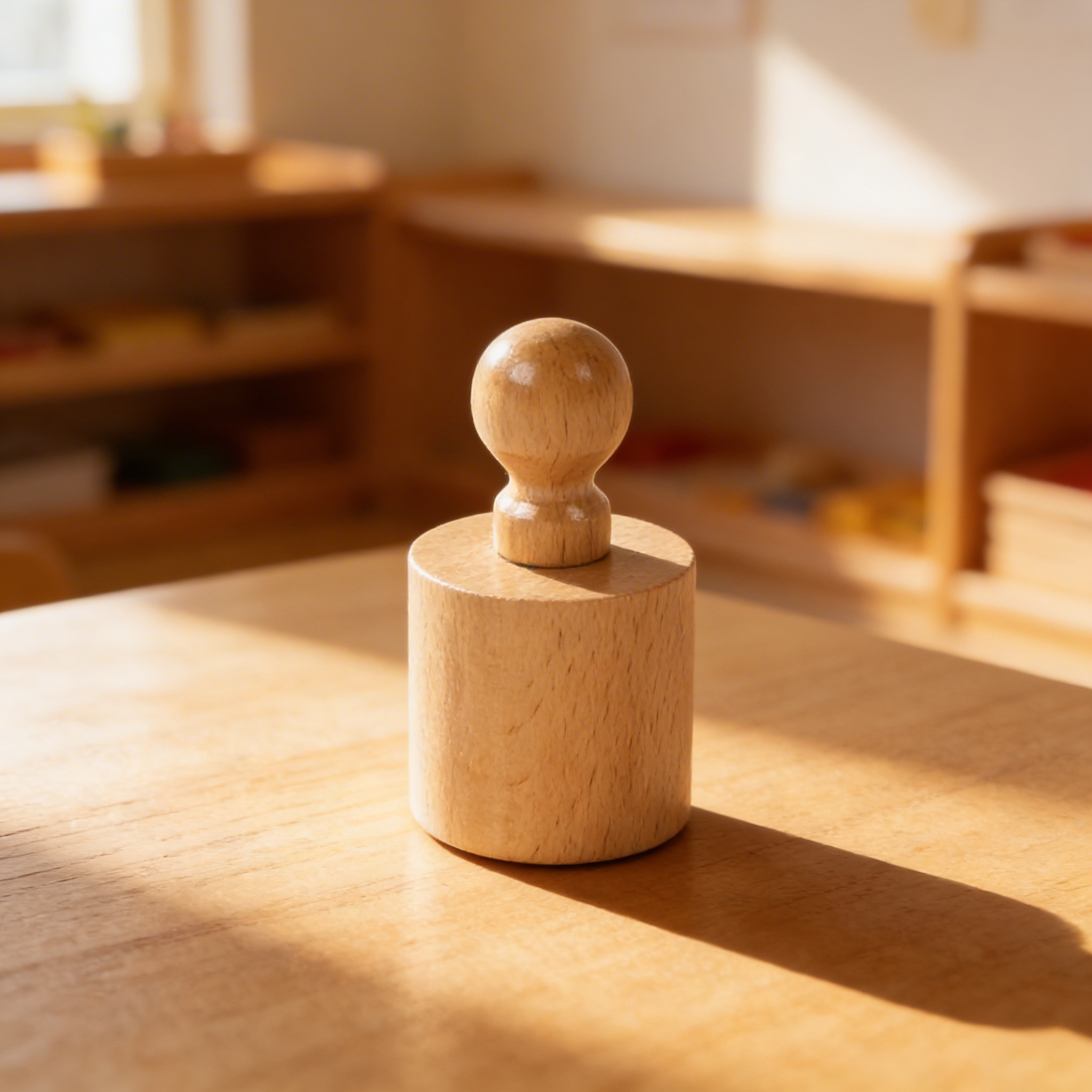
Each order includes everything needed for proper presentation and long-term use.
Follow the Montessori method of presentation for optimal child development.
Invite the child, saying 'I'd like to show you something.' Carry the tray with both hands to the table.
Grasp the knob with your dominant hand using a three-finger pincer grip. Lift slowly and deliberately.
Examine the cylinder visually, rotating it slowly to observe all dimensions.
If working with the complete block, demonstrate finding the correct socket by visual comparison.
Lower the cylinder into place with control, releasing when fully seated.
Every material is carefully selected for durability, safety, and authentic Montessori experience.
Provides authentic sensorial experience with natural texture and weight, essential for developing tactile discrimination
Each material supports multiple areas of child development simultaneously.
Helps children perceive subtle differences in dimensions through careful observation
Spherical knob design strengthens finger muscles and prepares hand for writing
Focused manipulation of individual cylinder builds sustained attention and precision
Designed for child-sized hands
Professional tips from AMI-trained guides to maximize the educational value of this material.
“Present this work only after the child has mastered the complete Cylinder Block No. 1 to ensure understanding of the gradation concept”
Observe the child's grip development - transition from palmar to pincer grasp indicates readiness for writing materials
Store replacement cylinders separately from complete blocks to maintain the integrity of the full sets
thick/thin, thicker/thinner, thickest/thinnest
Everything you need to know about this material.
The 4th cylinder from Block No. 1 follows the systematic progression of this block, where cylinders vary in both diameter and height. Each cylinder in Block 1 increases proportionally in both dimensions, with the 4th cylinder being medium-sized within the set of 10 cylinders.
Yes, individual cylinders can be used for isolated sensorial exercises, matching activities with other cylinders, or as replacement pieces. However, the full learning experience of dimensional relationships is best achieved when used with the complete Block No. 1 set.
This cylinder helps develop visual discrimination of dimensions, pincer grasp refinement, hand-eye coordination, concentration, and preparation for mathematical concepts. Children learn to perceive subtle differences in size while strengthening the muscles needed for writing.
Block No. 1 cylinders vary in both diameter and height simultaneously. The 4th cylinder is the fourth smallest in the series. If your block has cylinders that change in two dimensions together, and you're missing the 4th position, this is the correct replacement.
Children typically begin working with cylinder blocks around age 3 to 3.5 years, when they have developed sufficient hand control and concentration. The activity remains engaging through age 6, with children discovering new challenges and variations as their discrimination abilities refine.
Can't find what you're looking for?
Contact Our Experts
Share your experience with this material and help other educators and parents.
Bundle related materials and save. Free curriculum guide included with every set.


