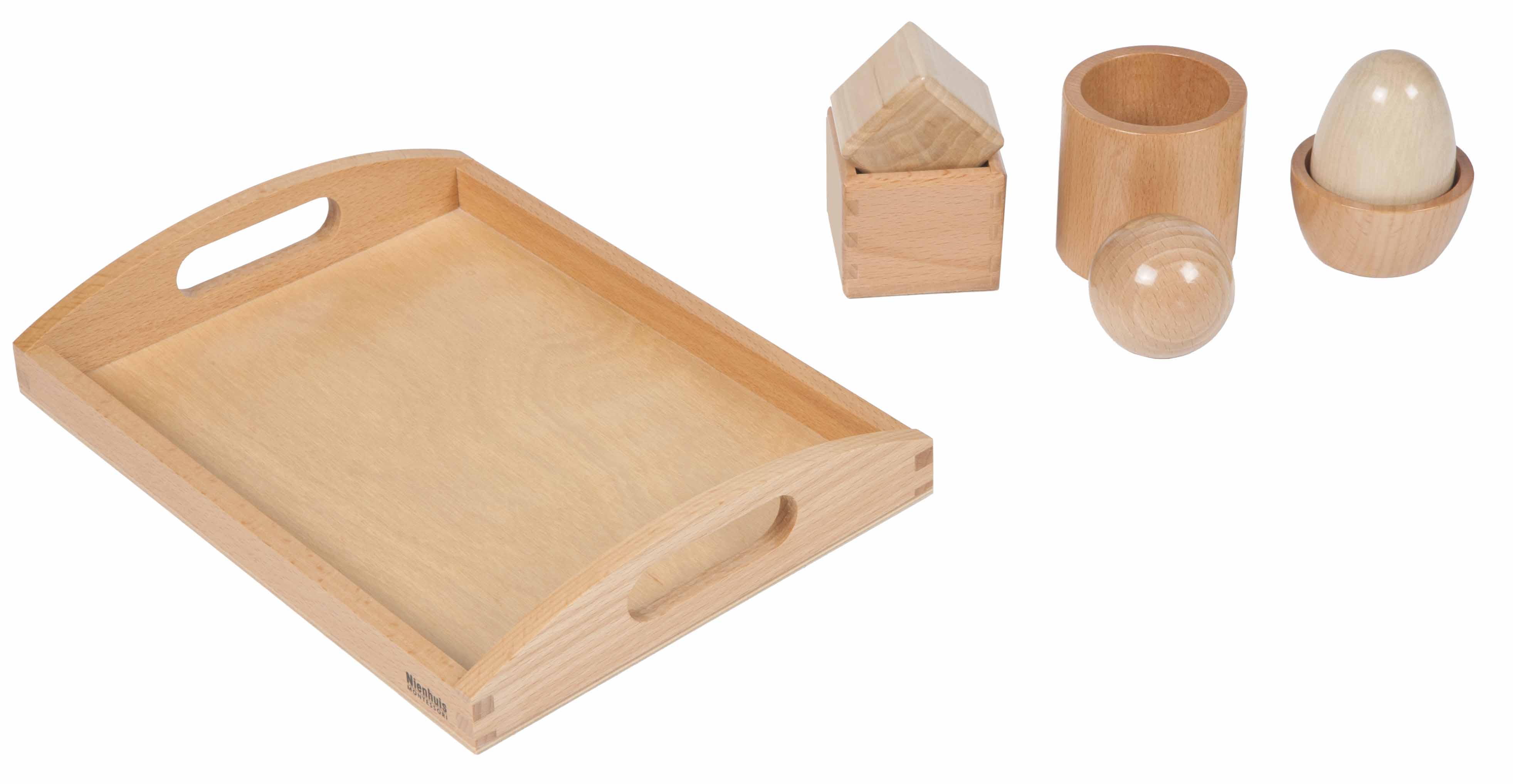
The 3d Object Fitting Exercise is a Educational Materials Montessori material designed for children aged 0-3, crafted by Nienhuis Montessori to AMI standards.
This elegant 3D Object Fitting Exercise introduces toddlers to fundamental geometric forms through hands-on exploration. The natural beechwood tray features four distinct shapes—cube, cylinder, ovoid, and sphere—each with a corresponding base for precise fitting exercises. The dual-handle design promotes independence, allowing young children to transport their work while developing spatial awareness and fine motor control.
“The child is both a hope and a promise for mankind.”— Maria MontessoriEducation and Peace
“The hands are the instruments of man's intelligence.”
— Maria Montessori, The Absorbent Mind
The 3D Object Fitting Exercise addresses the toddler's innate need to explore three-dimensional forms through purposeful hand movements. Between ages 0-3, children develop spatial intelligence by physically manipulating the cube, cylinder, ovoid, and sphere, discovering how each shape relates to its matching base. The natural beechwood tray with dual handles respects the child's drive for independence, allowing them to carry their chosen work to any workspace. Each geometric form in the 3D Object Fitting Exercise provides distinct tactile feedback—the cube's sharp edges, the sphere's continuous curve, the cylinder's rolling motion, and the ovoid's unique asymmetry. This material bridges the gap between the infant's grasping reflex and the preschooler's refined pencil grip, as fitting each shape requires different hand positions and pressures. The 3D Object Fitting Exercise isolates the concept of form, preparing the mathematical mind to later recognize these shapes in their environment and abstract geometric study.
Each order includes everything needed for proper presentation and long-term use.
Follow the Montessori method of presentation for optimal child development.
Invite the child by carrying the tray with both handles to a work mat
Remove one shape (start with the sphere) and explore it with both hands
Demonstrate fitting the sphere into its round base with gentle pressure
Return the sphere and invite the child to try
Continue with remaining shapes in order of difficulty: cylinder, cube, ovoid
Every material is carefully selected for durability, safety, and authentic Montessori experience.
Selected for its fine grain and durability, beechwood provides the perfect weight and texture for young hands learning to discriminate between shapes.
Each material supports multiple areas of child development simultaneously.
Matching each solid to its base strengthens hand-eye coordination and spatial reasoning essential for later mathematical concepts.
Handling three-dimensional forms builds the foundation for geometry while refining the visual and tactile senses.
The self-correcting nature of fitting exercises promotes focused attention and problem-solving skills.
Returning shapes to their bases after exploration instills habits of completing work cycles and maintaining the prepared environment.
Designed for child-sized hands
Professional tips from AMI-trained guides to maximize the educational value of this material.
“Observe which shape the child gravitates toward first—this reveals their current spatial understanding level”
If a child forces shapes, model gentle placement rather than verbal correction
Rotate shapes weekly to maintain interest—sometimes present only two shapes for younger toddlers
Use this material to assess readiness for more complex shape sorting work
Everything you need to know about this material.
This material is designed for children ages 0-3 years, with most children beginning to show interest around 12-18 months when they can sit independently and grasp objects with control.
This exercise develops hand-eye coordination, spatial awareness, fine motor control, shape discrimination, and concentration. It also promotes independence through the dual-handle design that allows children to carry their own work.
The tray and shapes are crafted from natural beechwood with a smooth, child-safe finish. The set includes four geometric solids (cube, cylinder, ovoid, and sphere) with corresponding bases, sized appropriately for toddler hands.
Children explore each shape through touch, then practice fitting each solid into its matching base. The exercise progresses from simple exploration to precise placement, building coordination and understanding of 3D forms.
Yes, each shape fits only in its corresponding base, providing immediate feedback to the child. This self-correcting feature allows independent learning and builds confidence through successful completion of the exercise.
Can't find what you're looking for?
Contact Our Experts
Share your experience with this material and help other educators and parents.


