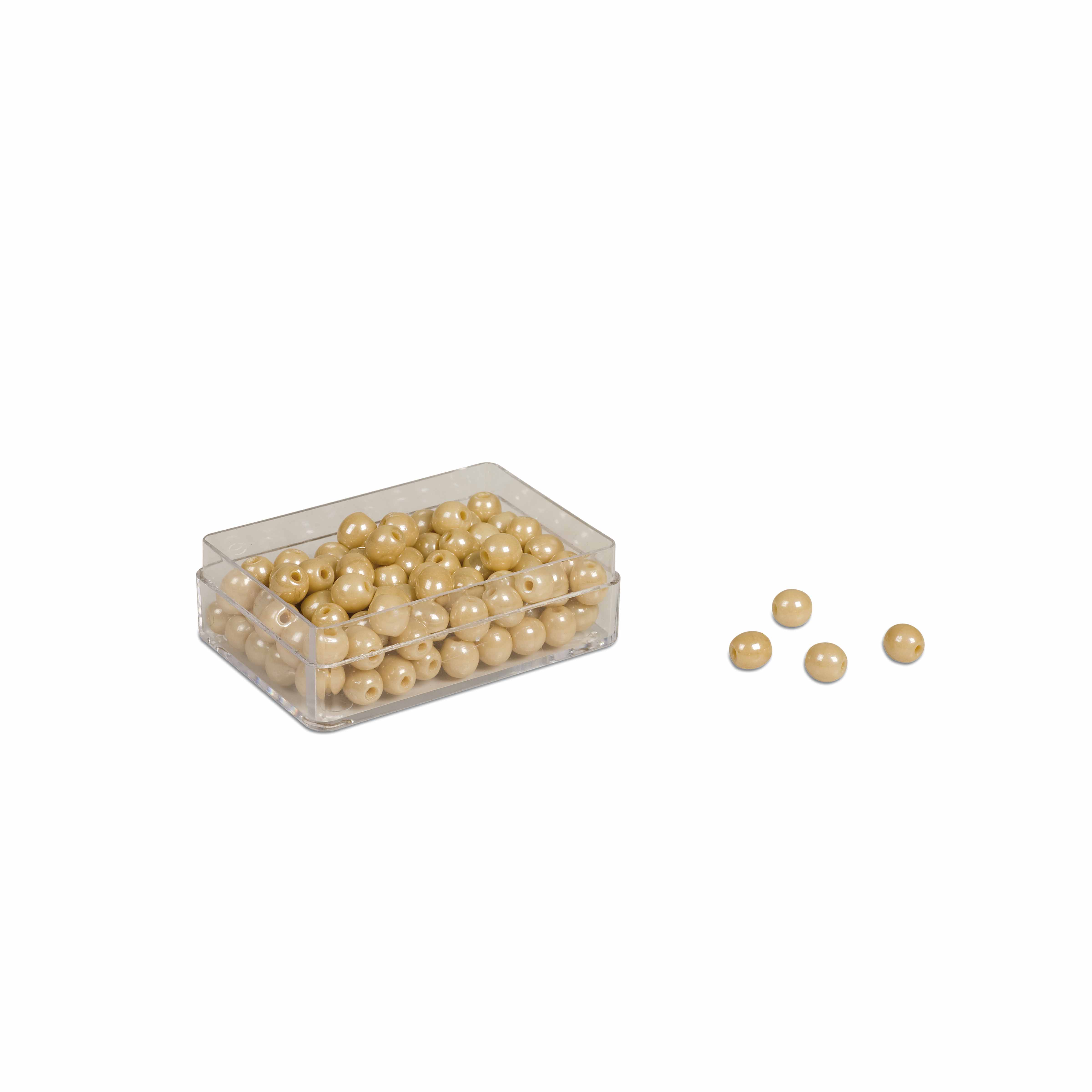
The 100 Golden Bead Units: Individual Beads Glass is a Mathematics Montessori material designed for children aged 3-6, crafted by Nienhuis Montessori to AMI standards.
These premium glass golden bead units provide the tactile weight and visual clarity essential for concrete mathematical understanding in the Montessori decimal system. Each perfectly spherical glass bead represents a single unit, allowing children to physically manipulate quantities while building number sense through the signature golden material that connects all mathematical concepts in the Casa environment.
“Children display a universal love of mathematics, which is par excellence the science of precision, order, and intelligence.”— Maria MontessoriThe Discovery of the Child
“The greatest sign of success for a teacher is to be able to say, 'The children are now working as if I did not exist.'”
— Maria Montessori, The Absorbent Mind
The 100 Golden Bead Units serve as the foundation of mathematical abstraction in Montessori education, where each glass bead becomes a tangible representation of the abstract concept 'one.' Through handling these individual glass beads, children internalize that numbers represent real quantities they can touch, move, and count. The golden color unifies these unit beads with tens bars, hundred squares, and thousand cubes, creating a visual and conceptual thread throughout the decimal system. The weight of glass beads provides essential sensorial feedback—when a child holds ten individual beads versus a ten-bar, they feel the same weight, reinforcing that ten units equal one ten. This physical manipulation of glass units builds the concrete foundation necessary before children can work with abstract numbers, as each bead's spherical form and golden shine makes the concept of 'unit' memorable and distinct.
Each order includes everything needed for proper presentation and long-term use.
Follow the Montessori method of presentation for optimal child development.
Invite the child to count out specific quantities of beads, starting with small numbers like 3 or 5
Match the counted beads to corresponding number cards
Introduce simple addition by combining two small groups of beads
Practice exchanging ten individual units for one golden ten-bar
Each material supports multiple areas of child development simultaneously.
Physical manipulation of individual units builds deep understanding of quantity and the base-ten system through hands-on exploration.
Handling small glass beads develops pincer grasp and controlled movement essential for later writing skills.
Forms the basis for understanding place value, addition, and the decimal system through concrete materials.
Designed for child-sized hands
Professional tips from AMI-trained guides to maximize the educational value of this material.
“Store units in a container that allows children to scoop rather than pick individually when working with larger quantities”
Check beads regularly for chips or cracks that could affect their uniform appearance or safety
Introduce the concept of 'unit' using the three-period lesson before beginning counting work
Keep a cloth nearby for children to polish the glass beads, maintaining their golden shine and teaching care of materials
Everything you need to know about this material.
Each glass golden bead unit is typically 8mm in diameter, matching the standard Montessori specification for golden bead materials to ensure consistency across all decimal system work.
Glass beads provide superior tactile feedback with their weight and smooth texture, helping children develop a concrete sense of quantity. The material's quality also reflects the respect we show for the child's work and maintains the aesthetic beauty central to Montessori environments.
These units form the foundation of the decimal system, combining to create tens (10-bars), hundreds (100-squares), and thousands (1000-cubes). Children use them for counting, place value work, and all four mathematical operations throughout their Casa experience.
Children use these beads for initial counting exercises, building teen and ten numbers, exchanging activities, introduction to addition and subtraction, and eventually for dynamic operations including multiplication and division with larger quantities.
Yes, these glass beads are specifically designed for Montessori use with proper supervision. However, they should always be presented as part of a lesson and used on work mats. Children should be shown proper handling and reminded these are precious materials for mathematical work, not play.
Can't find what you're looking for?
Contact Our Experts
Share your experience with this material and help other educators and parents.

